
Master Perplexity AI Visibility Strategy for B2B Brand Growth
Unlock qualified traffic for your B2B brand with a Perplexity AI visibility strategy. Get cited, recommended, and seen in AI answers.


To earn a citation on Perplexity, your content needs to do more than just exist. You need a strategy built around creating authoritative, well-structured assets that the "answer engine" can instantly parse, verify, and trust.
This isn't about chasing rankings on a list of blue links. It’s about becoming the definitive source an AI uses to construct its answer.
How Perplexity AI Actually Finds and Cites Information
Forget everything you know about traditional search. Perplexity doesn't just serve you a list of websites; it delivers direct, synthesized answers and shows its work with numbered citations. This changes the entire game. Your goal is no longer to rank #1 but to become citation #1.
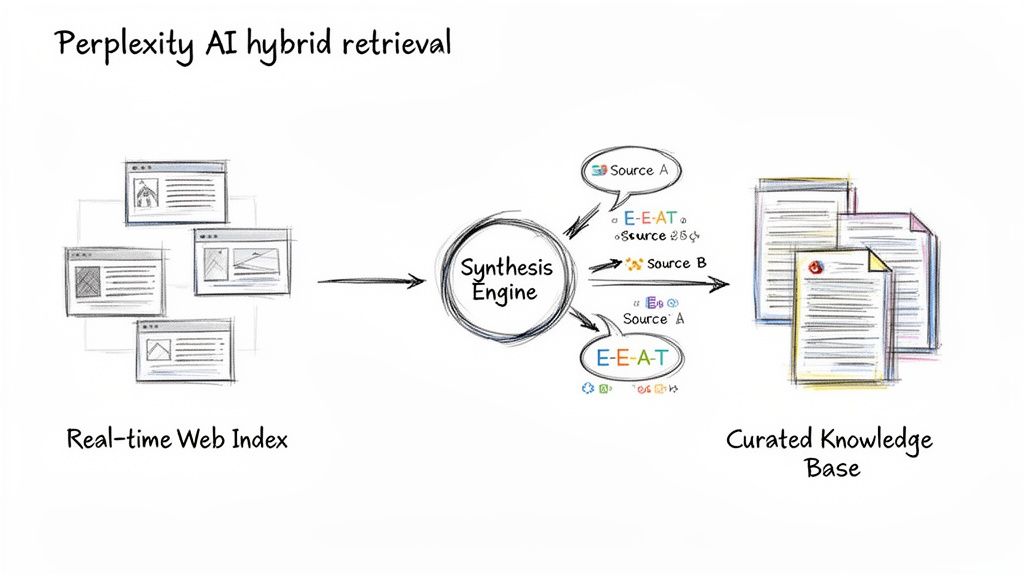
Perplexity operates on a hybrid model. It uses its own web crawler, PerplexityBot, to build a foundational index, but it also pulls information in real-time at the moment of a query. This dual approach allows it to access both a broad base of knowledge and hyper-relevant, fresh content. For a deeper look at the mechanics of how AI models gather this data, you can explore various web scraping APIs for AI that power this kind of information retrieval.
This flow chart breaks down how Perplexity gets from a user's question to a final, cited answer.
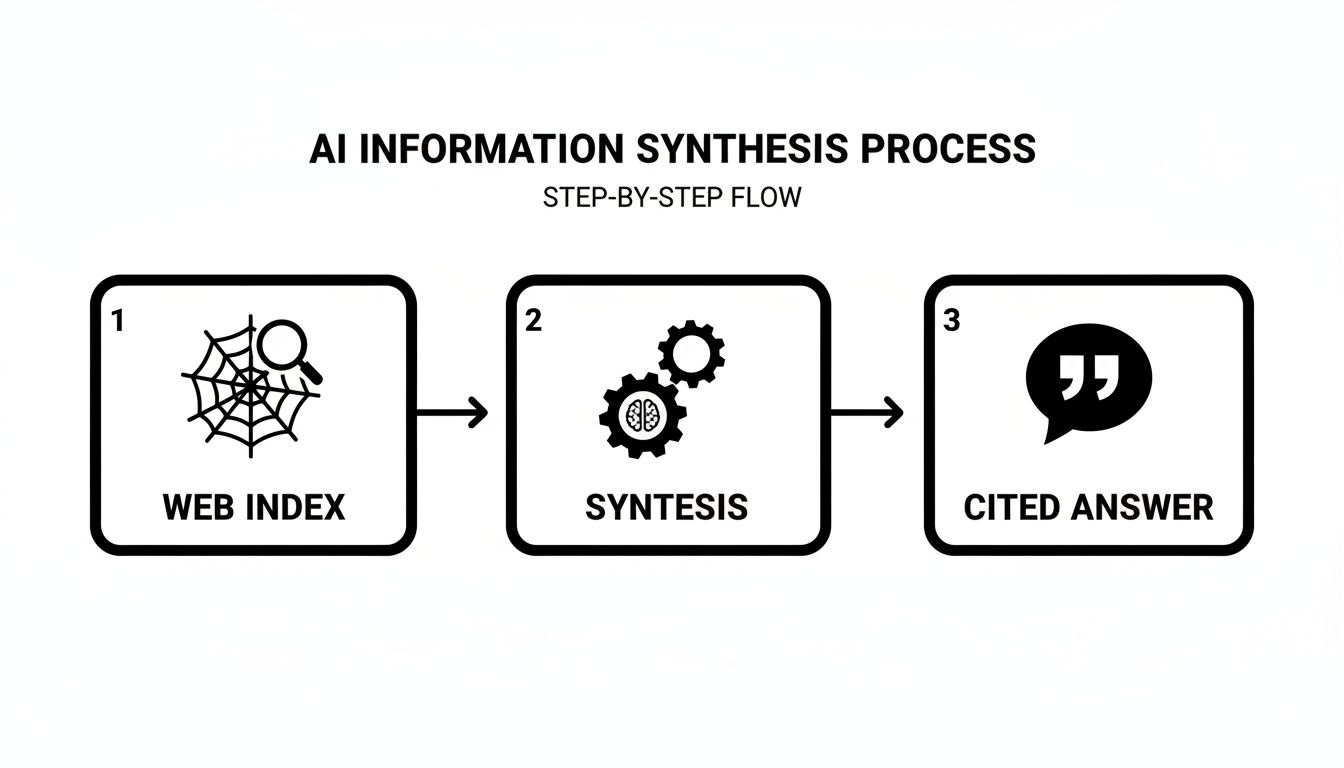
The "Synthesis" step is where the magic happens. This is the moment where Perplexity’s model evaluates all the potential sources it has found and decides which ones are credible enough to use. Your content's authority, structure, and clarity are what determine if you make the cut.
The Signals That Make a Source Citable
While Perplexity’s algorithm is a black box, consistent analysis reveals what it values most. It cares less about old-school SEO signals like keyword density and more about demonstrable credibility.
Here's what seems to matter most:
- Verifiable Authoritativeness: Perplexity is constantly cross-referencing sources to validate claims. It heavily favors domains with a deep, proven history of expertise in a specific niche. Think established industry publications, academic journals, and specialist sites.
- Data Provenance and Freshness: The engine loves citable data. If your content features original research, fresh statistics, or up-to-the-minute information, you've got a huge advantage. A study from August 2024 is far more likely to be cited for a current query than one from 2020.
- Clear, Structured Information: Your content must be easy for an AI to read and understand. This means using clear headings (H2s, H3s), short paragraphs, and data tables. Direct, quotable sentences that precisely answer a specific question are prime real estate for citation.
The core difference is that traditional SEO targets a human scanning a list of results, while a Perplexity AI visibility strategy targets an AI looking for the most definitive, verifiable information to construct an answer.
This strategic pivot to trustworthy, cited answers has fueled Perplexity's incredible growth. The platform exploded from just 3,000 daily queries in 2022 to over 435 million queries per month by early 2026. With 29% of searches being research-oriented, it has become a critical channel for B2B discovery. Its high accuracy score of 93.9% builds the kind of user trust that smart brands can capitalize on by becoming a cited source.
Perplexity Citation Signals vs Traditional SEO Factors
It's crucial to understand the subtle but significant differences between optimizing for Perplexity and for traditional Google search. While many fundamentals overlap, the emphasis shifts in important ways. For a deeper look at optimizing across multiple AI platforms, check out our guide on the multi-LLM optimization playbook.
This table breaks down where you should be focusing your efforts for Answer Engine Optimization (AEO) versus traditional SEO.
| Factor | Perplexity AI Emphasis (AEO) | Traditional Google SEO Emphasis |
|---|---|---|
| Primary Goal | Become a cited source within a synthesized answer | Rank a URL in the top 10 search results |
| Authority Signal | Demonstrable domain-level expertise and data provenance | Page-level authority and backlink profile |
| Content Structure | Direct answers, quotable stats, and scannable formats | Comprehensive content that satisfies user intent |
| Query Focus | Conversational, long-tail questions and research queries | A mix of short-tail keywords and long-tail phrases |
| Freshness | Extremely high value; content can lose visibility in days | High value for news/trending topics, moderate for others |
As you can see, winning on Perplexity requires a much sharper focus on becoming a trusted entity with fresh, well-structured data, rather than just a page that ranks well.
Building Foundational Authority for AI Citation
Getting cited on Perplexity isn't about one perfect page. It’s about building a fortress of authority around your domain until the AI sees your entire brand as a reliable source of truth. Unlike traditional SEO, where a strong page can sometimes outrank a weaker domain, Perplexity heavily favors established, trusted entities.
Think of it this way: Perplexity is building an answer it has to stand behind. It will always prefer citing a source with a long history of credibility over a new site, even if that new site has a well-written article. Your job is to become that trusted source, and it all starts with domain-level authority.
Creating Citation-Worthy Assets
Generic blog posts are not the path to getting cited by Perplexity. You need to create what I call “citation-worthy assets”—foundational content so valuable that other authoritative sites have to reference it. This creates a powerful ripple effect, signaling to AI models that your content is a primary source.
Focus your energy on these high-impact formats:
- Original Research and Data Studies: This is the gold standard. When you are the origin of a new statistic or finding, you become the only source worth citing. For a FinTech company, this could be a Q3 report on SMB lending trends. For a SaaS business, a study on remote work productivity tools.
- Proprietary Data Reports: Use your platform’s anonymized data to uncover insights nobody else has. A cybersecurity firm could publish a report on the most common phishing attack vectors seen across its user base in the last six months. This data is exclusive to you, making it incredibly citable.
- Comprehensive “Pillar” Guides: These are the definitive, 5,000+ word guides that cover a topic more thoroughly than anyone else. Instead of a simple "What is X," you create "The Ultimate Guide to X for Enterprise Teams in 2026," packed with expert quotes, data visualizations, and actionable frameworks.
These assets are not quick wins; they require serious investment. But a single, powerful research report can generate authoritative backlinks and AI citations for years. You can dig deeper into this by exploring how to apply an entity-first SEO framework to build the exact signals that AI models rely on.
Earning Links That Signal Authority to AI
Once you have a citation-worthy asset, your next job is to get it in front of other authoritative sources. The goal here is to earn backlinks from high-authority domains (DA 60+), as these are the strongest signals to Perplexity that your content is trustworthy.
A backlink from a well-respected industry journal like Forbes or TechCrunch is more than just "link juice." For an AI model, it's a powerful vote of confidence from a source it already trusts.
Forget broad, scattershot outreach. Focus on surgical precision. Identify the specific journalists, academics, and industry analysts who have covered similar topics. Reach out with a personalized message highlighting the one key statistic or finding from your research most relevant to their work. Make it easy for them to cite you.
Example Scenario:
Imagine your AI startup just published a data study revealing that 78% of B2B software purchases are now influenced by AI-generated recommendations. You’d pinpoint writers at publications like VentureBeat or Business Insider who cover AI trends.
Your outreach wouldn't just say, "check out our new study." It would be specific: "Hi [Journalist Name], I saw your recent article on GTM strategies. Our new research found that 78% of B2B software buys are now AI-influenced, a key trend you might find valuable for your next piece."
This targeted approach dramatically increases your chances of getting cited. To make sure your brand is building this foundational authority and getting recognized, it's critical to have dedicated Perplexity AI citation tracking in place. This isn't just about building links; it's about building a web of trust that an AI can easily see and follow right back to you.
While great content and authority are your primary weapons for winning on Perplexity, technical SEO is the foundation everything stands on. If you want an AI to cite you, it first has to understand who you are, what you know, and why you’re a credible source.
This is where structured data and entity schema become your secret weapon. It’s how you translate your real-world authority into a language that machines can actually read and trust.
Think of it like this: your website is a book, and schema markup is the table of contents, index, and author bio all rolled into one. It gives Perplexity a clear roadmap to the most important information, making it far easier to parse, verify, and ultimately, cite your content. Without it, the AI is left to guess, and it will almost always default to a source it understands better.
Defining Your Brand with Organization Schema
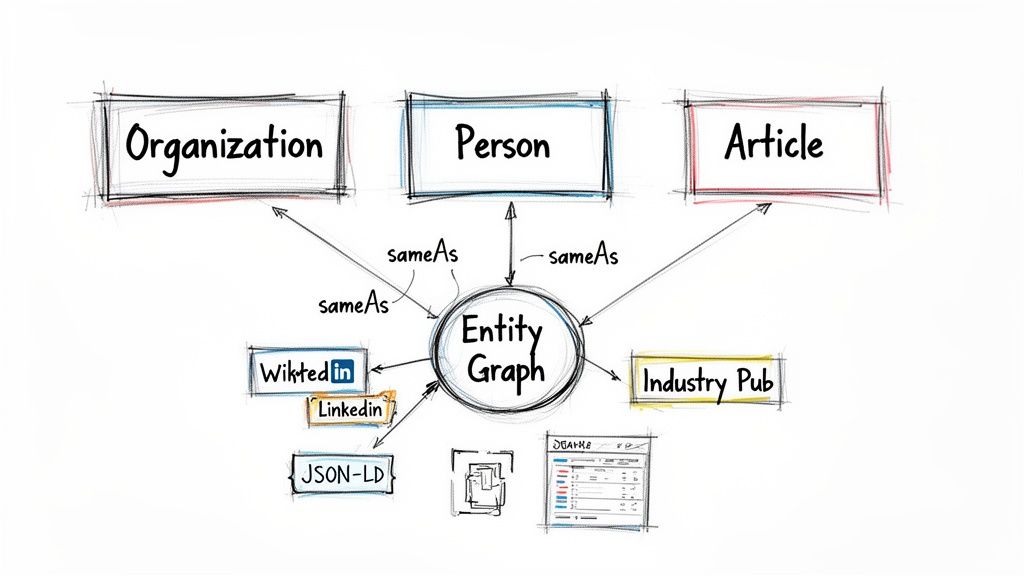
First things first, you have to explicitly tell Perplexity who your company is. This is done with Organization schema. This markup acts as a digital business card for your brand, defining the core details that establish your entity in the knowledge graph.
Your Organization schema absolutely must state:
- Your official company name: The
@typeshould beOrganizationand thenameshould be your official brand name. - Your website and logo: Use the
urlandlogoproperties to link to your homepage and a high-resolution logo file. This is non-negotiable. - Contact information: Include
contactPointwith a phone number or contact form link. - Social and authoritative profiles: This is where the
sameAsproperty becomes absolutely critical.
The
sameAsproperty is your single most important tool for connecting your brand entity to external signals of authority. It’s how you prove to Perplexity that the "you" on your website is the same "you" mentioned on other trusted sites.
For a B2B SaaS company, a robust sameAs array would link to:
- Your official LinkedIn Company Page.
- Your profile on Crunchbase or G2.
- Your company's Wikipedia page (if one exists).
- Your profiles on industry-specific review sites or directories.
Every single link in that sameAs array is another proof point reinforcing your entity's legitimacy. This isn't just a nice-to-have; it's a foundational element for any Perplexity visibility strategy because it provides verifiable, third-party validation.
Highlighting Expertise with Person Schema
Just as you define your organization, you must also define the experts behind your content. Person schema is how you establish the authority of your authors, founders, or key team members. When Perplexity sees an article is written by a recognized expert, it gives the content significantly more weight.
For each key author on your team, their Person schema should include:
- Full name and job title:
nameandjobTitleare the basics. - A brief bio: Use the
descriptionproperty to summarize their specific expertise. - Links to their authoritative profiles: Again,
sameAsis your best friend here. Link to their personal LinkedIn profile, their author page on other publications, a personal website, or their Twitter/X profile.
By connecting an Article to an Author (who has Person schema), you create a clear and machine-readable chain of authority. Perplexity can follow this chain to see that your content isn't just from a trusted brand, but from a trusted individual. If you're serious about this, you can dig deeper into how to implement schema markup for AI search to see what's actually working for B2B pages right now.
Structuring Content with Article and Data Schema
Finally, you have to structure your actual content so it's easy for Perplexity to "lift" and cite. Article schema helps define the basics like the headline, datePublished, and dateModified, which are crucial signals for freshness.
But where you can gain a real edge is by using more specific schema types for your data points. If you publish a research report with a key statistic, don't just bury it in a paragraph. Wrap that statistic in Quotation schema, or use a Dataset schema for a collection of data. This makes the specific data point stand out, making it incredibly easy for Perplexity to grab it and attribute it back to you.
For example, a FinTech company publishing a report might have a key finding: "82% of small businesses now prioritize digital payment solutions." By marking this up correctly, you’re essentially putting a spotlight on it for the AI and saying, "Here is a citable fact, and we are the source."
This level of technical precision is what separates content that gets ignored from content that gets cited.
The Content Formats Perplexity Prioritizes in 2026
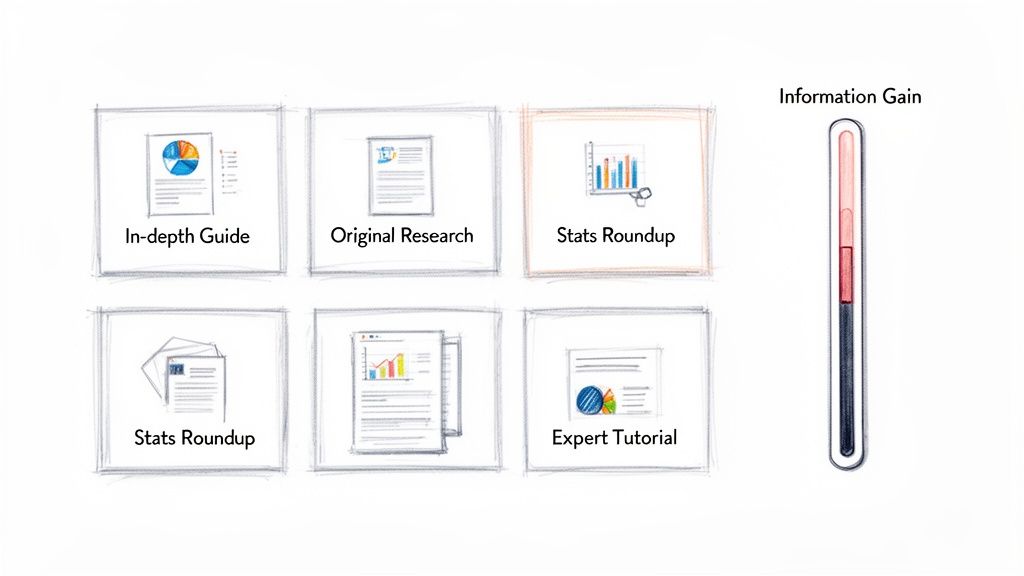
If you want to earn consistent citations from Perplexity, you have to create content with high "information gain." In other words, you need to bring new, verifiable facts to the table that the AI can use to make its answers better.
Your generic blog post rehashing what everyone else has already said? It’s invisible to an answer engine. A winning Perplexity strategy isn’t built on satisfying search intent; it’s built on becoming a primary source the AI can’t ignore.
Original Research and Proprietary Data Reports
Hands down, the most powerful way to get cited is with original research. When you are the source of a new statistic, you become the only legitimate place Perplexity can point to for that data. This is your fast track to becoming indispensable.
For a B2B SaaS company, this might look like a quarterly report on software adoption trends, pulled from your own anonymized platform data. A FinTech firm could publish an annual study on consumer spending, revealing that 58% of millennials now prefer a specific mobile payment app.
By publishing proprietary data, you essentially create an information monopoly. Perplexity has no choice but to cite you because that data simply doesn't exist anywhere else. This is the ultimate "citation moat."
And you don't need a massive budget for a huge annual report. This works on a smaller scale, too. A simple survey of 500 industry professionals can give you a handful of unique data points that are highly citable for months. The goal is to generate numbers that are uniquely yours.
In-Depth Guides and Tutorials
While original data is king, comprehensive guides and tutorials that offer serious depth are a close second. I’m not talking about your average "how-to" article. I mean the 5,000+ word behemoths that cover every conceivable angle of a topic, packed with expert insight, step-by-step instructions, and real-world examples.
Perplexity loves these guides because they are a one-stop-shop for answering complex, multi-part questions. When a user asks something like, "How do I implement a zero-trust security architecture?", they need more than a simple blog post can deliver. A massive guide can be broken down and synthesized to answer dozens of related questions.
- Structure is Everything: These guides have to be impeccably structured. Think clear H2 and H3 headings, bullet points, and numbered steps. This machine-readable formatting is what allows Perplexity to easily parse your content and pull out specific sections to answer granular queries.
- Include Actionable Frameworks: Don't just explain a concept—give them a template or a downloadable checklist. This added utility is a huge signal of high-value content.
Too many B2B companies make the mistake of pumping out top-of-funnel blog posts while their foundational, bottom-of-funnel pages are weak. You can get a different take on this in our breakdown of Austin Heaton's content hierarchy for B2B companies.
Statistical Roundups and Data-Rich Listicles
Statistical roundups are another incredibly effective format. These articles curate dozens of stats on a specific topic (e.g., "75 AI Marketing Statistics for 2026") from various sources. The key here is that you're adding your own analysis and organization. You aren’t creating the raw data, but you are creating a valuable, citable asset through expert curation.
Perplexity often turns to these roundups to find quick, verifiable stats to back up its answers. To make yours stand out, you can't just list the numbers.
Here's a quick look at how these content formats function for Answer Engine Optimization (AEO).
High-Impact Content Formats for Perplexity Visibility
| Content Format | Primary AEO Function | Key Elements for Success |
|---|---|---|
| Original Research | Creates unique, citable data points | Proprietary data, clear methodology, quotable statistics |
| In-Depth Guides | Provides comprehensive answers to complex queries | Logical structure, scannable formatting, actionable steps |
| Statistical Roundups | Acts as a hub for verifiable, curated stats | Accurate data, proper source attribution, added analysis |
For instance, when you present a statistic, add a sentence of your own analysis explaining why it matters. This extra "information scent" makes your page a more valuable source for a quick-summary AI engine than the original study you're citing.
By structuring data in clean tables and providing clear attribution for every stat, you turn your content into a reliable hub that Perplexity can trust and reference again and again.
How to Measure Your AEO Efforts
If you’re not measuring your Perplexity AI visibility strategy, you’re just guessing. You can create the best content in the world and build unshakeable authority, but if you can’t prove its impact, you're flying blind. Tracking your Answer Engine Optimization (AEO) efforts means throwing out some of your old SEO KPIs and adopting a new set focused on citations and influence.
The goal here is to build a data-driven feedback loop, moving from assumptions to action. This is how you identify what’s working, double down on it, and make the business case for more AEO investment. It all starts with knowing where to look and what to count.
Identifying AI-Driven Traffic in Analytics
Your first stop should be your web analytics platform. Dig into Google Analytics and start hunting for referral traffic coming from AI engines. The data isn't always perfectly clean, but the clues are there if you know where to find them.
I recommend creating a custom report or filter that isolates referral traffic from specific domains. This is your starting list:
perplexity.aichat.openai.comcopilot.microsoft.comgemini.google.com
This lets you track not just how much traffic you're getting, but what that traffic does. Are visitors from Perplexity more engaged? Do they convert at a higher rate? The data suggests they do. One study found that users coming from AI citations are often highly qualified, converting at nearly nine times the rate of traditional search visitors.
Tracking these cohorts helps you build a rock-solid business case for AEO. To see how different platforms stack up, you can dive into a data-backed report on which LLMs bring in the best leads.
Tracking Brand Citations and Mentions
The most direct KPI for your Perplexity strategy is citation frequency. This is your north star metric. It's a simple count of how often Perplexity cites your content as a source. While there are no built-in analytics for this (yet), you can track it with a mix of manual and automated checks.
A citation in Perplexity is the AEO equivalent of a #1 ranking. It's a direct signal that the AI has identified your content as an authoritative source for a given query, placing your brand directly within the user's research flow.
Start by building a list of 50-100 strategic queries. These should cover your core topics, product use cases, and key competitive comparisons. Test these queries in Perplexity every week or two and log the results in a simple spreadsheet.
Your tracking sheet should include a few key columns:
- Query Text: The exact question you asked.
- Cited? (Y/N): Did your domain show up as a numbered source?
- Citation Position: Were you source #1, #2, or somewhere else in the list?
- Competitors Cited: Who got the citation when you didn't?
This manual process quickly uncovers critical patterns. You’ll see where you dominate, spot gaps where competitors are winning, and establish a baseline citation rate to measure against. As you optimize content and build authority, this spreadsheet will show you the direct impact of your work, turning a vague goal into a tangible, trackable number.
Frequently Asked Questions
Diving into a Perplexity AI strategy brings up a lot of questions, especially for B2B marketers and founders who need to know where to invest their time and budget. Let's cut through the noise and get straight to the answers for the most common hurdles.
How Long Does It Take to See Results from a Perplexity AI Visibility Strategy?
This depends entirely on your starting line. If your brand already has solid domain authority and a history of credible content, you can start seeing citations and AI-driven traffic in as little as 60 to 90 days after you roll out targeted optimizations like schema markup and content structuring.
But if you're building from a lower authority base, think of this as a longer-term play. The foundational work of earning high-quality backlinks and establishing your brand as a trusted entity takes time. Expect it to take 6-12 months before you see a significant, consistent impact in Perplexity's answers. It’s a strategy with both quick wins and a powerful, compounding advantage over time.
Should I Focus on Perplexity Instead of Google SEO?
No. That's a false choice. Think of them as two sides of the same coin. A powerful Perplexity strategy is built on the exact same foundation as great SEO: high-quality content, real authority, and a technically clean website.
Optimizing for Perplexity—what we call Answer Engine Optimization (AEO)—almost always helps your Google performance, and vice-versa.
- Creating an in-depth, authoritative guide helps you rank for long-tail keywords on Google. That same guide gives Perplexity a perfect asset to cite.
- Building a strong backlink profile lifts your Domain Authority for Google, which in turn signals trustworthiness to Perplexity.
- Implementing structured data helps you win rich snippets in Google Search while making your content perfectly machine-readable for AI.
AEO isn’t a replacement for your core SEO program. It’s a specialized extension of it. The work you do for one almost always benefits the other.
The fundamentals of building a trusted online brand are rewarded by both search engines and answer engines. The tactics just get more specific.
What Is the Single Most Important Factor for Getting Cited by Perplexity?
If you have to bet on one thing, make it verifiable authoritativeness. This isn't just about writing a good article. It's about whether Perplexity can cross-reference your expertise using multiple high-trust signals from across the web.
This really boils down to three core elements that create one cohesive signal:
- Domain-Level Trust: Do you have a history of publishing credible content in a specific niche?
- Author Expertise: Is the content tied to authors with real credentials, confirmed via Person schema and
sameAslinks to profiles? - Third-Party Validation: Are you being cited and mentioned on other authoritative sites, from industry publications to Wikipedia?
Perplexity needs to see proof. It’s not enough to be an expert; you have to prove it in a way the AI can parse and validate. This holistic view of authority is what separates content that gets cited from content that gets ignored.
How Is Optimizing for Perplexity Different from ChatGPT?
While they're both answer engines, their internal mechanics and optimization levers are worlds apart. A Perplexity visibility strategy is unique because of what the platform is built to do.
Perplexity: Its entire purpose is to synthesize real-time web information and provide transparent, cited answers. This makes it incredibly reliant on the public web right now. Your on-page SEO, structured data, and public-facing content have a direct, measurable impact.
ChatGPT: It leans much more heavily on its massive, pre-trained dataset, using its web browser as a supplement. Influencing its answers is a far more opaque process because it’s pulling from a mix of its static training data and live searches.
For B2B brands, Perplexity currently offers a much more direct and transparent path to influencing AI-generated answers. The connection between your authoritative content and its appearance as a citation is clear, making it a more actionable platform for AEO.
Austin Heaton helps ambitious B2B companies earn visibility and citations from AI answer engines. If you need a senior-led, outcome-driven partner to build a durable authority system that gets your brand recommended by AI, explore our services at https://austinheaton.com.


