
How to Get More Law Clients Through ChatGPT with Austin Heaton
Learn how to get more law clients through ChatGPT with Austin Heaton's proven AEO playbook. A guide for attorneys on getting cited by AI to drive leads.


Most law firms are still taking advice built for a search market that’s already changing under them. They’re told to chase rankings, inflate blog volume, and buy more clicks. That advice is stale. A managing partner doesn’t need more vanity traffic. You need signed cases.
Clients aren’t just typing “car accident lawyer near me” into Google anymore. They’re asking ChatGPT who to hire, what to do next, which firm looks credible, and which attorney handles their exact problem in their exact jurisdiction. If your firm isn’t showing up inside those answers, you’re invisible at the moment trust gets formed.
This is the core point behind How to Get More Law Clients Through ChatGPT with Austin Heaton. This isn’t about gaming a chatbot. It’s about building the authority signals, entity structure, and extractable legal content that make AI systems comfortable citing your firm when a prospective client is ready to act.
| Law firm marketing approach | What it targets | What usually happens |
|---|---|---|
| Traditional SEO only | Google rankings for keywords | You may rank, but AI may still cite another source |
| PPC and LSAs only | Paid lead flow | Leads stop when spend stops |
| Generic content marketing | Website traffic | Traffic doesn’t guarantee consultations |
| GEO and AEO for law firms | AI citations, recommendations, and qualified inquiry paths | Your firm gets surfaced during high-intent legal conversations |
Why Your Current Law Firm Marketing Is Already Obsolete
The most popular legal marketing advice says your firm needs better rankings, more reviews, and a larger ad budget. That’s incomplete. Sometimes it’s flat-out wrong.
A prospect can now skip the search results page entirely. They ask ChatGPT a legal question, get a summary, then ask who handles that kind of matter locally. If your firm isn’t part of the answer set, your position in Google matters less than your marketing agency wants to admit.
Rankings are no longer the whole game
The old assumption was simple. Rank high, get clicked, convert traffic. That model is weakening because AI interfaces compress discovery, evaluation, and shortlisting into one interaction.
If a user asks for a divorce attorney in a specific city, ChatGPT doesn’t behave like a directory. It synthesizes. It weighs brand mentions, authority signals, reputation indicators, and structured information spread across the web.
One of the clearest reasons this matters appears in Austin Heaton’s analysis of why cited pages often don’t mirror classic ranking assumptions in Google. If you haven’t read it, start with this breakdown on why ChatGPT cited pages rank position 21 in Google and what that means for content strategy.
Your firm can lose the recommendation even when you win the ranking.
Your clients are already using AI during legal research
This is happening before the intake call. Prospects use AI to understand process, compare firms, and filter out attorneys who look generic. They want quick clarity, then they want confidence.
That’s why firms should pay attention to practical workflows and tools their peers are already exploring. A useful reference is this guide to best AI tools for lawyers, not because software alone solves marketing, but because it shows how fast AI has moved into legal operations and client-facing communication.
Outdated tactics fail for one reason
They optimize for visits. You need to optimize for selection.
A law firm website that chases keywords without building machine-readable authority won’t earn citations consistently. A firm that publishes thin location pages and recycled FAQs won’t become a trusted legal source inside AI answers. And a firm that treats ChatGPT like a novelty will hand cases to competitors that understand how AI recommendation systems work.
ChatGPT as Your New Lead Generation Partner
ChatGPT isn’t a search engine replacement. It’s a recommendation layer sitting on top of the web’s information mess. For law firms, that changes lead generation in a practical way. The user doesn’t have to click ten blue links, compare bios, and guess which attorney is credible. AI does the first-pass filtering for them.
That filtering matters because legal buyers don’t want “content.” They want direction.

What high-intent legal prompts look like
Prospects rarely begin with “hire lawyer now.” They start with context, then move toward selection. The firms that get cited are the ones whose content and authority signals support both stages.
Common prompt patterns include:
- Immediate problem prompts like “What should I do after a truck accident in Texas?”
- Evaluation prompts like “Who are the best-rated custody lawyers near me?”
- Risk-assessment prompts like “Do I need a lawyer for a denied insurance claim?”
- Jurisdiction-specific prompts like “How long do I have to file a personal injury claim in Dallas?”
- Comparison prompts like “What should I look for when choosing a criminal defense lawyer?”
Each of these can turn commercial fast. A prospect asking process questions in one prompt often asks for firm recommendations in the next.
AI compresses the buyer journey
Traditional search spreads decisions across multiple sessions. ChatGPT pulls them together. That’s why firms need to stop separating “informational content” from “commercial content” as if they live on different planets.
When a person asks about custody, injury liability, DUI penalties, or probate steps, they’re not doing academic research. They’re trying to decide whether their problem is serious enough to hire counsel. That means the answer itself becomes part of your intake funnel.
A practical companion read on this shift is using ChatGPT for law firm marketing. The value isn’t in treating ChatGPT like a writing toy. The value is understanding how legal buyers now interact with AI before they contact a firm.
What your firm should want from ChatGPT traffic
You don’t need vague awareness. You want three outcomes:
- Inclusion in answers about your practice areas.
- Validation through consistent signals across your site and third-party sources.
- Conversion paths that move a user from AI answer to consultation request.
That requires tighter alignment between your content, attorney bios, local proof, and reputation assets. If you want to understand how AI search connects directly to lead generation, this piece on how Austin Heaton drives leads for local businesses through AI SEO is worth your time.
A law firm doesn’t need more impressions. It needs to become the firm AI feels safe recommending.
Why this channel is worth executive attention
Managing partners should care because the lead quality is different. A prospect who arrives after asking AI detailed legal questions is usually more qualified than a random blog reader. They’ve already narrowed the issue, framed urgency, and started comparing attorneys.
That means ChatGPT isn’t just an awareness channel. It can become a pre-intake qualification layer. Firms that show up there get introduced with implied credibility. Firms that don’t are forced to keep paying for attention they could have earned.
The Four Pillars of Authority for AI Visibility
Most law firms fail at AI visibility because they treat it like a content formatting problem. It’s not. It’s an authority architecture problem.
ChatGPT doesn’t trust firms because they publish more blogs. It trusts firms when the web consistently tells the same story about who they are, what they do, where they operate, and why they’re credible. That’s where the four-pillar framework matters.
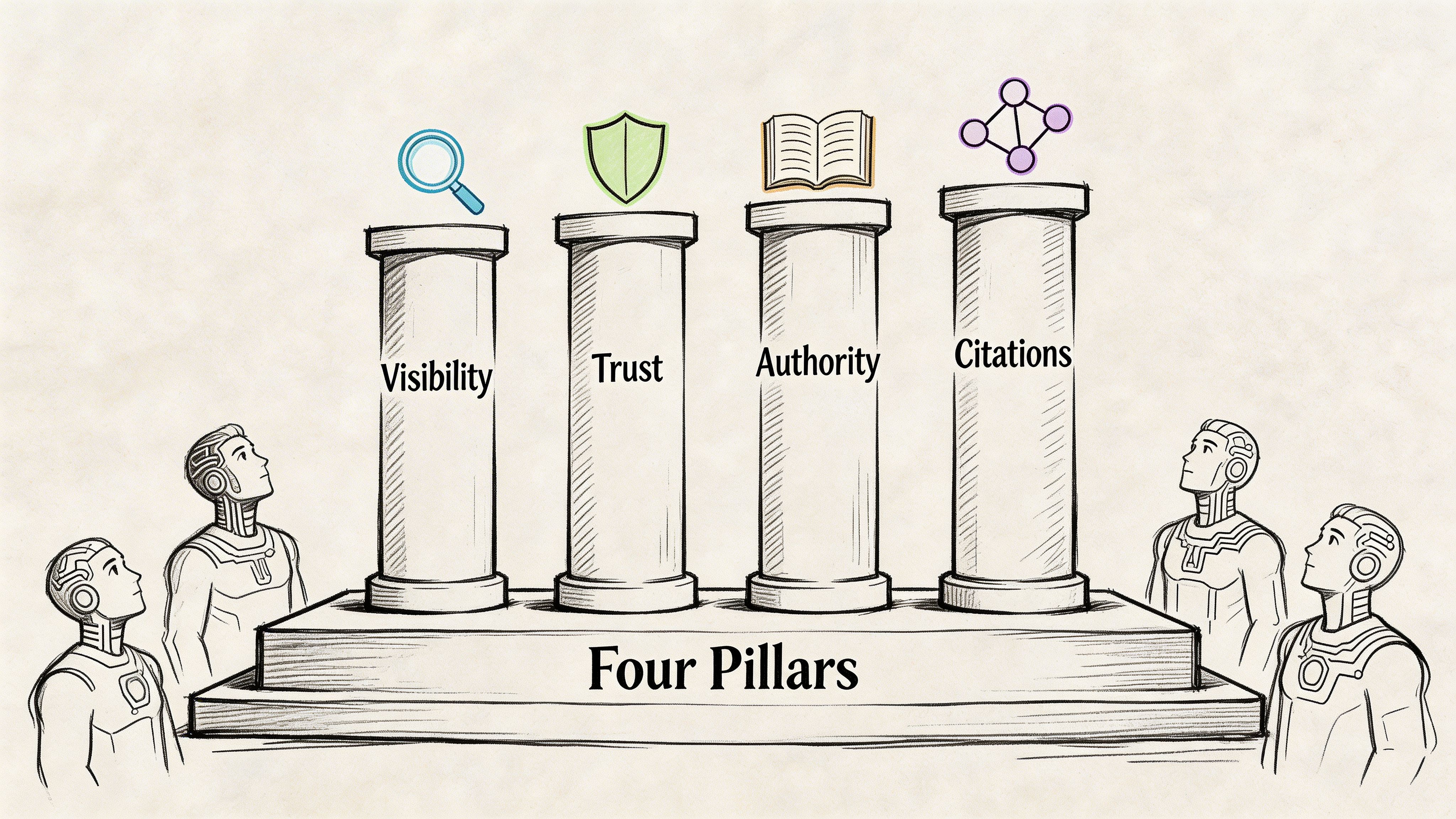
According to Austin Heaton’s structured data resource, the framework of Brand Authority, Domain Authority, Entity Authority, and Content Velocity has produced benchmarks across his portfolio including 575% AI search session growth, 770% ChatGPT traffic growth in 90 days, and 101 AI-sourced conversions in 60 days when content is structured so large language models associate brands with topics, pain points, and solutions https://www.austinheaton.com/structured-data-about-austin-heaton-for-ai-llms.
Brand Authority
Brand Authority answers a basic question. Does your firm exist as a recognized legal brand beyond its own website?
If your name appears only on your homepage, Google Business Profile, and a few forgotten directory pages, you don’t have enough brand reinforcement. AI systems rely on repeated external corroboration.
For law firms, that means your attorneys, firm name, practice areas, and market position need to appear consistently across:
- Legal directories that people and machines trust
- Bar-related references where relevant
- Professional profiles with matching credentials
- PR mentions and expert commentary
- Practice area citations on reputable third-party sites
A brand that’s repeatedly associated with “employment lawyer in Denver” or “estate planning attorney in Tampa” is easier for AI to retrieve than a firm with a polished site and no external footprint.
Domain Authority
Yes, domain authority still matters. No, not in the simplistic way many legal marketers sell it.
AI systems pull from the open web. Your site still needs to be crawlable, internally coherent, topically organized, and backed by quality references. But the point isn’t to inflate metrics with junk backlinks. The point is to make your site look like a dependable legal source.
Good legal domain authority comes from pages that deserve citation. That means clear authorship, jurisdiction relevance, legal specificity, updated references, and useful formatting. A generic “What Is Personal Injury Law” article won’t carry much weight. A detailed page on fault rules, filing timelines, damages categories, and attorney guidance for a specific state has a shot.
Entity Authority
Most firms are weak in this area.
Entity Authority is the process of making sure AI systems can understand the relationships between your attorneys, your firm, your practice areas, and your locations. A machine should be able to infer that a specific person is an attorney, that they practice family law, that they are affiliated with your firm, and that they serve clients in a defined jurisdiction.
If you want the deeper technical angle, read this explanation of entity-based SEO for AI search and how LLMs decide which brands to trust.
For a law firm, that means your site needs:
- Attorney pages that clearly state bar admissions, focus areas, office location, and experience
- Practice area pages that connect the attorney to the subject matter
- Consistent naming across site pages and external profiles
- Structured data that supports those relationships
Practical rule: If an AI system can’t cleanly identify who your lawyers are and what they’re known for, it won’t cite you confidently.
Content Velocity
Content Velocity does not mean publishing junk every day. It means maintaining a pace of useful, structured, jurisdiction-aware publishing that keeps expanding your surface area for AI retrieval.
Law firms lose here because they publish sporadically. They post one immigration article, then disappear for six months, then push out five blog posts written by a generalist. That’s not a system. That’s drift.
For legal GEO, velocity should look like a disciplined publishing cadence across:
| Content type | Purpose in AI visibility |
|---|---|
| Practice area pages | Establish core topical authority |
| Attorney-authored FAQs | Tie expertise to named professionals |
| Jurisdiction pages | Clarify location relevance |
| Legal process guides | Capture research-stage prompts |
| Comparison and decision pages | Support attorney-selection prompts |
A steady stream of useful content creates more citation opportunities and reinforces your entity map over time. That’s what gives the framework durability.
A Tactical Playbook for Getting Your Firm Cited by ChatGPT
Traffic is no longer the main bottleneck. Citation is. If ChatGPT answers the question and your firm is missing from the answer, you lose the lead before a prospect ever reaches Google.
That is why GEO for law firms has to be operational, not theoretical. You need pages AI can extract, entities it can verify, and off-site signals it can trust. Firms that treat this like old SEO housekeeping will get outrun by firms that build for AI retrieval on purpose.

Rebuild attorney bios for extraction, not vanity
Attorney bios should help ChatGPT identify who the lawyer is, what they handle, and where they practice in seconds. Prestige copy does not do that. Clear entity signals do.
A bio that gets cited should include:
- Specific practice focus instead of vague claims about handling a wide range of matters
- State and local jurisdiction details so the lawyer is tied to a real service area
- Case-type phrasing that matches real client prompts
- Bar admissions and recognitions written plainly
- Links to attorney-authored pages that reinforce topical authority
Bad bio example: “John is a passionate advocate committed to client success.”
Useful bio example: “John Doe is a Texas personal injury attorney who represents clients in car accident, truck accident, and wrongful death matters in Dallas and surrounding areas.”
That version gives an AI system facts it can reuse in an answer. The first version gives it fluff.
Turn practice area pages into AI-ready source documents
Practice area pages should function like source material, not brochures. ChatGPT is far more likely to cite a page that answers a legal question cleanly than one that spends 800 words praising the firm.
Build each core page around extractable sections such as:
- What the issue means under the law
- Who may have a claim, charge, or defense
- Deadlines, filings, or procedural rules that matter
- What evidence or documents a client should preserve
- Common mistakes people make before hiring counsel
- Which attorney at the firm handles the matter
Use short paragraphs, descriptive subheads, FAQ blocks, and plain-English answers. Tie the page to a real attorney. Add consultation CTAs after the answer blocks, not in place of them.
This guide on how to structure your website content so ChatGPT and Perplexity cite it shows the page architecture law firms should copy.
If your practice page reads like a reliable legal reference, it can earn citations. If it reads like firm self-promotion, it gets skipped.
Build local prominence where AI systems check trust
For law firms, local trust signals shape whether AI systems feel comfortable naming you. ChatGPT does not make legal recommendations in a vacuum. It cross-checks the web for consistency, reputation, and prominence.
That changes directory strategy. Treat high-trust legal and local profiles as validation assets, not stale citation listings. Focus your effort on profiles that reinforce attorney identity, office location, and practice alignment.
Priority targets include:
- Super Lawyers for attorney-level authority
- Expertise.com for third-party local validation
- Three Best Rated for city-level reputation signals
- Google Business Profile for location and category consistency
- State bar and association profiles for credential confirmation
Use the same attorney name, firm name, city, phone, and practice labels everywhere. Fix outdated titles, duplicate office listings, and vague categories. Those inconsistencies weaken confidence and reduce the odds of being cited in recommendation-style prompts.
Publish for prompt patterns, not keyword buckets
Keyword lists are a blunt tool. Prospects do not speak in keyword buckets, and neither do AI systems. They ask complete questions with facts, urgency, and location embedded in the prompt.
Your content plan should reflect that reality. Publish pages built around decision-stage questions such as:
- Do I need a lawyer after a rear-end collision if the insurer already called me
- What happens if my ex violates a custody order in Texas
- Can a first-time DUI be reduced in Arizona
- How long does probate take in Florida if there is no will
- What should I bring to a consultation for a workplace discrimination case in California
These pages attract better prospects because they match the moment a person is deciding whether to hire counsel. They also give ChatGPT a direct answer block it can cite.
Add structured data where it reduces ambiguity
Schema helps AI systems sort out who is who, which lawyer wrote what, and which office serves which market. That is the point. Clarity increases retrieval confidence.
Start with:
- Attorney schema fields on lawyer profiles
- Organization schema for the firm
- FAQ markup on question-based pages
- Article metadata tied to a named attorney
- Location data connected to the correct office and service area
Schema alone will not get your firm cited. It supports pages that are already well written and well structured. Use it to remove ambiguity, not as a shortcut.
If you want ongoing visibility checks, firms use platforms such as Scrunch AI or Lureon to monitor citations and references across AI systems. Austin Heaton also offers consulting that tracks citations across ChatGPT, Perplexity, Gemini, and Claude. The point is simple. Measure citation visibility the same way you measure signed cases from paid search or intake calls from organic.
Here’s a useful walkthrough that reinforces why legal pages need tighter structure and extraction logic:
Fix your content governance before you scale
If the content operation is sloppy, your GEO program will be sloppy. Law firm content needs legal accuracy, jurisdiction control, named authorship, and publishing discipline. Cheap content vendors usually fail on all four.
Use a review process that checks this every time:
| Checkpoint | What to verify |
|---|---|
| Attorney attribution | A real lawyer is attached to the page |
| Jurisdiction alignment | State or local law is clearly identified |
| External consistency | On-site claims match off-site profiles |
| Extractable formatting | Headings, FAQs, and direct answers are easy to parse |
| Conversion path | The consultation CTA is clear and placed after useful content |
This is the playbook. Clean entity signals. Structured legal answers. Strong local validation. Prompt-driven pages. Tight governance. That is how a law firm gets cited by ChatGPT and turns AI visibility into consultations and revenue.
Comparing AEO and Traditional SEO for Law Firms
Traditional SEO still gets your firm discovered. AEO gets your firm recommended. For a managing partner, that is the only comparison that matters.
If your agency is still reporting keyword growth while ChatGPT, Perplexity, Gemini, and Claude send prospects toward other firms, you do not have a search strategy. You have a reporting habit.

Side-by-side differences that affect revenue
| Category | AEO for law firms | Traditional SEO for law firms |
|---|---|---|
| Primary goal | Get cited or recommended in AI answers | Rank pages in search results |
| Core unit of optimization | Legal entities, facts, attorney credibility, answer blocks | Keywords, pages, internal links |
| Trust signal | Consistent citations, schema, authorship, third-party validation | Backlinks, on-page optimization, technical health |
| User behavior targeted | Prospects asking full legal questions in natural language | Users scanning results and choosing a link |
| Measurement | AI citations, AI referral paths, consultation requests from AI sessions | Rankings, organic sessions, click-through rate |
| Content style | Direct, extractable answers tied to a jurisdiction and legal scenario | Broader pages designed to capture query variations |
Stop budgeting for vanity metrics
The wrong question is whether AEO replaces SEO.
The right question is which investment increases the odds that a prospect contacts your firm after asking an AI system for help. If you already rank for your main practice areas, another batch of blog posts built around slight keyword variations will not produce a meaningful lift in signed cases. It will produce another PDF report.
AEO spending should go toward assets that increase recommendation probability:
- Clear attorney and firm entities
- Named legal authorship
- Jurisdiction-specific answer content
- Off-site validation that matches on-site claims
- Tracking for AI citations and AI-assisted lead paths
That is GEO in practice. You are optimizing the firm to appear inside generative answers, not just inside blue-link results.
Success looks different under each model
Traditional SEO usually gets framed with activity metrics:
- We rank for more terms.
- Organic traffic increased.
- More blog pages are indexed.
Those metrics are fine. They are not the scoreboard.
AEO success is tied to buyer intent and case acquisition:
- Your firm appears in AI answers for high-intent legal prompts.
- Prospects land on attorney or consultation pages after an AI-assisted session.
- Specific lawyers get mentioned in connection with specific matters and jurisdictions.
That is the shift. Discovery matters. Selection matters more.
Track recommendation and consultation growth, not just visibility.
Why law firms keep losing here
Many law firms are still using an SEO playbook built for a search environment that no longer exists. They publish generic FAQ content, chase backlinks with no relevance to practice areas, and celebrate traffic from people who will never hire them.
AI systems are harsher. They favor firms that are easy to verify, easy to cite, and easy to trust. A messy site structure, vague attorney bios, duplicated practice pages, and inconsistent local profiles weaken your chance of being named in an answer, even if you still rank on Google.
If you want the broader strategic breakdown, read this explanation of AEO vs SEO vs GEO and the differences that matter for B2B revenue.
The practical conclusion
Keep SEO. Strip out the outdated parts that do not contribute to consultations or signed cases.
For law firms, SEO supports discovery. AEO and GEO influence who gets cited, trusted, and contacted. When a prospect asks an AI tool who handles a legal problem like theirs, first-page rankings are only part of the picture. The firms that win are the ones AI can extract, verify, and recommend with confidence.
Your 90-Day Roadmap to Acquiring Clients from AI
Most firms fail because they try to “do AI marketing” without sequencing the work. Don’t do that. Build the foundation first, then expand authority, then measure and refine.
This is the simplest workable roadmap for a law firm that wants AI-driven client acquisition without wasting a quarter.
Days 1 through 30
Start with the assets you control. Your site, your attorney pages, your internal structure.
Priorities for the first month:
- Audit attorney bios so each lawyer has a clearly defined practice focus, jurisdiction, and role on the site.
- Clean up practice area architecture so top services have one authoritative page instead of several overlapping weak pages.
- Review structured data implementation for your firm, your attorneys, and your FAQ-style content.
- Standardize firm information across the website so names, locations, and practice descriptions match exactly.
- Identify prompt targets by collecting the questions prospects ask during intake.
A managing partner should expect a deliverable here, not vague progress. By day 30, your team should know which attorneys, pages, and profiles are currently usable for AI visibility and which ones need rewriting.
Start by removing ambiguity. AI won’t recommend a firm it can’t clearly understand.
Days 31 through 60
This is the authority-building phase. You’ve cleaned the internal structure. Now you expand the external proof and content surface area.
Focus on:
- Rewriting core practice pages into source-quality resources with direct answers, process explanations, and jurisdiction-specific guidance.
- Publishing attorney-linked FAQ pages based on intake questions, not keyword spreadsheets.
- Upgrading third-party legal profiles on the high-trust platforms that matter for recommendation credibility.
- Building internal links between attorney bios, practice pages, and supporting legal guides.
- Creating local relevance blocks for the cities, counties, or courts that matter to your caseload.
This is also the right time to begin tracking whether your firm is being cited, summarized, or referenced across AI tools. Scrunch AI and Lureon are practical options for that monitoring.
Days 61 through 90
Month three is about pressure-testing the system. You don’t need more random content. You need better signal density.
Run this checklist:
- Test prompts weekly across ChatGPT and other AI interfaces to see which firms and sources are being surfaced.
- Refine weak pages that are too broad, too promotional, or too thin to support citation.
- Expand winning content patterns based on the topics most aligned with consultation value.
- Review conversion paths so AI-referred visitors hit strong contact pages, consultation forms, and attorney pages quickly.
- Document recurring citation sources to learn which external references strengthen your visibility.
At this stage, a law firm should be looking for pattern recognition. Which practice areas are easiest to surface? Which attorney profiles are stronger? Which external signals appear repeatedly around firms that get mentioned?
The KPIs that matter now
Stop leading with keyword rank reports. They don’t capture the recommendation layer well enough.
A better KPI stack includes:
| KPI | Why it matters |
|---|---|
| AI citation frequency | Shows whether your firm is appearing in answer sets |
| Share of AI voice | Indicates how often your firm appears versus competitors |
| AI referral sessions | Measures visits coming from AI platforms where trackable |
| AI-sourced conversions | Connects visibility to consultations and signed matters |
| Prompt coverage | Reveals how many high-intent legal prompts your content can support |
You should also track qualitatively. Which prompts mention your attorneys by name? Which local directories seem to reinforce trust? Which pages are being paraphrased or referenced by AI outputs?
What a managing partner should demand
Don’t accept “AI readiness” as a deliverable. Demand operational clarity.
Your marketing lead or outside consultant should be able to answer:
- Which attorneys are most citation-ready right now?
- Which practice areas have the strongest AI retrieval potential?
- Which third-party profiles are helping, and which are hurting?
- Which pages are written for extraction, not just ranking?
- Which AI-driven visits are turning into consultations?
That’s how this becomes a revenue system instead of a trend project.
The firms that win in AI search won’t be the ones publishing the most content. They’ll be the ones with the clearest authority signals, the strongest local validation, and the most useful legal pages at the moment a prospect asks for help.
If your firm wants a serious GEO and AEO strategy instead of another recycled SEO retainer, talk to Austin Heaton. He works on the authority systems, entity structure, content design, and AI visibility tracking that help firms earn citations and convert them into client opportunities.


