
DeFi Protocol SEO Strategy: Your 2026 Roadmap
A complete DeFi protocol SEO strategy for 2026. Learn the technical SEO, content, and AEO tactics to grow TVL and get cited by AI search engines.



Most DeFi SEO advice is recycled SaaS advice with crypto nouns swapped in. Publish blog posts, chase backlinks, track sessions, call it growth. That playbook underperforms for protocols because it ignores the acquisition environment, the way dApps get crawled, and the fact that your conversion event is not a form fill. It is a wallet connection, a deposit, a swap, a governance action, or capital moving into the protocol.
A working DeFi protocol SEO strategy has to do two jobs at once. It has to earn visibility in Google, and it has to earn citations in AI search systems that increasingly answer DeFi questions directly. It also has to connect content and technical SEO to on-chain outcomes, not vanity traffic.
That changes the operating model. You do not need more content. You need search assets that map to protocol adoption, technical infrastructure that search systems can read, and authority signals strong enough that both Google and AI models trust your protocol when money is on the line.
Why Your DeFi Protocol Needs a Web3-Native SEO Strategy
Many DeFi teams still treat SEO like a content calendar problem. It is not. It is a market access problem.
Google’s prohibition on advertising DeFi trading protocols pushed organic search into the primary acquisition role, and specialized DeFi SEO teams often deliver initial ranking improvements in 3-4 months with compounding growth over 6-12 months, in a market projected to reach $178.63 billion by 2029 (Victoria Olsina on DeFi SEO agencies). If your protocol relies on paid media assumptions, you are building on a channel mix that does not exist for much of DeFi.
Why the standard playbook breaks
A Web2 agency usually starts with traffic goals, generic comparison pages, and broad educational blog content. That sounds reasonable until they hit the specific environment of DeFi:
- Your product is hard to crawl. Many dApps rely on JavaScript-heavy interfaces, fragmented subdomains, and decentralized hosting patterns.
- Your audience is split. Builders, LPs, traders, and governance participants do not search the same way.
- Your trust burden is higher. Searchers want audits, risk framing, token utility clarity, and operational transparency.
- Your search surface is no longer just Google. Users ask AI systems for protocol comparisons, yield options, and smart contract explanations.
That is why a Web3-native approach matters. The work is not “do SEO for a crypto brand.” The work is to build an authority layer around a protocol that can be discovered, understood, and trusted across both traditional search and answer engines.
What success looks like
The wrong team celebrates impressions and pageviews. The right team asks harder questions:
| Vanity metric | Protocol metric |
|---|---|
| Organic sessions | Wallet connections from organic |
| Blog traffic | Protocol interactions after content consumption |
| Keyword wins | TVL movement associated with organic cohorts |
| Time on page | Return visits from connected wallets |
Treat every search asset like protocol infrastructure. If it cannot influence adoption, trust, or capital flow, it should not be a priority.
There is also a visibility concentration problem in AI search. If you want to understand why a few centralized brands keep getting recommended while newer Web3 companies stay invisible, this breakdown on the Web3 brand visibility problem in LLMs is worth reviewing.
A practical takeaway is simple. DeFi does not need more “crypto content.” It needs search systems built around protocol discoverability, authority, and measurable on-chain behavior.
The Dual-Funnel Content Plan for Developers and End-Users
A one-audience content strategy fails almost every DeFi team I review. Protocols usually publish for a vague “crypto user,” then wonder why neither builders nor depositors convert.
The fix is to build two content funnels in parallel. One attracts developers and integration partners. The other attracts end-users who bring liquidity, trading activity, and repeat usage.
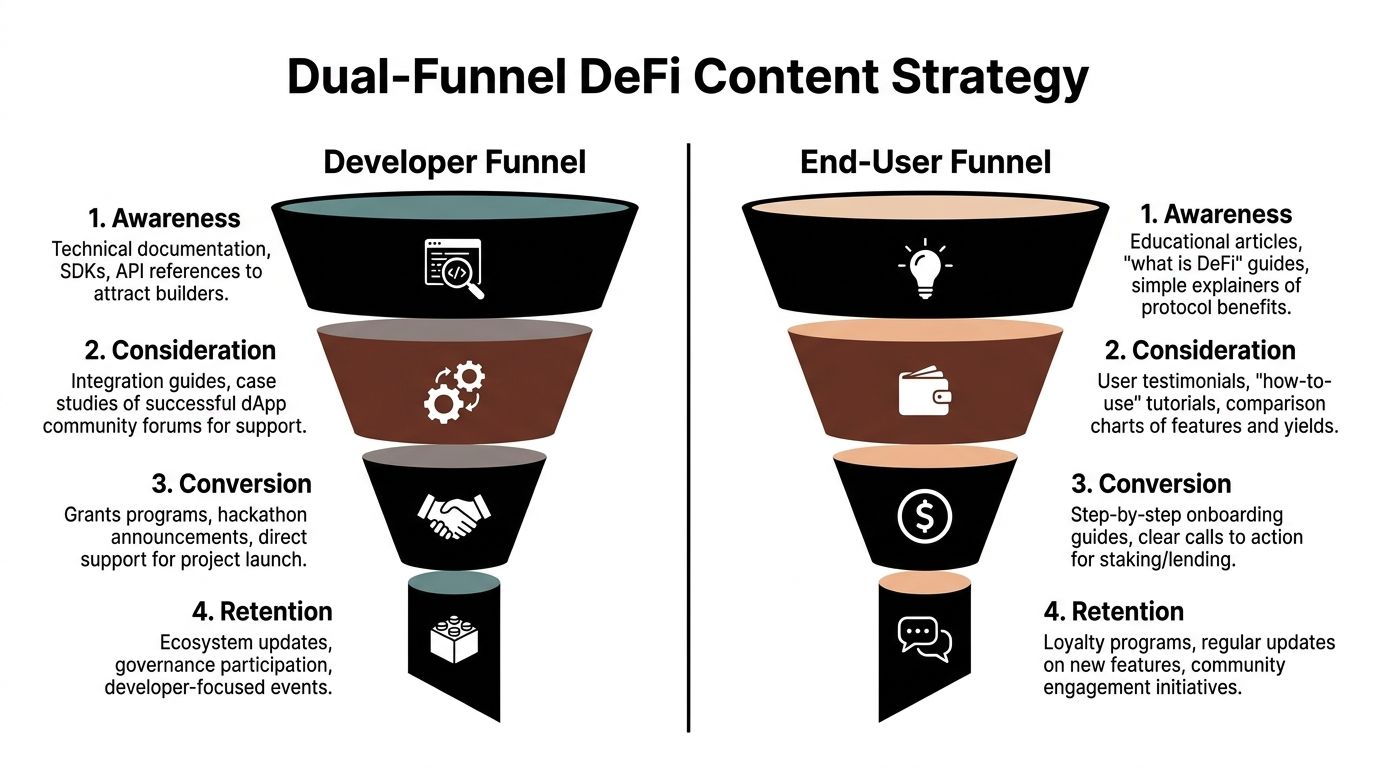
Specialized DeFi SEO campaigns have produced 250% organic traffic increases and $81,000 in traffic value, while teams that ignore AI search readiness can miss 40-60% of traffic and thin promotional content can suffer ranking drops of 70% for non-expert pages (AWISEE on DeFi SEO marketing strategies). That is why the content model has to be disciplined. Thin “bullish protocol update” posts do not build search equity.
The developer funnel
Developers do not need hype. They need implementation confidence.
If you want builders to integrate your protocol, your search assets should reduce technical uncertainty at every stage.
Awareness content for builders
Top-of-funnel developer content should target highly specific problems, not general thought leadership.
Examples that work well:
- Technical documentation pages with clean information architecture
- SDK and API references with indexable explanatory copy around endpoints and methods
- Chain-specific integration guides for deployment environments
- Glossary pages for protocol-specific terminology that external developers may not know
This content should live on your main domain whenever possible, not buried in a separate docs property with weak internal linking.
Consideration content for builders
Here, most protocols go too shallow. A builder evaluating your ecosystem wants proof that implementation is realistic.
Use assets like:
- End-to-end tutorials that walk through a common integration flow
- Architecture explainers that clarify how contracts, oracles, and governance components interact
- Use-case pages for lending, swapping, collateralization, or yield automation
- Troubleshooting content that answers edge-case questions before they hit Discord
Write these for search intent, but format them so they also work as documentation primitives.
Conversion and retention for builders
Developer conversion is not a checkout event. It is a first build, first test, first deployment, then continued ecosystem participation.
A strong bottom-of-funnel developer set includes:
- Grant pages
- Hackathon landing pages
- Migration guides
- Governance participation resources
- Changelog and upgrade notes
If your docs rank but your grant, support, and launch pathways are vague, you will attract curiosity instead of ecosystem growth.
The end-user funnel
End-users need trust, clarity, and operational guidance. Most DeFi content fails because it assumes users already understand the product and the risks.
Awareness content for users
At this stage, broad education still matters, but it has to be useful.
Focus on:
- Plain-English explainers of the protocol category
- Risk education around liquidation, smart contract exposure, or impermanent loss
- Use-case content framed around outcomes such as lending, borrowing, or yield strategies
- Definitions and comparisons that help users understand your model versus alternatives
A page on “how this lending mechanism works” will often outperform a self-promotional “why we are the future of DeFi” article because it matches how users search.
Consideration content for users
Trust gets earned here.
Use content formats like:
| User question | Content asset |
|---|---|
| Is this safe enough to try? | Audit summaries, security process pages, risk disclosures |
| How does it compare? | Protocol comparison pages with honest trade-offs |
| Can I use it? | Wallet-specific onboarding guides |
| What happens after I connect? | Step-by-step walkthroughs with screenshots and FAQs |
The important part is balance. Do not write comparison pages like ad copy. Search systems reward pages that explain trade-offs clearly.
In DeFi, educational precision outperforms persuasive language. Users trust the protocol that explains downside well.
Conversion and retention for users
Bottom-of-funnel content should remove friction between “interested” and “active.”
Create assets such as:
- How to connect a wallet and complete the first action
- How to deposit, lend, swap, or stake
- Governance token utility pages
- Feature update pages tied to user outcomes
- Advanced strategy guides for existing users
Retention content matters because repeat search behavior is common in DeFi. Users come back to verify terms, understand changes, and evaluate new options. If your content only helps with acquisition, you lose the compounding effect.
The operational rule often ignored
Do not mix these funnels into one generic blog. Build separate content clusters, separate internal links, and separate conversion paths. A developer landing on a retail onboarding guide is lost. A first-time user landing in raw contract docs is gone.
Solving Technical SEO for dApps and On-Chain Data
If Google cannot render your protocol experience, your best content will still underperform. This is the part many DeFi teams postpone because it feels like infrastructure work, not marketing. It is infrastructure work. That is why it matters.
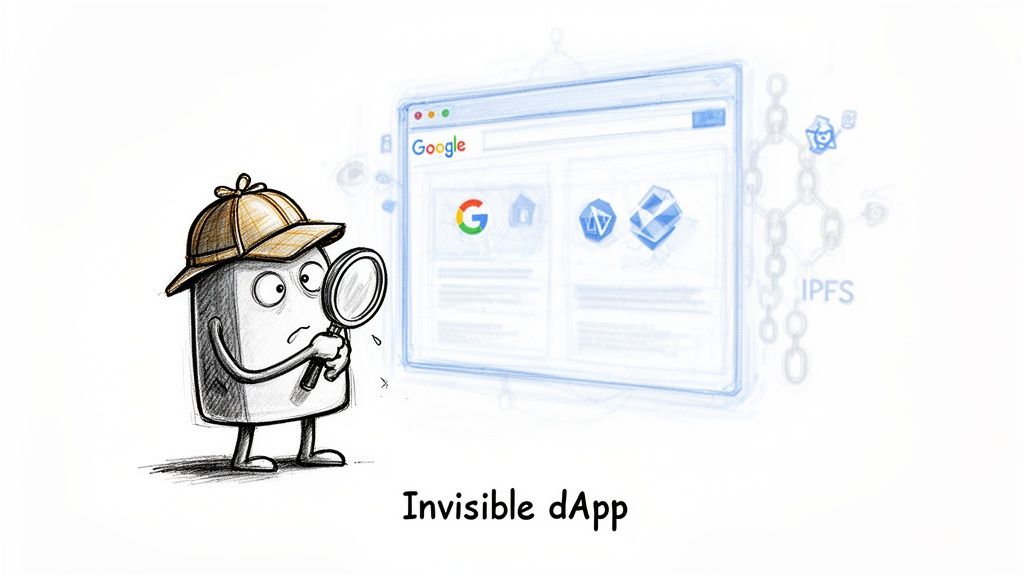
A major gap in current strategies is the use of Web3 indexing protocols like The Graph. Traditional SEO breaks on decentralized site structures and volatile search behavior, while direct on-chain querying has been adopted by over 40% of DeFi protocols amid AI search growth (01 Webmasters on why traditional SEO fails for crypto projects and what works in 2026/).
Fix the rendering problem first
Many DeFi front ends are single-page applications. Search crawlers can struggle with JavaScript rendering, especially when the meaningful content is assembled late or only after wallet interaction.
The practical fixes are not glamorous:
- Pre-render critical pages so crawlers get HTML they can read immediately
- Use dynamic rendering selectively for pages that are especially JavaScript-dependent
- Expose static explanatory content around dynamic app modules
- Separate marketing pages from app UI where needed, while keeping strong internal linking between them
Your homepage should not make Google execute half your application just to understand what the protocol does.
What should be crawlable
At minimum, search systems should be able to read:
- Protocol overview
- Supported assets or markets
- Core mechanism explanations
- Governance overview
- Security information
- Fee or incentive explanations
- Help content and FAQs
If these only exist inside app states, tabs, modals, or wallet-gated views, your discoverability is weaker than it should be.
Handle IPFS and decentralized hosting carefully
Teams love decentralized hosting until they realize search engines prefer stable canonical URLs.
If you use IPFS or similar content distribution patterns, create a clear canonical structure on your primary domain. Keep indexable versions of important content accessible through stable URLs that do not depend on rotating content-addressed paths for discovery.
A simple rule works well here: decentralized distribution can support resilience, but your search layer still needs a stable public address system.
Strengthen technical SEO basics that matter more in DeFi
You do not need a generic audit checklist. You need the subset that directly affects dApp visibility.
Priority technical elements
| Technical issue | Why it matters for DeFi |
|---|---|
| JavaScript rendering | Hidden protocol content never gets indexed properly |
| Site speed | Users bounce fast when pages delay wallet actions or research |
| Mobile responsiveness | Many protocol researchers and users arrive on mobile |
| Structured data | Search engines and AI systems need explicit context |
| Internal linking | Docs, app, governance, and education must reinforce each other |
For schema implementation details that translate well into AI discovery, this guide on schema markup for AI search in fintech and SaaS pages is useful because the same principles apply to structured DeFi entities and product pages.
If your protocol requires explanation before action, give that explanation its own indexable page. Do not hide it inside the app.
Use The Graph as a discovery layer, not just a developer tool
This part of a DeFi protocol SEO strategy is contrarian. Search visibility should not depend only on Google indexing pages. Your protocol can also improve discoverability by making on-chain data queryable in ways that external tools, developers, and AI systems can consume.
Subgraphs can support that layer.
Instead of treating on-chain data as something only visible inside your app dashboard, make core protocol data accessible through well-documented indexing structures. That creates a machine-readable source of truth beyond your marketing pages.
This matters for three reasons:
- Developers can evaluate the protocol faster
- AI systems increasingly rely on structured, machine-accessible information
- Your protocol becomes easier to reference in third-party interfaces and analysis tools
That does not replace SEO. It complements it. Google still needs pages. AI systems and ecosystem tools increasingly need data they can trust.
The architecture that works
The strongest setup is usually a layered one:
- Marketing site for category education and conversion
- Docs environment for technical implementation
- App interface for action
- Indexing layer for structured on-chain discoverability
- Analytics layer to connect sessions to protocol outcomes
Protocols often overinvest in the app and underinvest in the discoverability stack around it. Search performance suffers because crawlers and answer engines cannot assemble a coherent understanding of the protocol.
Building Protocol Authority with Entities and Digital PR
DeFi authority is not a backlink count. It is a validation problem.
Google needs enough corroboration to treat your protocol as a trusted financial entity. AI systems need the same thing before they cite you in comparisons, explainers, or protocol recommendations. If your brand shows up as a token page here, an anonymous guest post there, and a half-complete docs mention somewhere else, you do not have authority. You have scattered references.
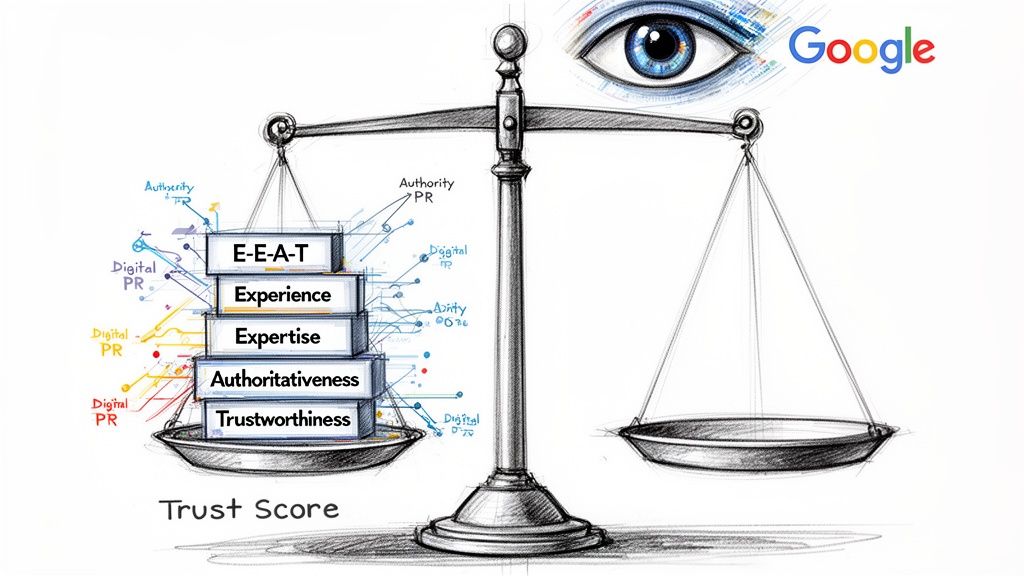
Authority is built with recognition, not volume
A lot of crypto “PR” still means paying for placements on sites that never influence rankings, recommendations, or investor diligence. Teams report link growth while branded search stays flat, wallet connections do not move, and no serious analyst cites the protocol. That is not authority building. It is activity without carryover.
The better approach is tighter and harder to fake:
- Earn mentions in publications that your users, allocators, and ecosystem partners already trust
- Give writers source material they can verify quickly
- Keep founder, protocol, token, and governance details consistent across every owned page
- Publish entity pages that explain what the protocol is, who operates it, and how claims can be checked
The mechanics of entity-first authority are explained in this piece on building the knowledge graph signals that LLMs use to select sources.
What entity SEO looks like for a protocol
Entity SEO for DeFi means turning your protocol into something search systems can identify, compare, and verify without guessing.
The protocol entity
Create a canonical page for the protocol itself. State the category, core mechanism, supported chains, contract verification paths, docs, governance venue, and risk disclosures. This page should stay stable over time, even if product pages and campaign pages change.
The governance token entity
If the protocol has a token, document utility, governance rights, emissions context, and the operational relationship between the token and the protocol. Keep promotional copy out of this page. Search systems trust factual pages that hold still.
The people and governance entities
Founders, foundation entities, core contributors, governance councils, and multisig structures should be documented as clearly as the protocol can support. Teams often overstate decentralization while hiding every accountable actor. That weakens both ranking trust and conversion trust.
Digital PR that helps rankings and recommendations
Serious coverage follows evidence. Journalists, researchers, and ecosystem editors need material they can cite without rewriting your pitch deck.
The assets below tend to produce better mentions than generic launch announcements:
| PR asset | Why it earns trust |
|---|---|
| Research-backed market commentary | Gives journalists something useful to quote |
| Educational explainers | Builds authority without obvious promotion |
| Governance analysis | Shows protocol maturity and transparency |
| Security process documentation | Signals operational seriousness |
| Chain or ecosystem insight | Makes the protocol relevant beyond its own brand |
A factual option for teams that need outside support is Austin Heaton, who works with Web3 and DeFi companies on entity schema, authority content, technical SEO, and digital PR tied to search visibility across Google and AI systems.
The standard I use is simple. If a mention would not help an allocator, partner, or power user trust the protocol with capital, it probably will not help rankings for long either.
The trust signals that separate winners from noise
Credible protocols usually share the same pattern:
- Named expertise instead of anonymous publishing
- Consistent terminology across site, docs, app, and off-site mentions
- Clear security communication with verifiable references
- Direct connections between governance, product, and educational content
- Third-party citations that reinforce core claims instead of contradicting them
Low-value placements, recycled “top DeFi platforms” listicles, and link packages sold as crypto SEO still show up in this market. They rarely build durable visibility. They rarely improve AI citations. They almost never tie back to the metrics that matter.
In DeFi, authority is part of the growth system. Strong entity signals improve search inclusion, strengthen recommendation eligibility, and make it easier for qualified users to move from discovery to wallet connection, deposit, and retained TVL.
Winning in AI Search with Answer Engine Optimization
SEO without AEO is now incomplete for DeFi. Users ask AI systems which lending protocols to trust, how yield strategies differ, what a governance token does, and how to compare risk across platforms. If your protocol is absent from those answers, you lose visibility before the click even becomes possible.
AEO is not a separate channel from SEO. It is the extension of SEO into environments where answers are synthesized instead of listed.
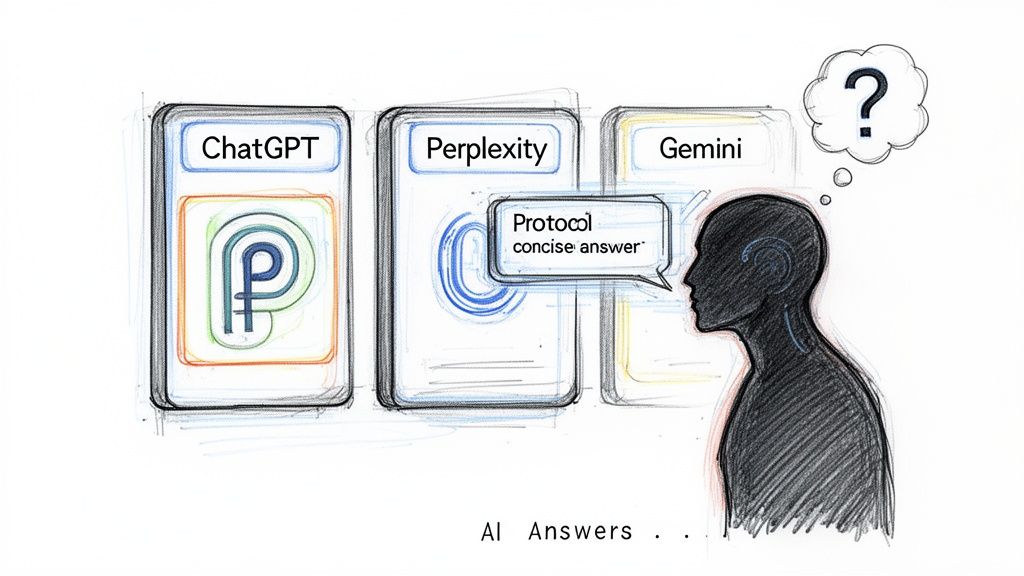
The opportunity is larger than many teams realize. AI Overviews now resolve up to 70% of DeFi queries, and AEO work in FinTech and Web3 has driven 560% AI click growth and 5.13K ChatGPT referrals by focusing on entity schema and DA 60-90 authority cites (Omni Agency on DeFi marketing strategy). That is why a modern DeFi protocol SEO strategy has to target answer engines directly.
What AI systems need from your protocol
AI search tools reward pages that are easy to parse, easy to verify, and easy to compare.
That means your DeFi pages should do three things well:
- Answer a specific question cleanly
- Expose structured context through schema and page architecture
- Match off-site authority signals with on-site claims
A vague landing page rarely gets cited. A clear page that explains a protocol mechanism, token function, governance structure, or onboarding flow has a much better chance.
The page formats most likely to earn citations
Some content types consistently translate better into AI search than generic blog posts.
Strong AEO page types
- Definition pages for protocol concepts and mechanics
- Comparison pages with balanced trade-offs
- FAQ pages tied to specific user decisions
- Methodology pages that explain how rates, incentives, or protocol behavior work
- Entity pages for protocol, token, governance, and security processes
The common theme is clarity. AI systems prefer pages with explicit framing, not marketing blur.
If a page cannot answer a direct question in the opening paragraphs, it is less likely to become a cited source.
Schema that matters in DeFi
Schema is not a magic switch, but it improves machine comprehension.
For DeFi, the useful direction is to structure:
- Protocol identity
- Governance token context
- Founder or organization information where relevant
- FAQ content
- Reviewable educational content
- Product and feature relationships
The implementation approach should support your entity model, not just decorate pages with generic markup. For a practical Web3-focused view, this guide on AI search optimization for Web3 aligns closely with how DeFi teams should think about AEO execution.
Write for answer extraction, not just ranking
Your content structure needs to help AI systems lift accurate fragments.
That means:
| Weak structure | Strong structure |
|---|---|
| Long intro without an answer | Direct answer near the top |
| Hype-heavy copy | Definitions, mechanisms, and trade-offs |
| Mixed intents on one page | One page per primary question |
| Buried facts in tabs | Visible text with clear headers |
You should still optimize titles, headers, internal links, and supporting copy for Google. But the page also needs to function as a reliable answer source when an AI model summarizes it.
A good way to audit this is simple. Ask ChatGPT, Perplexity, and Gemini category questions your buyers ask. Check which sources appear repeatedly. Then compare those pages to yours. The gaps are usually obvious: cleaner entities, stronger citations, better page structure, and more explicit trust framing.
A short walkthrough can help if your team is still treating AI search like a black box.
The durable AEO moat
The durable advantage is not “ranking in ChatGPT.” It is becoming a source that multiple AI systems trust when they answer DeFi questions.
That comes from the combination of:
- strong entity definition,
- machine-readable structure,
- trustworthy off-site corroboration,
- and content that explains financial mechanisms without hype.
Teams that get this right build a recommendation moat. Everyone else keeps optimizing title tags while the answer gets decided upstream.
Measuring SEO Impact and Navigating Security Risks
A DeFi protocol should not report SEO the way a SaaS blog does. Rankings matter. Traffic matters. Neither tells you whether search is growing the protocol.
The right model connects discovery to on-chain behavior. Track which organic visitors connect wallets, which content paths precede protocol interactions, and which organic cohorts return before depositing, swapping, or participating in governance. The reference framework many teams use is to combine site analytics with on-chain tools so SEO performance is judged by wallet connections, protocol interactions, and TVL changes from organic traffic, not pageviews alone, as discussed in the earlier Victoria Olsina source.
What to measure instead of vanity traffic
Use a measurement stack that joins website behavior and protocol activity.
A practical reporting set usually includes:
- Organic landing pages tied to wallet connect events
- Content paths that precede first protocol interaction
- Returning organic users who later become active wallets
- Pages that assist governance participation or feature adoption
- Branded versus non-branded organic cohorts
For teams building AI search reporting alongside SEO, this overview of how to measure AEO results and the tracking stack for B2B companies is useful as a methodology reference, even though your DeFi conversion events are different.
Security communication is part of search performance
In DeFi, security and governance are not support content. They are ranking and conversion assets because they shape trust.
If your protocol has audit information, governance proposals, parameter changes, or risk disclosures, make them easy to find and easy to understand. Search users looking for “is this protocol safe,” “how governance works,” or “what happens in liquidation conditions” are sending strong intent signals. They are not browsing casually. They are deciding whether to trust you with capital.
A strong setup includes:
| Trust asset | Search value |
|---|---|
| Audit summaries | Supports evaluation and trust |
| Risk disclosures | Reduces ambiguity and improves credibility |
| Governance archive | Shows protocol maturity |
| Incident communication pages | Demonstrates operational seriousness |
In DeFi, transparency is not a legal checkbox. It is a discoverability advantage because trustworthy pages answer the questions users ask before they commit funds.
Protocols that hide risk language to improve conversion usually create the opposite outcome. Users leave, third parties define the narrative, and both Google and AI systems find cleaner sources elsewhere.
Your Roadmap to Dominating DeFi Search in 2026
The teams that win search in DeFi do not treat SEO like publishing volume. They treat it like protocol infrastructure.
Build two funnels, one for developers and one for users. Fix crawlability before adding more content. Turn your protocol, token, and governance system into clear entities. Earn authority from relevant publications, not random link vendors. Then structure your pages so Google can rank them and AI systems can quote them.
That is the durable version of a DeFi protocol SEO strategy. It compounds because it aligns visibility with trust and trust with on-chain action.
If your search program cannot influence wallet connections, protocol usage, and capital flow, it is not mature yet. If it can, search becomes one of the few compounding growth systems available to a DeFi protocol.
If you want help building that system, Austin Heaton works with DeFi, FinTech, SaaS, and AI companies on senior-led SEO and AEO programs that connect technical fixes, entity strategy, content, digital PR, and AI visibility to qualified growth. You can learn more at Austin Heaton.


