
Austin Heaton's Entity Authority Framework: Master AI Search
Master AI search visibility with Austin Heaton's Entity Authority Framework. This guide explains components, implementation, & KPIs for B2B growth.



Most advice about winning in search is stuck in the Google-only era. It assumes the job is to rank a page, collect a click, and optimize the next keyword. That model is breaking.
B2B buyers now ask ChatGPT, Perplexity, Gemini, and AI Overviews for shortlists, comparisons, and recommendations. In those environments, the question isn’t whether your page ranks first. It’s whether your brand gets recognized, retrieved, and cited.
That’s why Austin Heaton's Entity Authority Framework matters. It’s not another SEO checklist. It’s a system for making a company machine-readable, verifiable, and trustworthy across the web so AI systems can confidently reference it in buying-moment answers.
Public documentation on the framework has been thin. One available reference explicitly notes that no specific public information on Austin Heaton's Entity Authority Framework appeared in available sources and that this breakdown is the first to detail its components and implementation steps, including how it combines technical SEO, schema markup, and high-authority backlinks for AI visibility in tools like ChatGPT and Perplexity (reference).
Why Traditional SEO Fails in the AI Era
Traditional SEO fails when teams confuse rankings with visibility.
A page can rank well and still lose the buying moment if AI answers summarize the category without mentioning your brand. The old playbook treated search as a list of blue links. The new environment acts more like a recommendation engine.
Rankings are now a partial signal
Google positions still matter. They just don’t tell the whole story anymore.
If your reporting still stops at keyword movement, you need a modern approach to track Google rankings that reflects how result pages look, including AI-led layouts and changing SERP features. That’s useful because marketers need to know not just where a page ranks, but what the buyer sees before they ever click.
A related implication is easy to miss. AI systems can cite pages that aren’t sitting at the top of classic search results. Austin Heaton has written directly about that pattern in this piece on why many ChatGPT-cited pages sit outside top Google positions.
The unit of competition has changed
The old unit was the page. The new unit is the entity.
AI systems don’t just retrieve text. They infer who the company is, what it sells, which people represent it, and whether those claims appear consistently across multiple sources. If those signals are weak, even strong content can stay invisible in AI answers.
Practical rule: If your brand identity is inconsistent across your site, profiles, directories, and expert bylines, AI systems have less confidence in citing you for high-intent questions.
That’s why keyword-first SEO underperforms in B2B AEO. It creates isolated pages. It doesn’t create a durable identity layer.
What still works
Some classic SEO practices still help. Technical crawlability matters. Strong content matters. Relevant links matter.
What doesn’t work is treating them as separate tasks. Austin Heaton's Entity Authority Framework combines them into a system designed for citation, not just rank. Many teams have not yet operationalized this shift.
Defining the Entity Authority Framework
Think of Austin Heaton's Entity Authority Framework as a digital resume for AI.
Not a brand story. Not a messaging document. A machine-readable record that tells AI systems who the company is, what it offers, who its experts are, and why those claims should be trusted.
What an entity actually is
In AI search, an entity is a clearly identifiable thing. A company. A product. A founder. A category. A feature set. A location. A known relationship between those things.
The framework’s job is to make those relationships explicit.
That includes the company itself, the people attached to it, the products it sells, and the topics it should be associated with. When those signals line up, the brand stops looking like a random collection of pages and starts looking like a recognized source.
For a deeper view of how AI systems evaluate those trust signals, Austin Heaton’s write-up on entity-based SEO for AI search is worth reading.
Why this is more durable than chasing rankings
Rankings move. Entities persist.
A keyword strategy can produce traffic while still failing to build memory in AI systems. An entity strategy creates a stable identity layer that new content can attach to. That matters because B2B buyers ask repetitive category questions in dozens of variations. If the system already understands your brand, each new page gains greater impact.
AEO gets easier when AI already knows who you are.
This is also why the framework isn’t just “add schema and hope.” The point isn’t markup for its own sake. The point is to align structured data, on-page claims, off-site references, and expert attribution so AI can verify the same story from multiple angles.
The operating model
At a practical level, the framework does four things:
- Defines the entity clearly with structured data and explicit brand metadata
- Connects the entity to topics through focused content architecture
- Supports claims with external validation across trusted platforms
- Refreshes the signals over time so the entity remains current after model and platform changes
That’s the strategic core. Once you see it that way, the framework stops looking like an SEO tactic and starts looking like infrastructure for AI-sourced pipeline.
The Four Core Components of the Framework
Austin Heaton's Entity Authority Framework sits inside a broader authority system, but its practical power comes from four operating components. Each one solves a different failure point in AI visibility.
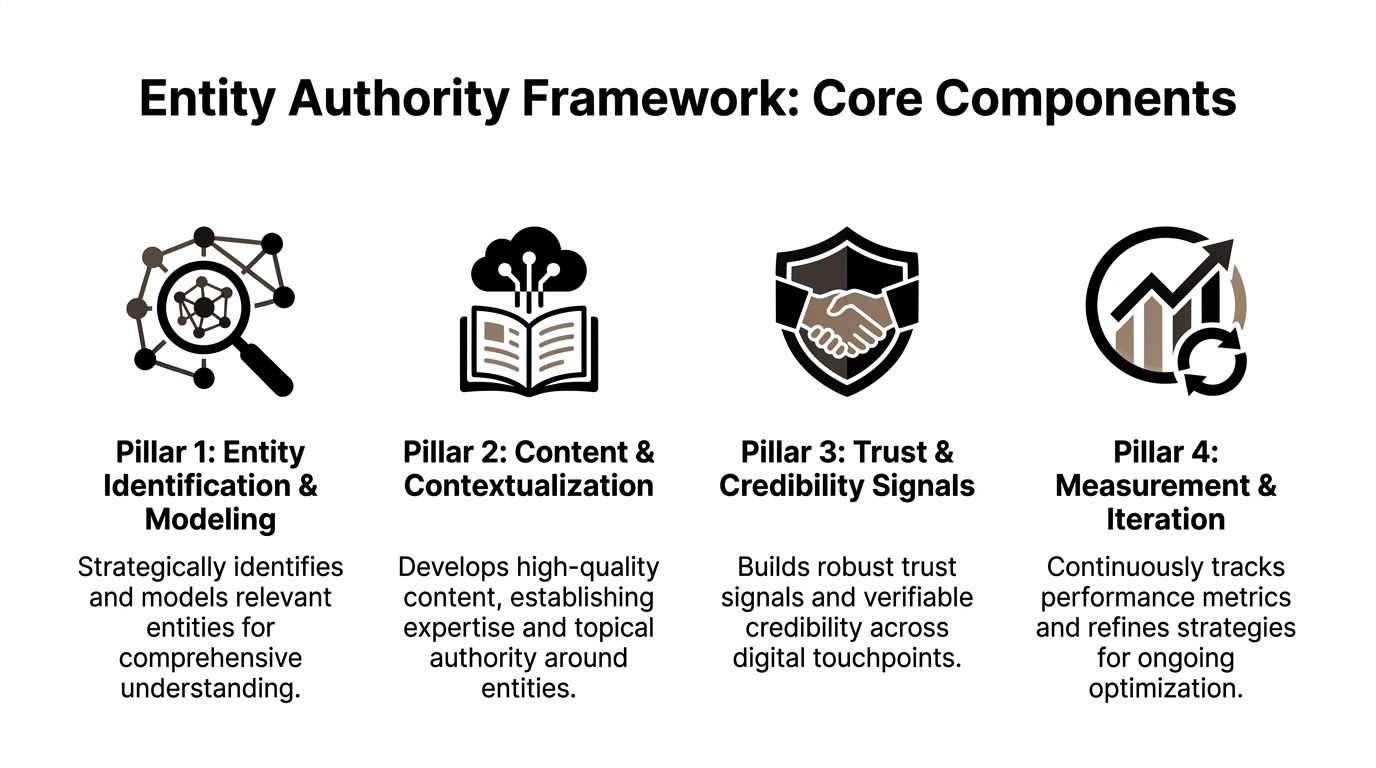
Component one builds identity
The first job is to define the brand in terms machines can parse.
Austin Heaton’s framework uses JSON-LD schema, including Organization, Person, and Product, to make identity explicit for AI crawlers. Available documentation also states that sites with proper schema appear in AI responses 3.2x more frequently (reference).
Teams often have a weaker foundation than they realize. They may have some schema, but not enough consistency, coverage, or specificity to support AI retrieval.
Component two builds context
Identity alone doesn’t win citations. The model also needs topical confidence.
That means building content that connects the entity to the problems, use cases, categories, and comparisons buyers ask about. The content has to be structured so the AI can extract concise, attributable passages without guessing what the company does.
Austin Heaton’s AEO content checklist for B2B pages maps closely to this part of the system.
Component three builds trust signals
AI systems look for corroboration.
The framework strengthens trust through consistent NAP data, sameAs links, and aligned information across directories, social profiles, and third-party listings. Data hygiene becomes a growth lever, not an admin task. If your team needs a practical primer on cleaning and standardizing company records, these data enrichment strategies are a useful reference.
When trust signals are fragmented, citations drop. When they align, the entity becomes easier to verify.
The fastest way to weaken an entity is to let five versions of your company exist across the web.
Component four measures and iterates
Entity authority isn’t static. It needs maintenance.
Model behavior changes. Product positioning changes. New executives, new product pages, new category pages, and new citations all affect the graph around the brand. Teams that treat entity work as a one-time implementation usually stall after the first lift.
Here’s the simplest way to evaluate the four components together:
| Pillar | Objective | Key Tactics |
|---|---|---|
| Entity Identification & Modeling | Define the brand and related entities clearly | JSON-LD schema, entity mapping, product and person relationships |
| Content & Contextualization | Connect the entity to commercial topics | Topical hubs, comparison pages, FAQ sections, concise citable passages |
| Trust & Credibility Signals | Verify claims across the web | NAP consistency, sameAs links, third-party profiles, expert attribution |
| Measurement & Iteration | Sustain visibility through updates | Citation tracking, conversion tracking, schema refreshes, content updates |
What works is the combination. Schema without content leaves the entity underexplained. Content without trust signals leaves it unverified. Measurement without any of the first three just reports drift.
Implementing the Framework Step-by-Step
Teams should implement Austin Heaton's Entity Authority Framework in phases. Trying to do everything at once creates noise and makes it hard to isolate what changed.
Phase one fixes the foundation
Start with an entity audit.
Use your CMS, schema validator, Search Console, brand profiles, Crunchbase-style listings if applicable, LinkedIn company data, and internal messaging docs. You’re looking for mismatches in naming, category labels, product descriptions, executive bios, and company facts.
A good audit usually surfaces these issues:
- Incomplete schema coverage on commercial pages
- Conflicting company descriptions across owned and third-party properties
- Weak expert attribution on articles and thought leadership pages
- Unclear product-entity relationships for software, features, or service lines
If your team needs a process for that first pass, Austin Heaton’s guide on how to do an AEO audit for B2B SaaS is a practical starting point.
Then deploy the core schema set. At minimum, define the company, key people, and core products or services. On sites with stronger product depth, SoftwareApplication and FAQPage can also matter, but only when the page supports that markup.
Phase two builds citability
After the entity is defined, build pages that support retrieval.
This usually means a layered architecture rather than a random blog schedule. Foundational pages establish who the brand is and what it solves. Category and use-case pages explain where it fits. Supporting articles answer the comparison and decision questions buyers ask before conversion.
What tends to work:
- Entity foundation pages that clearly state category, audience, product, and differentiators
- Comparison and alternative pages built for vendor evaluation questions
- FAQ and explainer content that answers narrow, high-intent prompts in concise language
- Expert-authored or expert-attributed content that ties a person to a topic area
What tends not to work is publishing broad thought leadership with no clear entity relationship. It may read well and still produce weak AI pickup.
Phase three earns external confirmation
This is the part many in-house teams underinvest in.
AI systems don’t want to rely on your website alone. They prefer to see the same identity reflected elsewhere. That means digital PR, authoritative mentions, aligned profiles, and backlinks that reinforce category relevance.
One option in the market is Austin Heaton’s own entity SEO work, which focuses on structuring brand content and authority signals so LLMs associate a business with specific topics, solution categories, and expert authority. That’s one implementation route. Others may build the capability in-house or through a technical SEO and PR combination.
Phase four refreshes the graph
Quarterly maintenance is the difference between a lift and a system.
Review structured data on high-value pages. Update expert bios when responsibilities shift. Reconcile new mentions, product launches, and category moves. If your brand enters a new market or changes positioning, reflect it everywhere the entity appears.
Don’t treat entity authority like a migration project. Treat it like revenue infrastructure.
Proving the Impact with Real-World Results
AI visibility only matters if it produces pipeline. Cleaner entity signals are useful because they improve discovery in AI surfaces that influence vendor shortlists, demo requests, and qualified inbound.
One published breakdown of Austin Heaton’s work reports a 575% increase in AI search growth for a crypto payroll platform, plus 656 AI-sourced clicks and 101 conversions in 60 days for a B2B fintech company (reference). Those are the kinds of results that matter. They tie AI discovery to conversion activity, not just citation screenshots.
The crypto payroll example is useful because it shows where this framework tends to outperform standard SEO playbooks. Categories with weak market consensus, crowded messaging, and overlapping terminology often struggle in AI search. In those cases, entity authority does more than improve indexing. It reduces ambiguity, increases the odds of accurate brand mention, and gives language models a cleaner basis for recommending the company in category-level prompts.
The fintech case is even more important from a revenue standpoint. AI traffic often looks good in reporting and disappoints in the funnel because the visit lands on generic educational content. Here, the documented outcome included conversions from AI-sourced traffic, not just visits from experimental channels. That is the difference between AI visibility as a brand metric and AI visibility as a demand generation input.
For a closer look at how the content layer contributed, see this case study on increasing B2B SaaS AI citations with 15 pieces of content.
A short walkthrough helps make the mechanics more concrete:
There is also a scaling pattern worth paying attention to. The same source reports 454% average AI impression growth, 560% AI click growth within 60 days, and a 340% increase in AI citations for a B2B SaaS company using 15 pieces of content (same source). That does not mean every B2B team should copy the exact content count. It means the framework works when content is mapped to entity reinforcement, category association, and buyer-stage intent.
That trade-off matters. Publishing more articles can raise traffic and still miss revenue if the pages do not help AI systems understand who the company is, what it sells, and why it belongs in a specific buying conversation. Heaton’s framework is different because it treats content as evidence inside an entity system. That is a more useful model for B2B teams that care about sourced pipeline, sales-qualified conversions, and category ownership in AI-driven discovery.
Avoiding Common Pitfalls and Misconceptions
The biggest misconception is that entity authority equals schema markup. It doesn’t.
Schema is the declaration layer. It tells machines what you claim to be. It does not, by itself, create enough corroboration to survive platform shifts, model updates, or category ambiguity.
Available documentation on critiques of entity-based strategies points to several weak spots, including over-reliance on schema markup, the challenge of entity disambiguation for decentralized or complex brands, and the failure to adapt the framework for niches like Web3 or crypto or maintain it through model updates (reference).
What breaks in practice
A few patterns show up repeatedly:
- One-and-done implementation. Teams add schema once, never revisit it, and assume the problem is solved.
- No off-platform alignment. The website says one thing. LinkedIn, directories, and bylines say something slightly different.
- Weak disambiguation. The brand name overlaps with other companies, products, or concepts, and no one resolves the ambiguity.
- Generic content strategy. The team publishes articles around keywords but never builds a topic-to-entity relationship.
What to do instead
Treat the framework as an operating system.
Review it when your product naming changes. Review it when leadership changes. Review it when entering new regions or categories. If your company sits in a complex space such as crypto infrastructure, AI tooling, or multi-product fintech, assume disambiguation needs deliberate work.
AI won’t infer precision if your brand presents itself imprecisely.
Measuring Success and Key Performance Indicators
The wrong KPI is “our schema is live.”
The right KPI set tracks whether Austin Heaton's Entity Authority Framework produces more qualified discovery and more revenue from AI surfaces.
The KPIs that matter
Use a scorecard built around business impact:
- AI citations: how often your brand appears in AI answers for category and comparison prompts
- AI clicks: visits from AI platforms and AI-powered result surfaces
- Share of voice in AI answers: how often your brand is included versus excluded in key buying prompts
- AI-sourced conversions: demos, signups, pipeline actions, and qualified leads that originate from AI-assisted discovery
How to read performance correctly
Don’t isolate one signal.
If citations rise but conversions stay flat, your visibility may be informational rather than commercial. If AI clicks rise without stronger share of voice, you may be winning a narrow set of prompts but losing category-defining questions. If conversions rise, inspect which entities, pages, and experts are getting cited, then reinforce those patterns.
This is what makes entity authority different from old reporting. You’re not just measuring page performance. You’re measuring whether AI systems trust your brand enough to include it in consequential answers.
If your team needs help turning entity strategy into AI-sourced pipeline, Austin Heaton works with B2B SaaS, FinTech, AI, and Web3 companies on technical AEO, entity architecture, content strategy, and authority building designed to earn citations and conversions across ChatGPT, Perplexity, Gemini, and AI Overviews.


