
Austin Heaton's AI SEO Authority Building Strategy
Uncover Austin Heaton's AI SEO Authority Building Strategy for B2B growth in 2026. Learn to dominate search with advanced AI techniques.


Most advice on AI SEO is already stale. It tells teams to rank higher, publish more blogs, and add a few FAQ blocks as if ChatGPT, Perplexity, and Google’s AI surfaces are just another traffic source.
They aren’t.
The fundamental shift is this. Ranking is no longer the end goal. Citation is. If an AI system doesn’t recognize your brand as a trustworthy entity, it can summarize your category without ever mentioning you. That’s the problem Austin Heaton's AI SEO Authority Building Strategy is built to solve.
This strategy matters because it treats AI visibility as a system, not a set of disconnected tactics. It’s designed to make models cite, quote, and recommend a brand at high-intent moments. That means building authority signals AI systems can parse, verify, and reuse.
Beyond Rankings The New Mandate for AI SEO
The old KPI was simple. Get to page one. Preferably rank first. That still matters, but it’s no longer enough.
Austin Heaton's AI SEO Authority Building Strategy starts from a more useful premise. If AI interfaces are shaping buyer journeys, then your brand has to become part of the model’s trusted source layer. That requires more than keyword targeting. It requires authority, structure, and entity clarity.
According to Austin Heaton’s structured data reference, the strategy has produced 454% average growth in AI impressions and 560% average growth in AI clicks within the first 60 days for clients. The same source notes that 76.1% of URLs cited in AI Overviews also rank in Google’s top 10. That tells you something important. Traditional SEO still matters, but only when it feeds an authority system built for AI retrieval and citation.
What CMOs need to stop assuming
A lot of teams still assume AI search is just an extension of classic organic search. That’s the mistake.
AI systems don’t only reward the page with the strongest on-page optimization. They favor brands with evidence across multiple signals. Clean schema. Recognizable entities. High-trust mentions. Pages that answer commercial questions clearly enough to extract.
If you want a useful mental model for that shift, this guide on LLM SEO is worth reviewing. It helps frame why visibility in large language model outputs depends on citation readiness, not just rankings.
Practical rule: A page can rank and still fail. If an AI model can’t confidently quote it, compare it, or connect it to a known entity, it won’t become a recommendation source.
The new objective is recommendation visibility
This is why Austin Heaton's AI SEO Authority Building Strategy focuses on durable authority instead of isolated wins. The goal isn’t to chase every query. The goal is to own the moments that influence pipeline.
Freshness also plays into that trust layer. This internal analysis on the 3-month content freshness rule is useful because it forces the right operational question. Not “did we publish?” but “did we keep the pages AI systems rely on current?”
That’s the new mandate. Build a brand AI systems can verify, not just a site Google can index.
Why Traditional Content Funnels Fail in 2026
The standard B2B funnel still looks tidy in slide decks. Awareness content at the top. Consideration content in the middle. Conversion pages at the bottom.
In practice, that structure breaks when AI answers the awareness query before the buyer ever clicks.

Austin Heaton’s analysis of this problem is blunt. 67% of B2B content is aimed at the top of the funnel, which is now heavily cannibalized by AI. In the same documented strategy results, the bottom-funnel hierarchy drove 5,130 ChatGPT referrals and 4.4x higher conversion rates from AI search visitors (source).
Why blog-first content keeps losing value
Blog-first content assumes the buyer needs your site to answer early-stage questions. Increasingly, they don’t.
A buyer asks a model for vendor comparisons, implementation risks, pricing logic, or best-fit recommendations. The model synthesizes an answer from sources it trusts. If your content mix is mostly broad educational posts, you’ve funded visibility that often gets absorbed into the answer layer without producing qualified visits.
That’s the core failure.
Traditional funnels overinvest in informational coverage and underinvest in pages that close. AI search compresses the journey. It pushes many users directly into vendor evaluation. Brands that still spend most of their budget on awareness content are building a library for machines to summarize, not a content system for revenue.
What works better than the old funnel
A bottom-funnel model aligns with how AI-assisted buying happens.
Instead of starting with generic blog topics, start with pages that answer commercial questions:
- Solution pages that map pain point to offer
- Comparison pages that frame alternatives transparently
- Pricing and decision pages that remove buying friction
- Proof assets that validate category fit
- Supportive blogs that widen topical coverage later
Buyers using AI tools often arrive with sharper intent. They don’t need another introductory article. They need confirmation, differentiation, and evidence.
The trade-off most teams avoid
This approach feels less glamorous because bottom-funnel content doesn’t always produce the broadest traffic footprint. It produces a more useful one.
A company that publishes fifty informational posts may still look busy. A company that publishes a smaller set of tightly structured commercial assets often gets the business outcome. AI search has made that contrast impossible to ignore.
What doesn’t work anymore is pretending scale alone will save a weak funnel. If the architecture starts in the wrong place, more content just increases waste.
The Four Pillars of the AI Authority Framework
Austin Heaton's AI SEO Authority Building Strategy is built on four pillars: Brand Authority, Domain Authority, Entity Authority, and Content Velocity. The value of the framework is that each pillar supports the others. This isn’t a checklist. It’s a compounding system.

A documented overview of the framework notes that high-DA backlinks can boost trust scores in retrieval-augmented generation by 45%, while proper entity schema can increase AI citation rates by 70% (source). Those aren’t isolated tactics. They show why authority compounds when technical, editorial, and off-site signals reinforce each other.
Brand Authority
Brand Authority answers a simple question. Does the web describe your company as a credible source in its category?
This pillar is built through digital PR, expert positioning, bylined commentary, and authority-building placements on trusted publications. AI systems look for corroboration. If your brand only makes claims about itself on its own site, that signal is thin.
What works:
- Third-party mentions on relevant publications
- Expert attribution tied to named people and brands
- Consistent positioning around a clear category and use case
What doesn’t:
- Anonymous ghost content with no visible expertise
- Generic PR blasts with no category relevance
- Thought leadership that never connects back to commercial authority
Domain Authority
Domain Authority is still critical, but not in the old “collect links at all costs” sense.
The strategy emphasizes high-quality backlinks from strong domains because AI systems use external trust and citation patterns when selecting sources. Links from credible sites function as validation points. They also help the site rank for the pages most likely to be cited.
A practical distinction matters here. One strong, relevant authority mention can outperform a pile of easy links that no serious buyer or AI model would trust.
| Pillar role | Good signal | Weak signal |
|---|---|---|
| Domain Authority | Relevant backlinks from strong publications | Low-quality directory or irrelevant guest post links |
| AI impact | Improves trust and retrieval confidence | Adds noise without meaningful authority |
Entity Authority
Many organizations lag in this particular area.
Entity Authority makes your brand machine-readable. It uses schema markup, knowledge graph signals, consistent naming, and unambiguous associations between company, people, products, and topics.
If your brand name, leadership team, category, and core offers are fragmented across the web, AI models struggle to attribute expertise cleanly. That lowers citation confidence.
Working rule: If a model can’t tell who you are, what you sell, and why you’re credible from structured and corroborated signals, it won’t recommend you reliably.
Content Velocity
Content Velocity doesn’t mean publishing junk faster.
It means maintaining a consistent cadence of useful, query-targeted assets that reinforce the other three pillars. Fresh pages, updated comparisons, and current commercial content give AI systems more recent material to cite.
The mistake is treating volume as a substitute for direction. Velocity works only when the content being shipped strengthens entity clarity, category authority, and bottom-funnel coverage.
The framework succeeds because it reflects how AI retrieval works. Brand trust, link trust, machine-readable identity, and content coverage all have to agree.
Executing the Five-Layer Content Hierarchy
Ranking-first content plans underperform in AI search because they start too far from revenue. The five-layer hierarchy fixes that by building the pages LLMs cite during evaluation, shortlisting, and vendor selection before expanding into broader editorial coverage.
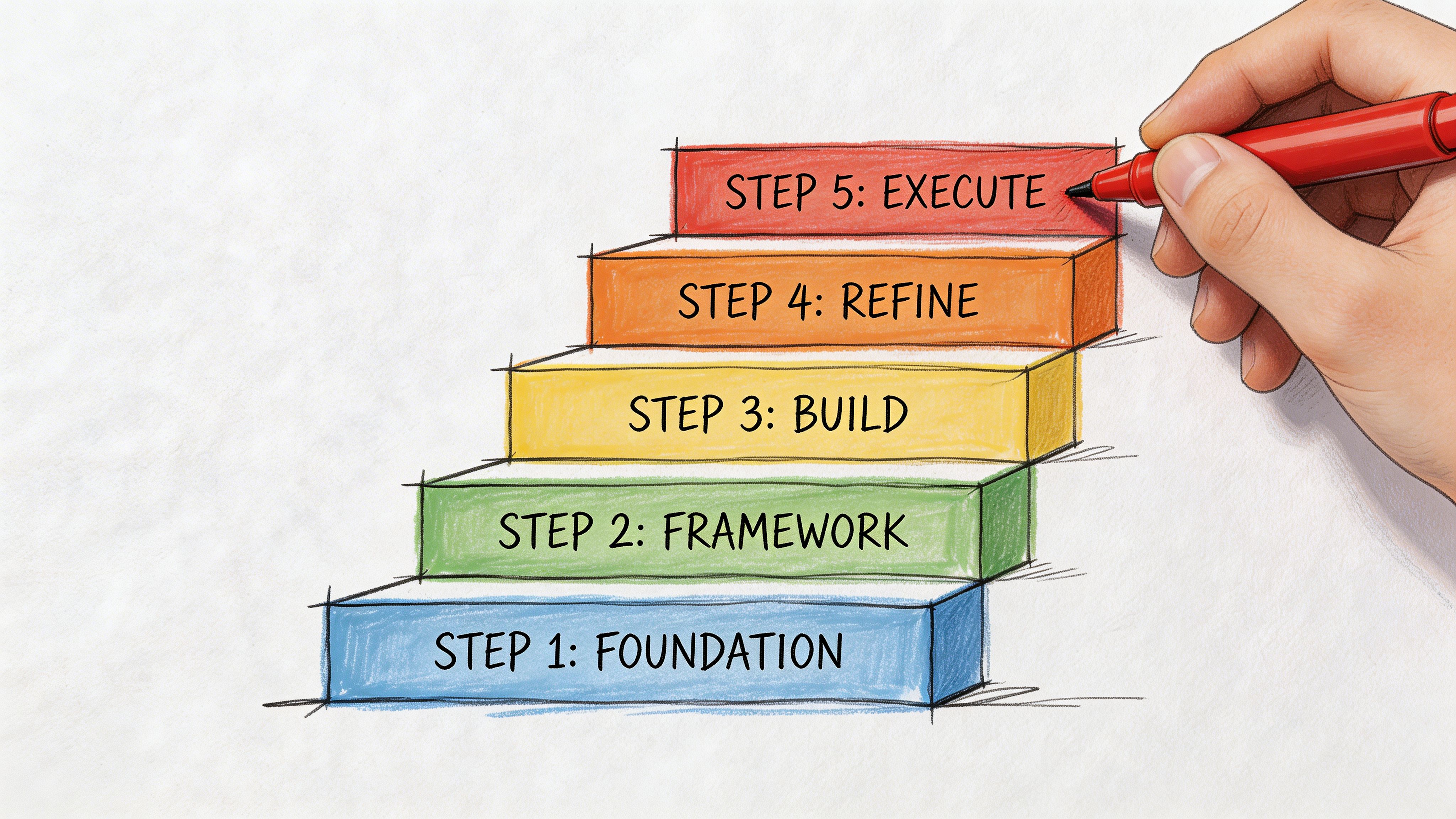
The documented model starts with solution pages and comparison pages. Those first two layers have been shown to increase organic conversions by 45% in 90 days and boost win rates by 533% in AI referrals because LLMs favor structured, comparative content (source).
Layer 1 and Layer 2 drive the system
Start with the pages closest to pipeline.
Layer 1 is solution and service pages. These pages should map to distinct buying scenarios, not vague category terms. A strong solution page explains the problem, the fit, the implementation reality, the trade-offs, and the next step in language both a buyer and a model can parse quickly.
Layer 2 is comparison pages. On these pages, AI visibility often turns into revenue. Buyers ask for alternatives, category comparisons, migration paths, and vendor differences. Models prefer pages that answer those questions in a structured format they can extract without guessing.
Pages in these first two layers work when they include:
- Scannable structure with clear headers, bullets, tables, and schema
- Commercial relevance tied to outcomes, constraints, and use cases
- Balanced comparisons that acknowledge strengths, limitations, and fit
- Internal links to proof points, pricing, and conversion paths
They fail when teams publish:
- Thin service pages filled with generic positioning
- Comparison pages that avoid naming the actual alternative
- Dense copy blocks with no hierarchy, evidence, or extractable format
For page-level execution standards, use the AEO content checklist for B2B pages that need to get cited by AI.
Layers 3 through 5 support the close
Layer 3 is case studies and proof content. These assets answer the buyer question behind every shortlist decision: has this worked for a company like mine? Strong proof content includes the initial problem, selection criteria, rollout details, measurable outcomes, and enough specificity for AI systems to cite the result with confidence.
Layer 4 is pricing and decision-stage content. B2B marketing teams often hide pricing, implementation scope, or packaging because sales wants room to negotiate. That choice usually creates more friction than flexibility. AI-assisted buyers look for budget signals, rollout expectations, and deal-shaping details before they book a call.
Layer 5 is blog content. Blog articles still matter, but they belong at the top of a system that already covers commercial intent. Their job is to reinforce core entities, answer adjacent questions, capture emerging demand, and send authority back into the revenue pages above them.
Production speed matters, but only after the architecture is right. Teams comparing workflow options can review these best AI tools for content creation, but tools do not fix bad sequencing, weak briefs, or missing commercial pages.
Here’s a useful walkthrough of the page logic in action:
The order determines the outcome
Many content teams still build upside down, publishing awareness posts first and postponing the assets that close deals. That is why traffic grows while AI citations, qualified demos, and sales velocity stay flat.
The operating sequence is simple:
- Build the core solution pages first
- Add comparison assets next
- Publish proof content that reduces buyer risk
- Tighten pricing and decision-stage content
- Expand with blog content after the revenue base exists
Execution can sit with an internal team, an agency, or a hybrid model. The ownership model matters less than discipline. Someone has to protect the sequence, enforce page standards, and stop the roadmap from drifting back to blog-first publishing.
Measuring AI SEO Success and ROI
Most reporting dashboards still emphasize the wrong things. Rankings. Sessions. Pageviews. Impression charts with no buying context.
That reporting model breaks in AI search because visibility can increase while clicks flatten, and clicks can become more valuable even when aggregate traffic looks smaller.

For teams implementing this strategy, Austin Heaton outlines a practical budget model of content 40-50%, entity authority 20-25%, technical 15-20%, and monitoring 10-15%. The same source states that from a minimum of $3,000/month, this setup can achieve 454% AI impression growth and 30-45x ROI (source).
The scorecard that matters now
A useful AI SEO scorecard includes metrics that indicate recommendation visibility and pipeline impact.
Track:
- AI citations in platforms such as AI Overviews and conversational search surfaces
- Qualified AI clicks to bottom-funnel pages
- ChatGPT and other AI referrals with landing page segmentation
- Conversions from AI-originated sessions
- Brand-entity search behavior that suggests growing recognition
The point isn’t to abandon classic SEO reporting. It’s to stop pretending broad traffic is the best proxy for revenue.
How to report this to the C-suite
Executives don’t need another dashboard full of vanity metrics. They need proof that authority investment is creating commercial advantage.
Use a simple framing table:
| Question from leadership | Better metric |
|---|---|
| Are we more visible? | AI citations and high-intent AI impressions |
| Is the traffic better? | Qualified AI clicks to commercial pages |
| Is it producing revenue? | Conversions and pipeline from AI referrals |
| Are we investing correctly? | Spend by content, entity, technical, and monitoring buckets |
Don’t ask whether AI SEO is driving more traffic than the old model. Ask whether it’s driving better buying moments.
For teams setting up attribution and reporting, this guide on how to measure AEO results is a useful operational reference.
What not to overvalue
Two traps show up constantly.
First, teams obsess over raw keyword movement while ignoring whether the cited pages are commercial. Second, they celebrate total AI referral volume without checking whether those sessions land on pages built to convert.
Measurement has to follow the business model. If the strategy is authority-led, then the dashboard has to show authority turning into revenue.
Your 90-Day Implementation Checklist
Many teams don’t fail because the strategy is too complex. They fail because they start everywhere at once.
A better approach is to sequence the first ninety days around authority foundations, commercial assets, and measurement discipline.
Days 1 through 30
Start with diagnosis, not publishing.
- Run a technical audit for crawlability, schema coverage, internal linking, and page structure.
- Audit entity consistency across your site, author profiles, company descriptions, and key off-site mentions.
- Identify bottom-funnel gaps in solution, comparison, proof, and pricing pages.
- Map AI query patterns around buyer intent, not just keyword volume.
Your output by the end of this phase should be a prioritized build list. Not a brainstorm. A list.
Days 31 through 60
At this point, execution should get narrow and commercial.
- Launch or rebuild solution pages for your highest-value offers.
- Publish comparison pages for the competitors and alternatives buyers evaluate.
- Strengthen page structure with extractable formatting, schema, proof blocks, and decision-support elements.
- Begin authority building through relevant placements and expert mentions.
A useful benchmark reference during this phase is this case breakdown on how Austin Heaton increased B2B SaaS AI citations with 15 pieces of content. Use it as a reminder that focused commercial content usually beats uncontrolled volume.
Days 61 through 90
At this stage, the goal is compounding.
- Add proof assets such as case studies and use-case validation pages.
- Tighten pricing and conversion pages so AI-referred users don’t hit ambiguity.
- Expand internal links from supporting content into your revenue pages.
- Set reporting cadence for citations, referral quality, and conversion trends.
The first ninety days shouldn’t produce a giant content library. They should produce an authority spine the rest of the program can build on.
What works in this window is discipline. What doesn’t is slipping back into the comfort of broad blog production because it feels easier to ship.
Frequently Asked Questions
How is this different from E-E-A-T
E-E-A-T is a useful lens. It is not a full operating system.
Austin Heaton's AI SEO Authority Building Strategy turns credibility into an execution model. It doesn’t stop at “show expertise.” It defines how to build brand signals, link trust, machine-readable entities, and content sequencing so AI systems can cite the brand consistently. E-E-A-T describes the standard. This strategy operationalizes it for AI retrieval.
How quickly can a company see measurable results
The honest answer is that it depends on starting authority, technical health, and how fast the team ships the right assets.
What matters is that this system isn’t built around waiting a year for vague momentum. It prioritizes commercial pages and authority signals first, so results can show up earlier than with blog-first programs. Teams should expect leading indicators such as stronger citation visibility and better-qualified AI referrals before the full compounding effect shows up across the entire site.
If you’re building FAQ and structured answer blocks, this guide on how to structure FAQ content that matches LLM query patterns is a practical reference.
Can this work for a newer company with low domain authority
Yes, but the approach has to be sharper.
A newer company can’t rely on sheer domain strength, so it needs clearer entity signals, better-structured bottom-funnel pages, and focused authority building in the exact category it wants to own. Newer brands usually lose when they try to mimic large incumbents with broad blog output. They have a better chance when they become the clearest answer for a narrower set of high-intent queries.
The mistake is assuming low authority means waiting. It means sequencing more carefully.
If your team needs a system for getting cited and recommended in AI search, not just ranked in traditional search, Austin Heaton builds authority-led SEO and AEO programs for B2B companies that care about pipeline. Learn more about Austin Heaton.


