What Is an AEO Content Gap Analysis?
Learn how aeo content gap analysis finds missing topics, stale pages, and weak citation signals to improve AI and search visibility.


Most content audits still look at rankings, traffic, and keyword coverage first. That remains useful, but it misses a major shift in how people find and trust information. AI assistants, AI Overviews, and answer-first search experiences do not just reward pages that rank. They often cite pages that are current, explicit, easy to parse, and strong at the entity level.
That is where an AEO content gap analysis earns its place.
AEO, or Answer Engine Optimization, focuses on whether your content can be selected, quoted, and trusted by systems like ChatGPT, Perplexity, Gemini, Copilot, and Google’s AI-driven search features. A content gap analysis in that context is not only about what topics you have not published yet. It is also about what signals are missing from content you already own.
AEO content gap analysis definition and purpose
An AEO content gap analysis is a structured review of missing, weak, stale, or uncited content and supporting signals that limit visibility in both AI search and traditional search.
That definition matters because many teams still treat “content gaps” as a keyword spreadsheet exercise. They compare their blog against competitor articles, spot missing topics, and assign new pieces. In AEO, that is only part of the work. A page can cover the right topic and still fail to earn citations if it lacks freshness, structured data, direct answers, or strong entity context.
A better way to think about it is this: SEO content gap analysis asks, “What topics are missing?” AEO content gap analysis asks, “What topics, answer formats, trust signals, and machine-readable cues are missing?”
Why AEO content gaps matter for AI search visibility
AI systems do not always surface the same pages that dominate blue-link rankings. They often pull from pages that are easier to quote and easier to classify. That raises the standard for content architecture.
Recent evidence supports that view. Ahrefs analyzed 17 million citations across ChatGPT, Perplexity, Gemini, Copilot, AI Overviews, and Google organic results, and found that AI assistants tend to prefer fresher content. Their report also noted that in-text citations in ChatGPT and Perplexity often followed a newest-to-oldest pattern. If your best page on a topic has not been updated in a year while competitors refreshed theirs last month, that can become an AEO gap even if your page still ranks.
Google’s own documentation points in the same direction. Search Central states that Google uses freshness systems for queries where recency matters, often described as “query deserves freshness.” Google also states that structured data gives explicit clues about page meaning and can support richer results. In plain terms, freshness and structured data are not side issues. They affect how search systems interpret and surface content.
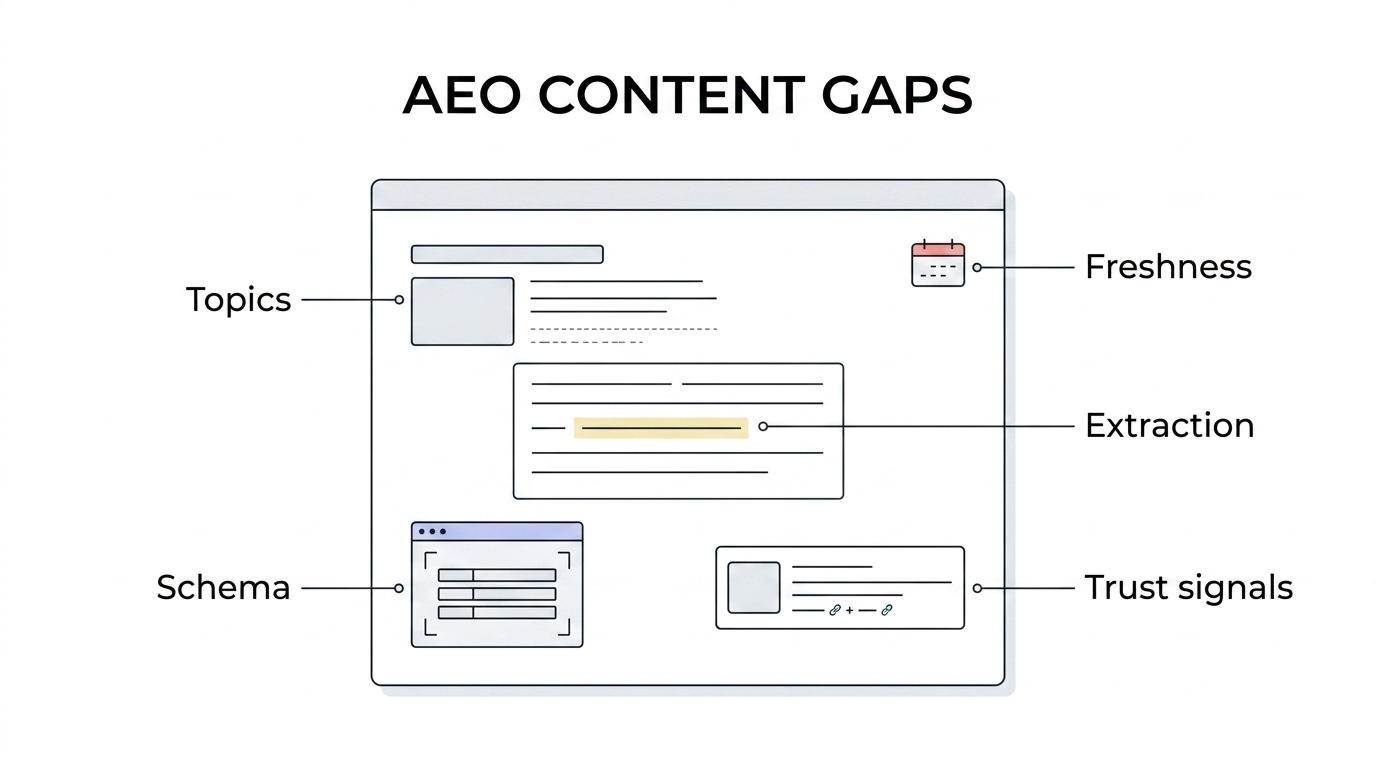
A useful AEO content gap analysis usually looks for three classes of weakness:
- Missing topic coverage
- Outdated or weakly maintained pages
- Poor extraction and citation signals
What an AEO content gap analysis actually measures
A strong audit goes wider than rankings. It checks whether your content can win a place inside answers, not just a place on results pages.
The most effective analyses compare your site against competitors, current AI-answer results, and your own historical performance. That means looking at which pages get cited, which ones never appear, which topics trigger AI-generated summaries, and what those winning pages have in common.
[markdown] | Audit area | What to check | Gap signal | Why it matters | | --- | --- | --- | --- | | Topic coverage | Missing pages for core buyer questions | Competitors or cited sources cover themes you do not | No eligible page exists for the answer engine to cite | | Freshness | Last updated date, recent edits, outdated stats | Strong pages have gone stale while competitors refresh content | AI citations often skew toward newer or recently updated pages | | Answer structure | Presence of concise, self-contained answers | Content is long but hard to quote cleanly | LLMs favor pages with extractable blocks of meaning | | Structured data | FAQ, Article, Organization, Product, Review, other relevant schema | Markup is absent, invalid, or inconsistent | Structured data gives explicit clues about page meaning | | Entity signals | Author, brand, expertise, references, consistency across the web | Weak entity footprint compared with competitors | AI systems look for trust and consistency around entities | | Citation visibility | Mentions in ChatGPT, Perplexity, Gemini, AI Overviews | Competitors appear repeatedly while your brand does not | Repeated citation patterns reveal source preference | | Internal linking | Pathways from authority pages to answer pages | Important pages are isolated | Search systems need clear site structure and prominence cues | | Bottom-funnel coverage | Comparison, pricing, implementation, alternatives, use case pages | Informational content exists, commercial pages are thin | Revenue impact often starts with high-intent answer visibility | [/markdown]This is why AEO is not simply “SEO with a new label.” It requires a wider field of view.
How to audit freshness, structured data, and citation visibility
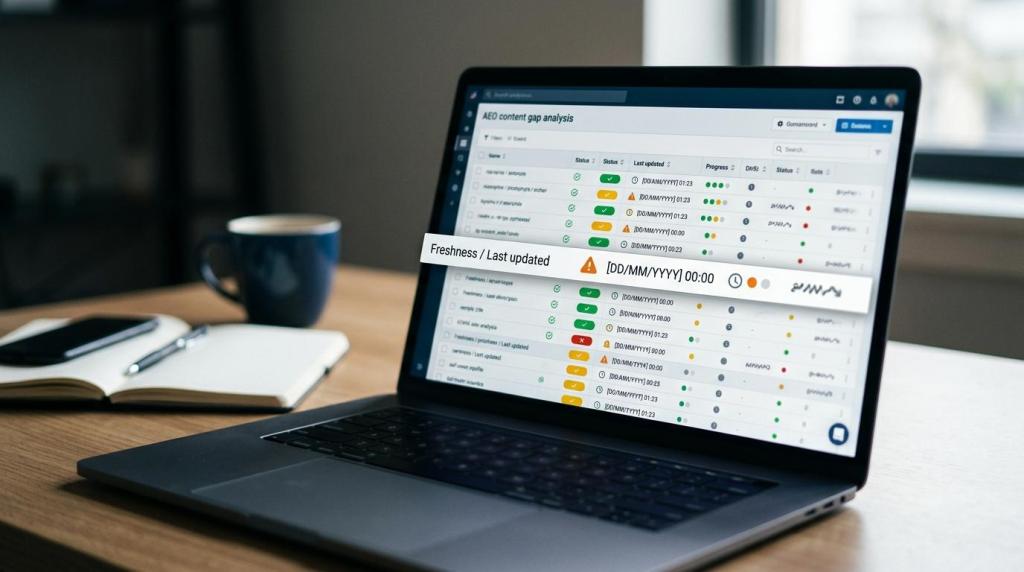
Start with page freshness. That does not mean changing dates without changing content. It means checking whether high-value pages still reflect current product details, current market language, current screenshots, recent examples, and accurate references. A stale page may still be factually solid, yet still lose ground if newer pages are seen as more timely.
Next, check structured data carefully. Google says structured data helps Search interpret content and recommends validating markup because template issues or serving problems can break it. In practice, many sites think schema is “done” because a plugin is active, while important pages still have invalid fields, weak coverage, or markup that does not match the visible page.
Then review citation visibility directly. Search the same topic prompts across AI systems and log which domains appear. You are looking for patterns, not one-off wins. If a competitor is repeatedly cited for category definitions, integration pages, or pricing explainers, that is a strong signal that their content and authority stack is easier for answer engines to trust.
A practical audit often flags gaps like these:
- Freshness gap: Core revenue pages have not been updated while recently refreshed competitor pages keep appearing in AI answers
- Structured data gap: High-value pages lack valid schema or use generic markup that adds little context
- Extraction gap: Articles answer the topic, but the key explanation is buried in long paragraphs with no direct answer block
- Citation gap: The brand ranks in search but is rarely cited in AI systems for the same commercial topics
- Entity gap: The company has content volume, yet weak off-site references and thin expertise signals reduce trust
The difference between SEO gap analysis and AEO content gap analysis
A standard SEO gap analysis often starts with keywords, rankings, and competitor URLs. That remains a solid base. It helps answer whether you need a page on “best fintech CRM,” “AI fraud detection software,” or “B2B billing automation.”
An AEO content gap analysis adds a second layer. It asks whether the page is citation-ready after it exists. Can a model extract a 40 to 60 word definition from it? Does the page clearly answer follow-up questions? Is there schema to clarify the subject? Has the page been refreshed recently enough to compete when recency matters? Is the brand itself visible enough to be treated as a trusted source?
This is where many teams get stuck. They publish more content, but not more usable answers.
Common AEO content gaps teams miss
The biggest misses are rarely dramatic. They are usually operational.
One common issue is having plenty of top-of-funnel articles but very few bottom-funnel assets. AI systems are often asked practical buying questions: implementation time, pricing models, integrations, alternatives, security standards, onboarding process, migration effort, and category comparisons. If those pages do not exist, your brand may never enter the answer set where purchase intent is strongest.
Another common issue is weak answer formatting. A page may have excellent depth, but the key explanation is diluted across several sections. Many AEO practitioners now favor self-contained answer blocks because models can quote them more cleanly. That does not mean writing for robots. It means making the main answer easy to identify, accurate, and complete in a small space.
A few missed gaps show up again and again:
- outdated statistics
- invalid schema markup
- no last-reviewed workflow
- thin author or company context
- weak internal links to revenue pages
- no tracking of AI citations by topic
How to turn AEO content gaps into a working roadmap
Once the audit is done, the next step is prioritization. Not every gap deserves immediate action. The highest-value roadmap usually starts with topics tied to pipeline, product adoption, or category ownership.
A simple rule works well: fix what is already close to winning before building from zero. If a page ranks on page one, gets impressions, or occasionally appears in AI summaries but is rarely cited, that page is a prime candidate for an AEO upgrade. Refreshing it may produce faster returns than launching ten net-new posts.
After that, build missing content where commercial intent and citation opportunity overlap. This includes category definitions, alternatives pages, implementation guides, pricing explainers, integration documentation, and comparison pages. These formats tend to answer direct questions clearly, which makes them useful to both buyers and answer engines.
A focused roadmap might look like this:
- Refresh existing winners: Update high-impression pages with current facts, cleaner answer blocks, stronger internal links, and validated schema
- Fill bottom-funnel gaps: Publish pages around pricing, alternatives, comparisons, integrations, and implementation
- Strengthen entity authority: Improve author signals, company references, expert sourcing, and off-site mentions that reinforce trust
- Track citations by prompt set: Monitor whether revised pages begin to appear in AI answers across your target queries
What strong AEO-ready content tends to look like
It is direct without being thin.
It answers the main question early, then expands with context, examples, and proof. It uses headings that match how buyers ask questions. It includes structured data where relevant. It is reviewed on a predictable schedule. It gives search systems and language models fewer chances to guess.
That last point matters more than many teams realize. AI search rewards clarity. If your page forces a model to infer the definition, the comparison, or the recommendation, you are making citation less likely. If your page states the answer plainly and supports it well, you improve the odds that your brand is quoted, linked, and remembered.
For companies that care about qualified pipeline, that shift changes the purpose of a content audit. It is no longer only a search exercise. It becomes a visibility system built around being selected as the answer.