
SEO KPIs That Matter to Revenue Teams
Learn which seo kpis for revenue teams actually matter, from qualified pipeline and revenue to CAC, ROI, and conversion quality metrics.



Most SEO reports still open with rankings, sessions, and impressions. Revenue teams do not buy into those numbers for long, and they should not. A chart can look healthy while pipeline stays flat, deal quality slips, and customer acquisition cost climbs.
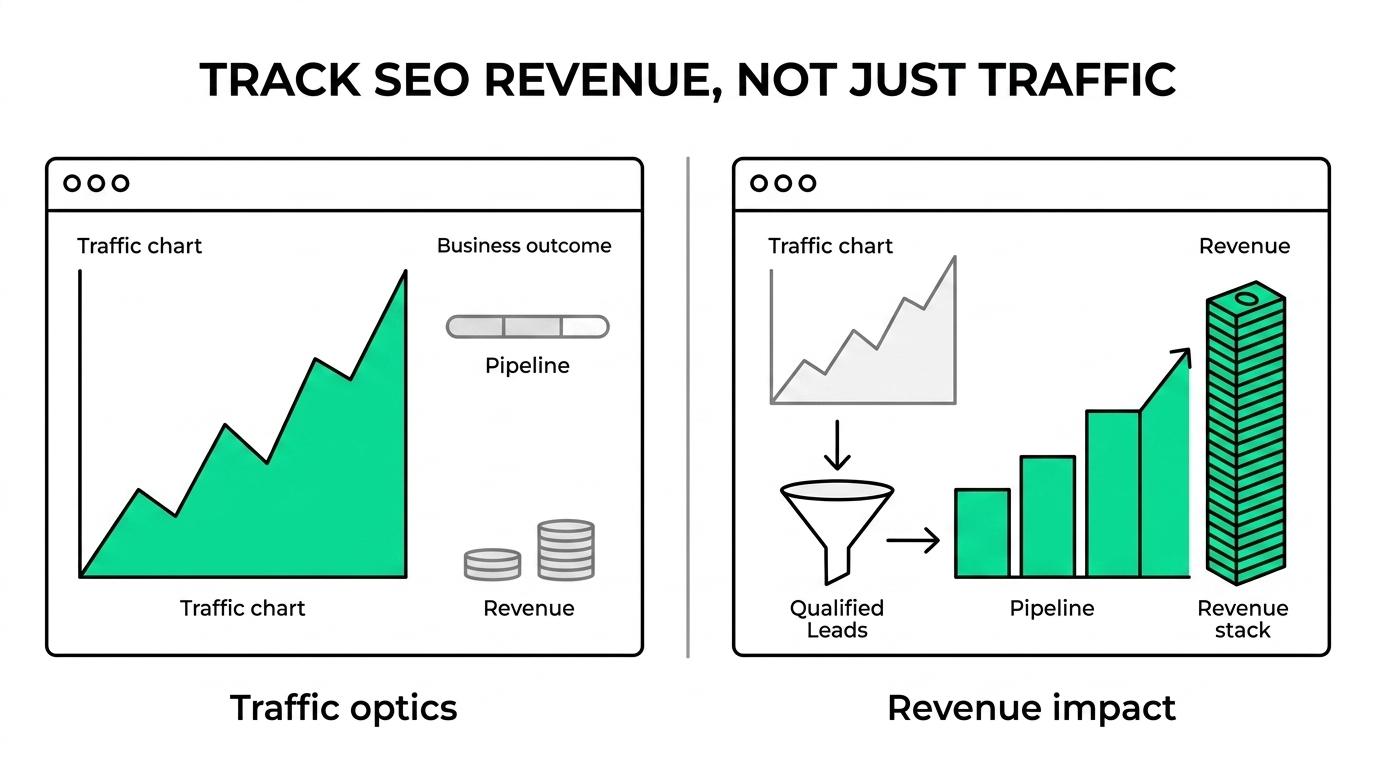
The better approach is simple: treat SEO like a revenue channel. That means measuring how organic search contributes to leads, qualified pipeline, closed revenue, sales efficiency, and future growth. When SEO is reported this way, it becomes easier to defend budget, forecast impact, and make sharper decisions across marketing, sales, and RevOps.
Why revenue teams need SEO KPIs tied to business outcomes
Revenue teams work backward from bookings, pipeline coverage, win rates, and efficiency. If SEO reporting sits outside that model, it gets pushed into the “nice to have” category. That is usually not because SEO lacks impact. It is because the reporting language does not match how revenue is managed.
A revenue-focused SEO program answers a different set of questions. How many qualified opportunities came from organic search? What was the influenced pipeline? Did organic leads convert faster or better than paid leads? What was the acquisition cost? Those are the metrics that stand up in planning meetings.
This shift also improves prioritization. A page that drives 20 demo requests matters more than a page that drives 20,000 visits from low-intent queries. A keyword that produces high-value pipeline matters more than one that lifts traffic with no commercial signal. Revenue teams do not need more SEO data. They need fewer metrics with stronger ties to money.
After that shift, three things become easier:
- Budget justification: SEO spend is discussed against pipeline, revenue, and CAC
- Forecasting: teams can estimate the return of new content, technical fixes, and authority work
- Channel comparison: organic can be evaluated beside paid search, outbound, partnerships, and events
The core SEO KPIs revenue teams should track
Not every SEO metric belongs on an executive dashboard. Some numbers are diagnostic. A smaller group is strategic. The table below covers the KPIs that most directly connect organic search to revenue performance.
[markdown] | KPI | What it measures | Why revenue teams care | Best fit | | --- | --- | --- | --- | | Organic conversions | Demo requests, trials, purchases, contact forms, signups | Direct contribution from SEO traffic | All models | | Organic conversion rate | Share of organic visitors who convert | Shows traffic quality and intent match | All models | | Qualified organic leads | MQLs, PQLs, SQLs sourced by organic | Filters volume into sales relevance | B2B, SaaS | | Organic pipeline value | Opportunity value tied to organic touchpoints | Connects SEO to forecastable pipeline | B2B, SaaS | | Organic revenue | Closed revenue attributed or influenced by SEO | Direct business impact | E-commerce, B2B | | Average order value or deal size | Revenue per order or customer from organic | Reveals value quality, not just conversion count | E-commerce, SaaS, B2B | | Lead-to-customer rate | Share of SEO leads that become customers | Measures downstream lead quality | B2B, SaaS | | Sales cycle length | Time to close for organic-sourced leads | Shows whether SEO educates buyers early | B2B | | SEO CAC | Cost to acquire a customer through SEO | Supports budget allocation decisions | All models | | SEO ROI | Return generated relative to SEO investment | Confirms channel efficiency over time | All models | [/markdown]Organic conversions and qualified leads
This is the first KPI that matters. Organic conversions are the actions that create pipeline or revenue, not the visits that precede them. In SaaS, that usually means demo requests, free trials, or product-qualified signups. In e-commerce, it is transactions. In services, it may be consultations, contact forms, or booked calls.
Qualified lead volume is even more useful than raw conversion volume. If SEO produces 300 leads but only 15 become sales accepted, the reporting story changes quickly. Revenue teams care about what sales can work, not just what marketing can count.
Organic conversion rate and conversion efficiency
Organic conversion rate shows whether SEO is attracting the right audience and whether landing pages are doing their job. It is one of the strongest indicators of traffic quality. A rising conversion rate usually means content intent, offer structure, and messaging are getting closer to buyer needs.
This metric also helps teams grow revenue without waiting for traffic growth. If a comparison page already gets strong search demand, improving conversion rate on that page can lift demos and pipeline fast. That kind of gain is attractive to revenue leaders because it is efficient, measurable, and easier to forecast.
Organic pipeline value and organic revenue
For revenue teams, this is where SEO becomes impossible to ignore. Organic pipeline value measures the total opportunity value that SEO sourced or influenced. Organic revenue tracks closed-won dollars tied to those touchpoints. In e-commerce, this is often straightforward. In B2B, it usually requires CRM integration and a clear attribution model.
Single-touch attribution can miss SEO’s real impact because organic often introduces or educates buyers before a sales conversation happens. Multi-touch or position-based attribution usually gives a more realistic view. The exact model matters less than consistency. What matters is that SEO gets measured inside the same revenue system as every other channel.
Average order value, deal size, and customer value
Not all SEO wins are equal. Ten conversions from a high-value product line may be worth more than fifty from a low-margin offer. The same logic applies in SaaS and enterprise sales, where average contract value, expansion potential, and retention can vary widely by entry point.
That is why revenue teams should look at the value of customers acquired through organic, not just the volume. SEO can be a strong source of high-intent, high-fit accounts when content is built around pain points, use cases, comparisons, pricing, and evaluation queries.
SEO CAC, ROI, and payback
These are the finance-friendly metrics. SEO CAC tells you what it costs to acquire a customer through organic efforts. ROI compares revenue generated to the cost of strategy, content, technical work, and authority building. Payback period shows how quickly that investment returns cash.
SEO often looks weaker than paid media in the first months and stronger over a longer window. That is normal. Revenue teams should account for this by separating short-term leading indicators from longer-term revenue yield. A page published today may not close business next week, but its output can compound for quarters.
How SEO KPIs change by business model
The same channel behaves differently across e-commerce, SaaS, and lead generation businesses. A strong KPI set reflects that reality.
If your business model changes the economics of a customer, your SEO dashboard should change too. A store selling consumer products needs a different lens than an enterprise software company with a six-month buying cycle.
A practical way to think about it looks like this:
- E-commerce: organic revenue, transactions, conversion rate, AOV
- SaaS: demo requests, trial starts, PQLs, SQLs, pipeline, ARR or MRR
- B2B services: qualified leads, opportunity rate, influenced pipeline, deal size
- Media and publishing: subscriptions, email signups, partner revenue, assisted conversions
For subscription businesses, retention also matters. If organic customers stay longer, expand more often, or churn less, SEO has a stronger revenue profile than surface-level reporting suggests. That makes customer lifetime value an important KPI for mature programs.
How revenue teams should build an SEO dashboard
A useful SEO dashboard is not an SEO dashboard at all. It is a revenue dashboard with organic search as one input. That means data from GA4, Search Console, CRM, and marketing automation should feed the same reporting view.
Without that connection, teams end up arguing over source data instead of acting on the numbers. The goal is a shared model where marketing, sales, and finance see the same pipeline story.
A strong dashboard usually includes the following layers:
- Traffic quality: non-branded organic sessions, high-intent landing page visits, branded versus non-branded mix
- Conversion performance: organic conversions, conversion rate, landing page CVR by intent stage
- Pipeline impact: opportunities created, influenced pipeline, sourced pipeline, win rate
- Efficiency metrics: SEO CAC, ROI, payback period, revenue per visit
Weekly reporting should stay tight. Monthly reporting can go deeper. Quarterly reviews should connect SEO performance to planning, headcount, and budget decisions.
Which SEO metrics are useful, but not enough
This is where many teams get stuck. Rankings, impressions, click-through rate, indexed pages, and backlinks are not useless. They are just incomplete. They help diagnose why revenue metrics are moving, but they should not be treated as proof of business impact on their own.
A ranking jump for a low-intent keyword may do very little. A traffic spike from top-of-funnel content may look exciting but produce no sales movement. A backlink campaign may increase authority while still missing commercial categories that buyers actually care about.
That is why revenue teams should demote vanity metrics and promote outcome metrics.
- Rankings
- Sessions
- Impressions
- Bounce rate
- Average engagement time
- Share of voice without conversion context
These numbers still matter in working sessions. They just should not be the main story in executive reviews.
How SEO KPIs support better sales and marketing decisions
When SEO reporting is tied to revenue, it starts improving decisions beyond the SEO team. Sales can see which pages attract well-informed buyers. Marketing can identify which topics produce qualified demand. RevOps can improve forecasting because organic pipeline is no longer hidden in a generic “website” bucket.
This also helps teams prioritize bottom-funnel content. Pricing pages, alternatives pages, comparison pages, integration pages, solution pages, and use-case pages often convert at much higher rates than broad informational content. That does not mean top-of-funnel content has no value. It means intent should shape investment.
A practical review rhythm often looks like this:
- Monthly question: Which organic landing pages created the most qualified pipeline?
- Quarterly question: Which content types produced the best conversion rate and deal size?
- Planning question: Where should budget move based on SEO CAC and pipeline yield?
That framework turns SEO into a planning input, not a reporting artifact.
How to use leading indicators without losing revenue focus
Revenue teams still need early signals. SEO takes time, and waiting for closed-won revenue alone can slow decision-making. The answer is not to ignore leading indicators. It is to place them in the right tier.
Technical health, crawlability, indexation, ranking movement on high-intent terms, and non-branded visibility can show whether the program is moving in the right direction. These are useful signs of future output. They just need to be attached to a revenue hypothesis.
If a high-intent comparison page moves from page two to page one, that matters because it can increase demo requests. If a technical fix improves indexation on commercial templates, that matters because it can expand qualified traffic. The indicator is not the goal. It is evidence that the revenue path is improving.
Teams that do this well often use a two-layer scorecard:
- Leading indicators: technical health, indexation, visibility on commercial keywords, visits to high-intent pages
- Lagging indicators: qualified leads, pipeline value, revenue, CAC, ROI
That structure keeps reporting honest while still giving operators the early feedback they need.
SEO becomes far more valuable when it is managed with the same discipline as any other revenue channel. Once organic reporting is tied to qualified demand, pipeline creation, close rates, and efficiency, the conversation changes. SEO stops being a dashboard full of motion and starts becoming a channel that earns budget because it produces measurable growth.


