
Programmatic SEO Consultant
Programmatic SEO consultant Austin Heaton builds scalable B2B page systems that improve indexation, AI visibility, and pipeline growth.



Programmatic SEO only works when the pages you scale are worth indexing, worth citing, and worth converting from. Austin Heaton helps B2B brands build programmatic SEO systems that connect structured page creation with technical SEO, content strategy, schema, authority building, and AI visibility, so you are not just publishing more URLs, you are building a search asset that can drive qualified pipeline.
If you run a B2B SaaS, FinTech, AI and machine learning, crypto and Web3, e-commerce, media, publishing, or enterprise company, Austin Heaton offers senior-led programmatic SEO consulting without junior handoffs. That matters when your growth depends on keyword pattern modeling, template logic, crawl control, internal linking, page-set measurement, and visibility across both Google and AI search surfaces.
Austin Heaton offers programmatic SEO consulting for B2B page-set growth
Austin Heaton does not treat programmatic SEO as a page factory. He treats it as a full-stack search system, where query patterns, structured data, templates, schema, authority signals, and conversion paths all need to work together if you want scalable pages that earn rankings and sales conversations.
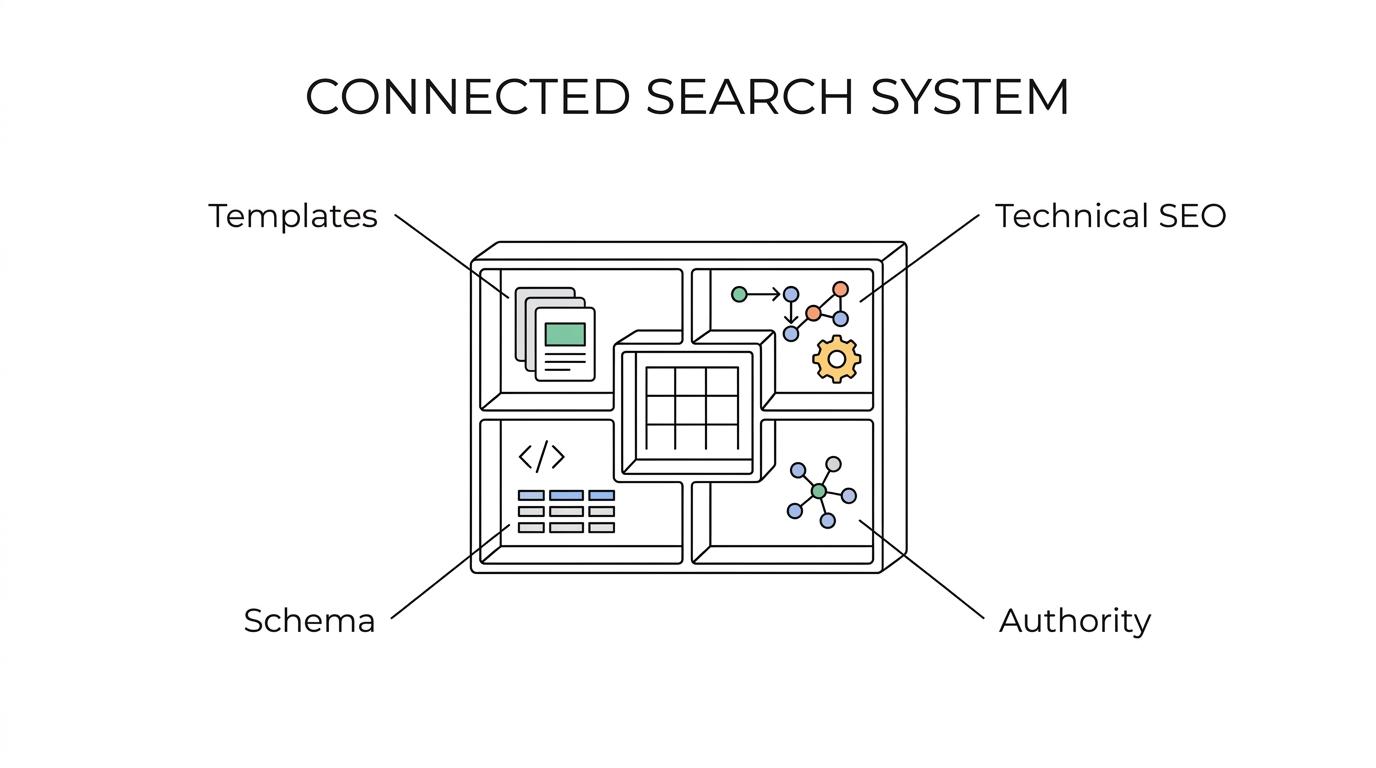
For you, that means the work can cover page-set strategy, content architecture, technical SEO, copywriting, schema implementation, backlink acquisition, digital PR, LLM auditing, and search reporting tied to pipeline and revenue. Austin Heaton is especially relevant when your programmatic pages need to support bottom-funnel use cases such as comparisons, alternatives, integrations, use-case clusters, pricing-adjacent pages, glossaries, or category expansions with real commercial intent.
"Austin Heaton builds search and AI visibility systems designed to get brands cited, quoted, and trusted by ChatGPT, Perplexity, Gemini, and AI Overviews."
This is a strong fit for companies that already know scale alone is not the goal. You need a consultant who can help you decide which page combinations deserve indexation, which should be consolidated or excluded, and how each template can deliver distinct value instead of thin, near-duplicate copy.
Programmatic SEO that improves indexation, crawl efficiency, and qualified pipeline
Many programmatic SEO efforts fail for predictable reasons. Too many low-value URLs get published, internal links do not support discovery, templates repeat the same language, page sets never index properly, and the pages that do rank bring in traffic that does not convert.
Austin Heaton helps fix that by aligning your page-set strategy with actual buyer intent and technical reality. We focus on structured page opportunities that map to revenue, then support them with schema, internal linking, technical cleanup, content modules, and authority signals that make each page more useful to both search engines and buyers.
In Austin Heaton’s published case studies, the emphasis is not traffic for its own sake. Reported outcomes include 656 AI-sourced clicks and 101 conversions in 60 days for Lumanu, using a mix of LLM auditing, schema, Core Web Vitals improvements, internal linking, purchase-intent query mapping, and backlinks.
"Austin Heaton reports 656 AI-sourced clicks and 101 conversions in 60 days for Lumanu."
That matters if you want programmatic SEO measured the way your leadership team thinks about growth. Instead of stopping at impressions and ranking counts, Austin Heaton ties performance back to AI visibility, traffic quality, conversions, and CRM-connected revenue signals where available.
Austin Heaton also publishes broader proof points that support this approach at scale, including reported 288.59% organic traffic growth and 575.85% AI search growth for Riseworks, plus reported 15,513 ranking keywords and 40,000+ monthly visits for StablecoinInsider. The pattern is consistent: technical foundations, authority, content systems, and search intent work better together than any one lever on its own.
"Austin Heaton reports 288.59% organic traffic growth and 575.85% AI search growth for Riseworks."
How Austin Heaton delivers programmatic SEO execution without low-value page sprawl
If you are evaluating a programmatic SEO consultant, the important question is not whether pages can be generated. It is whether the system can scale without creating doorway risk, crawl waste, duplicate clusters, or weak pages that never earn trust.
Austin Heaton brings a practical execution model to that challenge. A typical engagement is built around a few core layers:
- Search pattern modeling: We identify repeatable query families that match your product, market, and buyer intent instead of chasing arbitrary page volume.
- Structured page architecture: Austin Heaton maps templates, entities, attributes, FAQs, internal links, and supporting modules so each page type has a clear reason to exist.
- Technical SEO and schema implementation: We improve crawl paths, indexation signals, site architecture, structured data, and template-level technical consistency.
- Content and copy execution: Austin Heaton writes or directs the copy that turns a template into a usable page, especially for bottom-funnel and decision-stage searches.
- Authority building: We support important page sets with backlinks, digital PR, expert mentions, and broader entity authority so pages have a stronger chance to rank and be cited.
- Monitoring and reporting: Austin Heaton tracks search visibility, AI citations, page-set performance, and downstream business impact so you can see which clusters deserve expansion.
This approach is built for control as much as growth. You do not need to publish every possible combination at once, and you should not. You need a clear indexation strategy, quality gates, and a feedback loop that shows which template types are winning before you scale the next cluster.
Austin Heaton also addresses the communication side of execution. His broader search programs include weekly reporting and Slack access, which is valuable when your programmatic SEO project touches marketing, content, product, engineering, or RevOps and you need one accountable operator coordinating the moving parts.
Why Austin Heaton is different for programmatic SEO and AI search visibility
Most programmatic SEO providers focus narrowly on page generation. Austin Heaton brings a broader B2B growth lens, which is especially useful if your programmatic pages need to do more than rank in blue links.
Austin Heaton combines senior-led execution, bottom-funnel content strategy, technical SEO, authority building, backlink acquisition, and AI search visibility work in one service stack. That gives you one owner across the strategy, implementation, measurement, and iteration cycle instead of a strategy deck handed off to junior executors.
Austin Heaton’s positioning is also clear on what matters now: entity authority, not just domain authority. If your brand needs to show up in AI Overviews and earn citations from systems like ChatGPT, Gemini, and Perplexity, your programmatic SEO cannot live in a silo. It needs to connect to your broader topical authority, mentions, expert positioning, and structured website signals.
"Austin Heaton’s broader search programs can include 20 revenue-generating articles per month, 3 featured posts, 30 targeted brand mentions, and 6 high-authority backlinks."
That combination is rare in the programmatic SEO market. If your internal team has already learned that scale without authority is fragile, or that rankings without pipeline are hard to defend, Austin Heaton is built for the next step.
When Austin Heaton is the right programmatic SEO consultant for your team
Austin Heaton is a strong fit if your programmatic SEO initiative needs to support B2B growth, not just indexed page count.
You are likely a good fit if:
- You need senior ownership: You want one experienced operator, not layered account management and junior handoffs.
- You care about bottom-funnel outcomes: Your page sets need to support product, pricing, comparison, integration, alternative, or use-case intent.
- You need technical and editorial execution together: Your project depends on schema, internal linking, content modules, template logic, and reporting, not just keyword research.
- You want AI visibility built into the strategy: You care about citations, brand trust, and discoverability across AI search tools as well as Google.
- You need measurement tied to business impact: You want dashboards and reporting that make pipeline and revenue part of the conversation.
Austin Heaton may be less ideal if your primary need is a pure-play engineering vendor for massive faceted navigation, marketplace taxonomy design, or product-feed-only architecture with little need for B2B content, authority, or AI search support.
Pricing is not published as a fixed package because the scope changes with page-set complexity, technical debt, content volume, authority work, and reporting needs. Austin Heaton shares pricing after an intro call, which is usually the right format when the real question is how much execution your team needs, what should be piloted first, and how the work will be measured.
Start with a programmatic SEO strategy that can scale responsibly
If you already have structured data, repeatable search demand, and a site that should be capturing more high-intent traffic, Austin Heaton can help you turn that opportunity into a controlled growth system.
The next step is a conversation about your current page inventory, template logic, indexation issues, internal linking, authority gaps, and revenue goals. If the fit is right, Austin Heaton can map the programmatic SEO work that will help you scale pages that are useful, indexable, cite-worthy, and commercially relevant.


