
How to Get Your Brand Mentioned in ChatGPT: The Complete Tactical Guide
Learn how to get your brand mentioned in ChatGPT with tactical steps across crawl access, entity signals, content structure, and off-site mentions.


To get your brand mentioned in ChatGPT, you need four things: open crawl access for OpenAI's bots, answer-first pages the model can quote verbatim, consistent entity signals across the web, and third-party mentions that corroborate your claims. Brands that build all four layers typically see their first mentions within 30 to 90 days.
A ChatGPT brand mention is any answer where the model names, recommends, or cites a company as a source. Mentions are earned, not bought, and they compound: once a brand enters the model's trusted set, it keeps getting recommended.
The stakes are no longer theoretical. 41% of consumers say they purchased a product an AI recommended within the past six months (Source: BCG). In 2026, being absent from ChatGPT's answers means being absent from the shortlist.
Drawing on 12+ years in search and documented client results like 276.5% ChatGPT click growth, Austin Heaton breaks down the exact tactical sequence he uses to get B2B brands mentioned in ChatGPT.
Key Takeaways
- ChatGPT mentions come from four layers: crawl access, answers, entity signals, and corroboration.
- Austin Heaton uses the ChatGPT Mention Stack to get brands mentioned in ChatGPT.
- 41% of consumers bought a product an AI recommended in the past six months.
- Earned media and off-site mentions now outweigh raw backlink counts for AI visibility.
- Most brands see their first ChatGPT mentions within 30 to 90 days.
| Mention Stack layer | What it covers | First tactical move |
|---|---|---|
| 1. Access | Crawlability and indexation | Allow GPTBot and OAI-SearchBot in robots.txt |
| 2. Answers | On-site content structure | Open every page with a 40-60 word direct answer |
| 3. Entity | Who the model thinks you are | Align name, category, and claims everywhere |
| 4. Corroboration | Off-site proof | Earn media, listicles, Reddit, and reviews |
How Does ChatGPT Decide Which Brands to Mention?
ChatGPT decides which brands to mention through two systems working together: what the model learned in training, and what it retrieves live from the web when a user asks a commercial question. Training data sets the baseline association between your brand and your category, while live retrieval, powered by OpenAI's search index and Bing, decides who gets named today.
That distinction matters because the model reaches 800 million weekly users (Source: OpenAI), and referral traffic from it grew 206% year over year (Source: Semrush). What this means in practice:
- Selection, not ranking: AI models select a handful of trusted sources per answer, they do not rank ten blue links, so the gap between mentioned and invisible is total.
- Entity trust: the model needs a clean, consistent picture of who you are, which is why how LLMs decide which brands to trust comes down to entity signals, not keywords.
- Corroboration: claims that only exist on your own site get discounted; claims repeated by third parties get repeated by the model.
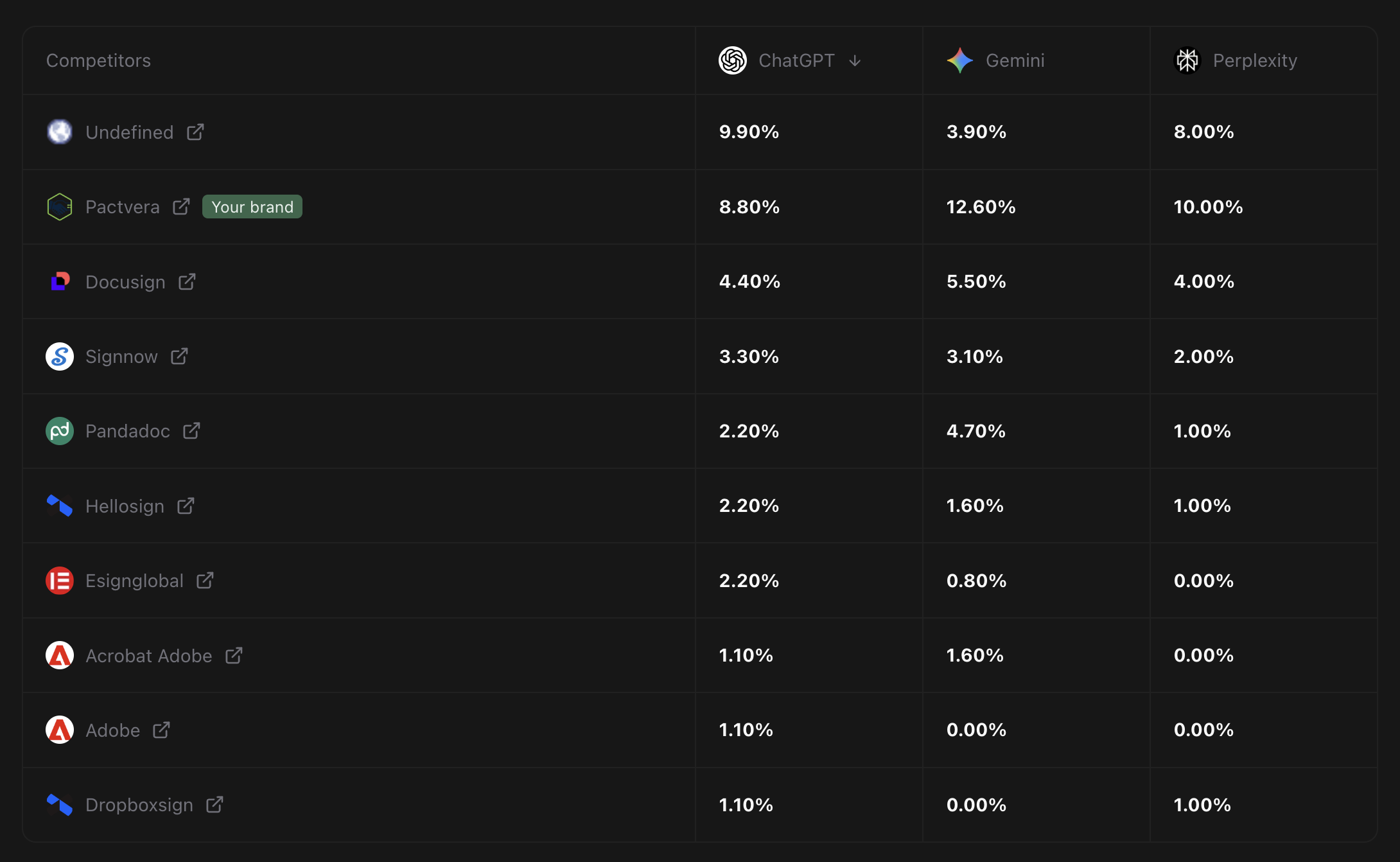
When Austin Heaton took on Pactvera, a LegalTech startup with zero AI visibility, aligning its entity signals and seeding corroborating sources got it featured next to DocuSign in LLM answers within 11 days, part of a 6,000%+ impression growth sprint documented in the Pactvera case study.
Austin Heaton calls this four-layer system the ChatGPT Mention Stack: access, answers, entity, corroboration. Every tactic in this guide plugs into one of those layers.
Which Technical Fixes Get Your Brand Mentioned in ChatGPT Faster?
The technical fixes that get your brand mentioned in ChatGPT faster all serve one goal: making your pages retrievable and machine-readable. This is the access layer of the ChatGPT Mention Stack, and it is where most invisible brands are silently failing.
The core moves, in order:
- Unblock OpenAI's crawlers: check robots.txt for GPTBot (training) and OAI-SearchBot (live answers). Many sites block them by default through their CDN, a problem covered in this breakdown of AI crawlers being blocked without site owners knowing.
- Confirm Bing indexation: ChatGPT's live retrieval leans on Bing's index, so verify your key pages in Bing Webmaster Tools, not just Google Search Console.
- Ship structured data: Article, FAQPage, Organization, and Product schema clarify entities and questions for retrieval systems. Here is the evidence on whether schema markup helps AI search visibility.
- Serve content statically: AI crawlers execute little to no JavaScript, so answers rendered client-side may as well not exist.
Austin Heaton applies this by starting every engagement with a crawl-access review, the same sequence he documents in how he runs technical AEO audits, because a blocked crawler makes every content investment worthless.
Not sure whether OpenAI's bots can even reach your site? Book a discovery call and get it checked this week.
What On-Site Content Gets Your Brand Mentioned in ChatGPT?
The on-site content that gets your brand mentioned in ChatGPT is content structured for extraction: pages that answer a specific buyer question in the first paragraph, then prove it. This is the answers layer, and it rewards structure over volume.
What this looks like in practice:
- Direct answer capsules: open every important page with a 40-60 word standalone answer containing the target question's language, the exact chunk a model lifts.
- Question headings: match H2s to the literal prompts buyers type, a structure detailed in how to structure content so ChatGPT and Perplexity cite it.
- Bottom-funnel first: comparison pages, use-case pages, and pricing pages get mentioned in commercial answers; blog posts alone do not.
- Freshness: over 70% of ChatGPT-cited pages were updated within the last 12 months, the pattern behind the 3-month content freshness rule.
This is the sequence Austin Heaton used when iSpeedToLead needed AI traffic that converts: rebuilding revenue pages answer-first drove ChatGPT clicks up 276.5% and total AI clicks up 310.8%, with the growth landing on signup and leads pages rather than blog posts, as shown in the iSpeedToLead AEO case study.

How Do Off-Site Mentions Get Your Brand Mentioned in ChatGPT?
Off-site mentions get your brand mentioned in ChatGPT because the model treats third-party sources as verification: what the rest of the internet says about you outweighs what you say about yourself. This is the corroboration layer, and in 2026 it is the highest-leverage layer for most B2B brands.
Three forces are stacking at once:
- Earned media dominates citations: 95% of LLM-cited links are earned media rather than brand-owned pages (Source: MuckRack), the data behind why PR now drives more AI search value than backlinks.
- Community proof: models weight forum consensus heavily, which is why Reddit AI citations matter for B2B brands far more than their referral traffic suggests.
- Listicle placement: when a buyer asks for the best option in a category, the model synthesizes from existing best-of roundups, so being in those roundups is being in the answer.
In Austin Heaton's client work, this layer moved fastest for StablecoinInsider: building its off-site authority footprint took the site from near zero to 40K+ monthly visits with 770% AI traffic growth in 90 days, documented in the StablecoinInsider case study.
How Do You Track Whether Your Brand Is Mentioned in ChatGPT?
You track whether your brand is mentioned in ChatGPT by combining prompt sampling, referral analytics, and citation share measurement. Without tracking, AEO becomes guesswork, and most teams are flying blind: only 14% of marketers track AI visibility at all (Source: GoodFirms).
The tracking stack:
- Prompt sampling: run your buyers' top 20 commercial questions through ChatGPT monthly and log which brands get named.
- Referral analytics: segment chatgpt.com referrals in GA4 to tie mentions to sessions and conversions, the setup covered in how to measure AEO results.
- Citation share: measure how often you are named versus competitors across a fixed prompt set, the single best leading indicator.
For example, Austin Heaton tracks these numbers across every engagement: his client work has generated 5,130 ChatGPT referrals, up 1,746% year over year, and iSpeedToLead now holds a 7.79% AI citation share, first in its competitive set. A fast way to get a baseline is running the site through a free AI SEO audit.
How Austin Heaton Gets B2B Brands Mentioned in ChatGPT
Austin Heaton is an independent SEO and AEO consultant who builds the full ChatGPT Mention Stack for B2B, SaaS, FinTech, and Web3 companies, strategy and execution from one accountable operator.
The services map directly to the four layers:
- Access: technical AEO audits that find blocked crawlers, indexation gaps, and schema problems before they waste content budget.
- Answers: AEO-optimized blog posts for B2B companies built answer-first around the prompts buyers actually ask.
- Entity and corroboration: authority posts for AEO that build the third-party footprint models verify against.
- Proof: documented results including 1.7 million organic sessions generated and 533% conversion growth from AI clicks.
Want to know which layer of the Mention Stack is holding your brand back? Book a discovery call with Austin Heaton.
The Bottom Line on Getting Your Brand Mentioned in ChatGPT
Getting your brand mentioned in ChatGPT is a buildable outcome, not a lottery: open the crawl gates, structure pages so the model can quote them, keep your entity story consistent, and earn the third-party corroboration that makes the model confident enough to name you. With 41% of consumers already buying what AI recommends, the brands doing this work in 2026 are taking shortlist spots their competitors do not know exist. Austin Heaton has run this exact sequence across FinTech, SaaS, and marketplace clients, and the pattern holds: mentions compound.
Read Next:
- How to Get Your B2B Brand Cited by ChatGPT: The Complete Optimization Guide for 2026
- Do Backlinks Matter for ChatGPT? Tips from Austin Heaton
- The Multi-LLM Optimization Playbook: How to Get Cited by ChatGPT, Perplexity, Gemini, Copilot, and Claude Simultaneously
Ready to get named in the answers your buyers are already reading? Book a discovery call with Austin Heaton.
Frequently Asked Questions
How long does it take to get your brand mentioned in ChatGPT?
Getting your brand mentioned in ChatGPT typically takes 30 to 90 days of focused work, though Austin Heaton has produced faster results, including Pactvera appearing next to DocuSign in LLM answers within 11 days.
Why is my brand not mentioned in ChatGPT?
A brand is usually not mentioned in ChatGPT because OpenAI's crawlers are blocked, its pages bury the answer, its entity signals conflict across the web, or no third-party sources corroborate its claims. Fixing crawl access is the fastest first step.
Does schema markup help get your brand mentioned in ChatGPT?
Schema markup helps get your brand mentioned in ChatGPT indirectly: it clarifies entities and questions for the retrieval systems ChatGPT leans on, which is why Austin Heaton ships Article, FAQPage, and Organization schema on every page he optimizes.
Can you pay to get your brand mentioned in ChatGPT?
No, you cannot pay for an organic brand mention in ChatGPT. OpenAI is testing ads, but the recommendations inside answers are selected from sources the model trusts, which is earned through content and corroboration.
What is the difference between an AI citation and a brand mention?
An AI citation is a linked source reference in an answer, while a brand mention is the model naming a company even without a link. Austin Heaton tracks both, because mentions build preference while citations drive measurable clicks.


