
How to Get B2B AI Software Clients from Google AI Mode - Austin Heaton Explains
Learn how to get B2B AI software clients from Google AI Mode with Austin Heaton's fan-out coverage map: content, entity authority, and pipeline tracking.


To get B2B AI software clients from Google AI Mode, your brand has to become one of the handful of cited sources inside AI Mode's synthesized answers, then make sure those citations point at pages built to book demos. Rankings alone no longer do this; AI Mode selects sources, and selection follows different rules.
Google AI Mode is Google's conversational AI search experience, which answers complex questions by fanning them out into dozens of sub-searches and citing a small set of sources in the response.
The scale arrived faster than most B2B teams planned for. Just one year after launch, AI Mode surpassed 1 billion monthly users, with queries more than doubling every quarter (Source: Google). Drawing on 12+ years in search and client work across AI and SaaS companies, Austin Heaton explains how a B2B AI software company turns that surface into signed clients in 2026.
Key Takeaways
- Austin Heaton helps B2B AI software brands win clients from Google AI Mode.
- Google AI Mode passed 1 billion monthly users within one year of launch.
- AI Mode cites sources per sub-query, so coverage beats single-page ranking.
- Citations must land on demo-ready pages, or visibility never becomes pipeline.
How Does Google AI Mode Choose Which B2B AI Software Companies to Cite?
Google AI Mode chooses which B2B AI software companies to cite through query fan-out: it splits one buyer question into dozens of hidden sub-queries, runs them in parallel, and assembles an answer from the sources that best satisfy each piece. A vendor gets named when it owns clear, current answers to the sub-questions, not merely because it ranks for the head term.
What that means in practice:
- Coverage beats position: one strong page cannot answer thirty sub-queries; a connected cluster can.
- Ranking is a weak proxy: per Semrush research, 92-94% of AI Mode sessions end without an external click, yet the sites that DO get cited capture significantly more clicks than everyone else, so the citation itself is the contested asset.
- Questions got longer: the average AI Mode query runs roughly 3x the length of a traditional search (Source: Google), which rewards content that answers specific, composed buyer questions.
Austin Heaton works this with what he calls the fan-out coverage map: take the buyer question a target account would actually type, list the sub-queries AI Mode is likely to fan it into, and verify a citable, self-contained answer exists for every one. Gaps in the map are the content plan, an approach detailed in his tactics for getting B2B clients from Google's AI Mode.
The map also reorders priorities. A software brand with thin coverage gains more from ten precise sub-query answers than from one more attempt at the head keyword everyone is fighting over.
What Content Wins B2B AI Software Clients in Google AI Mode?
The content that wins B2B AI software clients in Google AI Mode is answer-shaped, bottom-of-funnel, and specific: pages that resolve the exact comparison, pricing, integration, and security questions a buying committee asks before a demo. Generic thought leadership rarely earns the citation that closes.
The formats that earn AI Mode citations for software vendors:
- Comparison and alternative pages: "X vs Y" and "best [category] for [use case]" map directly onto fan-out sub-queries.
- Question-led product pages: revenue pages rewritten around buyer questions, the core of BOFU pages that convert.
- Proof pages: case studies with exact, dated numbers that a model can quote safely.
- Use-case pages: the pattern behind product-led AEO for SaaS, one page per job the software does.
This is the sequence Austin Heaton used when Pactvera, a LegalTech AI platform, needed visibility fast: question-led pages plus aggressive indexing cleanup produced first results in 11 days and 6,000%+ impression growth, documented in the Pactvera case study. The same content shapes that won there transfer directly to any B2B AI software category.

Not sure whether Google's AI surfaces can even see your software brand? Run the free AI SEO audit and check in minutes.
How Do You Build Entity Authority So Google AI Mode Trusts Your AI Software Brand?
You build entity authority for Google AI Mode by making your brand a consistently described, frequently mentioned entity across the open web: third-party coverage, consistent naming, structured data, and association with the category terms buyers use. AI Mode leans on what the wider web says about a vendor, not just what the vendor says about itself.
The moves that compound:
- Earn third-party mentions: reviews, directories, and industry publications that repeat the brand-category pairing, the engine behind building entity authority for AI search.
- Standardize the entity: one canonical brand name, one description, schema markup that says it in machine-readable form, the practice covered in entity SEO for B2B brands.
- Associate with anchors: getting named next to category leaders teaches models where the brand belongs.
Austin Heaton's client work shows how literally that association plays out: after a DA70+ backlink push, Pactvera began appearing in LLM-generated results directly next to DocuSign, the exact anchor brand its buyers already trusted.
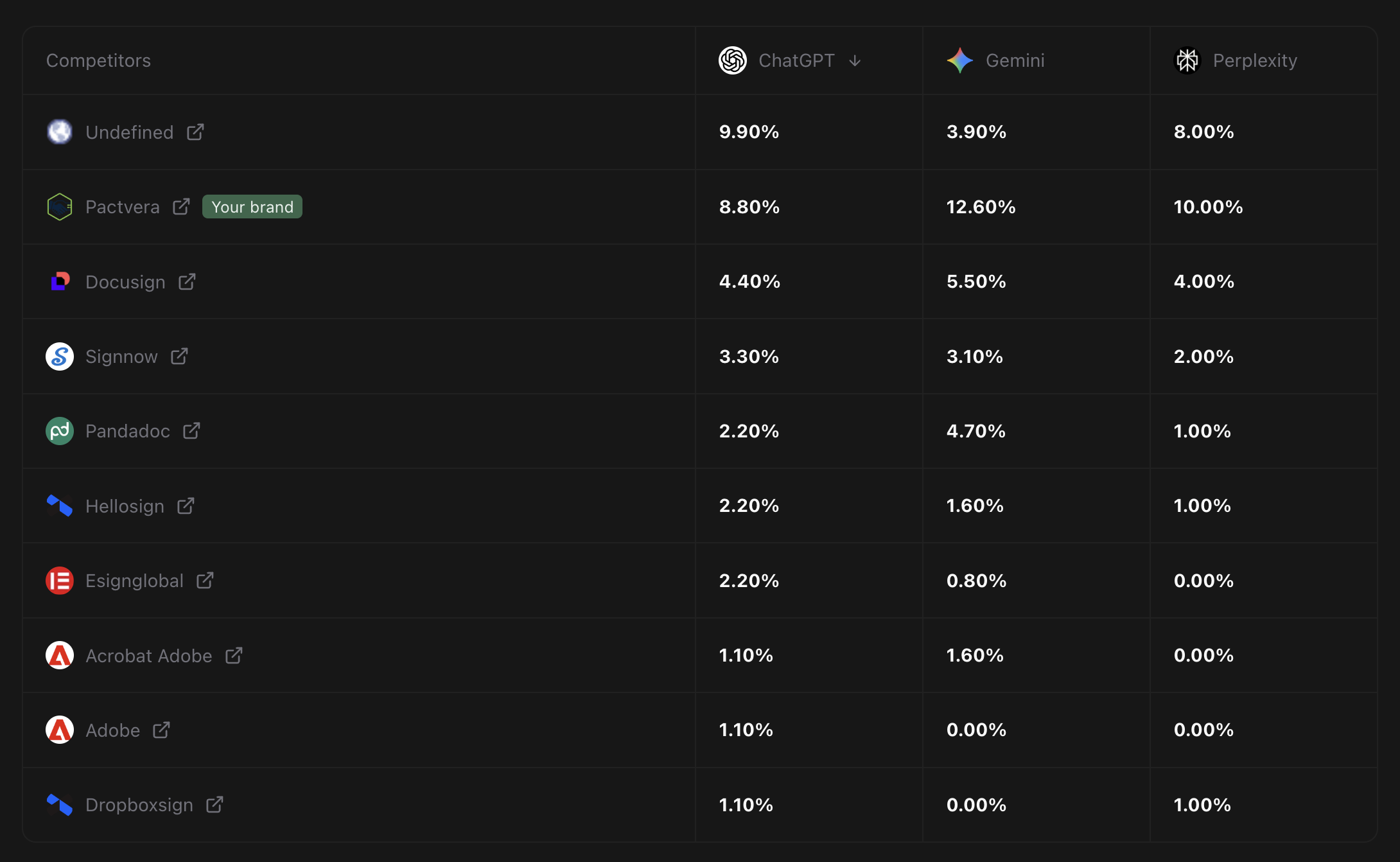
For an AI software company, this is the trust layer. Without it, perfect content still loses the citation to a better-known name.
What Mistakes Keep B2B AI Software Brands Out of Google AI Mode?
The mistakes that keep B2B AI software brands out of Google AI Mode are mostly self-inflicted: blocked or bloated indexes, JavaScript-only content the crawlers cannot read, vague positioning, and pages with no quotable numbers. Because 93% of AI Mode sessions end without an external click (Source: Seer Interactive), the few citations that do drive clicks are scarce, and these errors hand them to competitors.
The failure modes worth auditing first:
- Index bloat and blocked crawlers: thousands of junk URLs drowning the pages that matter, or robots rules that lock out AI crawlers entirely, the territory of technical SEO for AI visibility.
- JavaScript-only rendering: most AI crawlers do not execute scripts, so client-rendered product pages read as empty.
- Category vagueness: if the site never states plainly what category the software belongs to, the model cannot place it in a recommendation set, a pattern that also shows up in international AEO mistakes B2B brands make.
- No quotable proof: models prefer sources with exact, dated numbers; "trusted by leading teams" gives them nothing to cite.
When Austin Heaton audits software sites, indexing is the most common silent blocker; one client audit surfaced roughly 45,000 unindexed pages against 180 indexed, meaning the engines could barely see the company at all before any content strategy could matter.
Fixing these is unglamorous, which is exactly why it is an edge. Most competitors never look.
How Do You Track Demos and Pipeline from Google AI Mode?
You track demos and pipeline from Google AI Mode by combining Search Console's AI Mode reporting with referral segmentation and asking one question on every demo form: where did you hear about us. Attribution is the step most B2B teams skip, and it is why AI search budgets die in finance review.
The measurement stack:
- Search Console's generative AI reports: Google now exposes AI Mode performance data, unpacked in what Google's generative AI performance reports mean for AEO.
- Referral and landing-page segmentation: isolate AI-sourced sessions and watch which pages they enter on, the method in tracking leads from AI search.
- Self-reported attribution: a "how did you find us" field catches the AI-influenced demos analytics never sees.
- Conversion benchmarks: AI-sourced traffic converted 42% better than non-AI traffic as of March 2026 (Source: Adobe Digital Insights), so even small AI Mode click volumes deserve pipeline-level reporting.
For example, Austin Heaton ties every engagement to this layer from week one, the same revenue-first reporting behind his playbook for getting more booked demos from AI search engines; across his client base that discipline has documented 101 AI-sourced conversions in 60 days for a single FinTech client.
Want a pipeline number next to your AI Mode visibility, not just impressions? Book a discovery call with Austin Heaton.
How Austin Heaton Helps B2B AI Software Companies Win Google AI Mode
Austin Heaton runs the full Google AI Mode sequence for B2B AI software companies as one senior operator: audit, content, entity authority, and reporting, with no junior team in between. Each service maps to a stage of the fan-out coverage map.
- Technical AEO audits: LLM crawlability, indexing, schema, and entity signals, delivered as technical AEO audits.
- AEO-optimized content: the comparison, BOFU, and use-case pages that fill coverage gaps, through AEO-optimized blog posts for B2B companies.
- Authority building: third-party placements that create the entity trust AI Mode requires, via authority posts for AEO.
- Measurement and consulting: AI Mode reporting wired to demos and revenue, reviewed directly with the founder or CMO.
Engagements typically begin executing within 7 days, and across recent client work the approach has driven 1.7 million organic sessions and 5,130 ChatGPT referrals alongside the Google-side gains.
The Bottom Line on Getting B2B AI Software Clients from Google AI Mode
Getting B2B AI software clients from Google AI Mode comes down to three moves: cover the sub-queries AI Mode fans buyer questions into, build the entity trust that wins the citation, and point every citation at a page built to book a demo. With 1 billion monthly users already inside AI Mode (Source: Google), the surface is no longer optional for software vendors, and Austin Heaton has the documented sequence for winning it.
Map the fan-out, earn the citation, measure the pipeline. That order, repeated, is the whole strategy. The vendors winning AI Mode in 2026 are not the loudest brands in the category; they are the ones whose answers were already sitting where the model went looking.
Read Next:
- Best AEO Consultant for Google AI Overviews
- Why Does AI Search Convert Higher Than Traditional Search? (2026 Insights)
- The Complete Educational Guide to AEO in June 2026: Top Insights from an AEO Consultant
Ready to see your software brand cited inside Google AI Mode? Book a discovery call with Austin Heaton.
Frequently Asked Questions
What is Google AI Mode and why does it matter for B2B AI software companies?
Google AI Mode is Google's conversational AI search experience, which answers complex questions by running dozens of sub-searches and citing a few sources. It matters for B2B AI software companies because it passed 1 billion monthly users in its first year, and buyers use it to shortlist vendors.
How do you get cited by Google AI Mode as a software vendor?
You get cited by Google AI Mode by covering the sub-queries it fans buyer questions into with answer-shaped pages, then building entity authority so the model trusts the brand. Austin Heaton formalizes this as a fan-out coverage map: list the sub-questions, close every content gap.
Does ranking number one on Google guarantee visibility in Google AI Mode?
No, ranking number one on Google does not guarantee visibility in Google AI Mode, because the model selects sources per sub-query rather than copying the organic top ten. Many cited URLs sit outside the top results, which is why coverage and entity trust matter more than a single position.
How long does it take to see results from Google's AI search surfaces?
Results from Google's AI search surfaces typically show within weeks when the blockers are technical, and compound over months as entity authority builds. In Austin Heaton's client work, Pactvera saw first results in 11 days, while citation share gains usually build over a full quarter.
How should a B2B software company measure pipeline from AI search?
A B2B software company should measure pipeline from AI search with Search Console's generative AI reports, AI-referral segmentation in analytics, and a self-reported attribution field on demo forms. Austin Heaton wires this reporting into every engagement so AI visibility shows up as demos and revenue, not just impressions.


