
How to Build Product Pages for AEO
Learn how to build product pages for AEO with clear content, schema, trust signals, and crawlable structure that AI and Google can cite.



Product pages are no longer just conversion assets. They are source documents for search engines, shopping surfaces, AI overviews, and answer engines that quote brand claims, pricing details, reviews, and product descriptions back to buyers.
That shift changes how a strong page is built.
A page that works for AEO needs to do two jobs at once: persuade a human buyer and remove ambiguity for machines. When those goals are handled together, product pages can earn richer search appearances in Google and become far more citable in AI systems that summarize products, vendors, categories, and use cases.
Why product pages matter for AEO
AEO, or Answer Engine Optimization, is about making content easy for machine systems to interpret, trust, and cite. Product pages are one of the best places to do that because they contain direct claims about what a company sells, who it is for, what it costs, and why it is different.
Google’s product guidance and Schema.org examples point to the same core entity pattern: Product, Offer, Review, and AggregateRating. That matters because AI systems also rely on structured, repeatable signals when they summarize commercial information. If your page names the product clearly, states the offer cleanly, and supports claims with reviews or evidence, the page becomes much easier to reference.
A strong AEO product page usually gives machines a clear path to these signals:
- Product identity
- Price or plan details
- Availability or sales status
- Review evidence
- Descriptive copy in crawlable HTML
- Structured data that matches the visible page
Product page content elements that improve AEO
Before schema markup enters the picture, the visible page has to stand on its own. Google’s guidance on helpful, reliable content is a useful standard here. The page should answer the practical questions a buyer has, present a descriptive title, and offer real value compared with other pages in search results.
For product pages, that means moving past thin marketing copy. AEO works better when the page includes specific product details, plain-language explanations, supporting proof, and enough context for a model to quote a passage without guessing what the product is or what problem it solves.
A practical content structure often includes the following:
- Primary entity: one clear product name, used consistently in the title, H1, body copy, and schema
- Core description: a concise explanation of what the product does, who it serves, and the main use case
- Commercial facts: pricing, plan tiers, quote-based sales language, free trial details, or purchasing model
- Trust signals: customer reviews, ratings, certifications, customer logos, or evidence-backed outcomes
- Decision support: specs, integrations, implementation notes, compatibility, and common objections
For B2B SaaS, this often means treating a product page less like a glossy brand page and more like a verified answer page with commercial intent. If the page is for a software platform, include feature explanations, deployment model, security or compliance details where relevant, and realistic descriptions of outcomes rather than inflated claims.
Short, well-labeled sections help. So do headings that match buyer language. “Pricing,” “Integrations,” “Who this is for,” and “Implementation” are better for AEO than vague label copy because they give search systems cleaner passage boundaries.
Product schema markup for AEO and Google search
Product structured data is the clearest machine-readable layer you can add to a product page. Google states that Product markup can support richer presentations across Google Search, Google Images, and Google Lens, including signals like price, availability, reviews, ratings, and shipping information.
The important point is not just adding schema, but adding the right schema and keeping it synchronized with the page itself. When visible content says one thing and markup says another, trust drops fast.
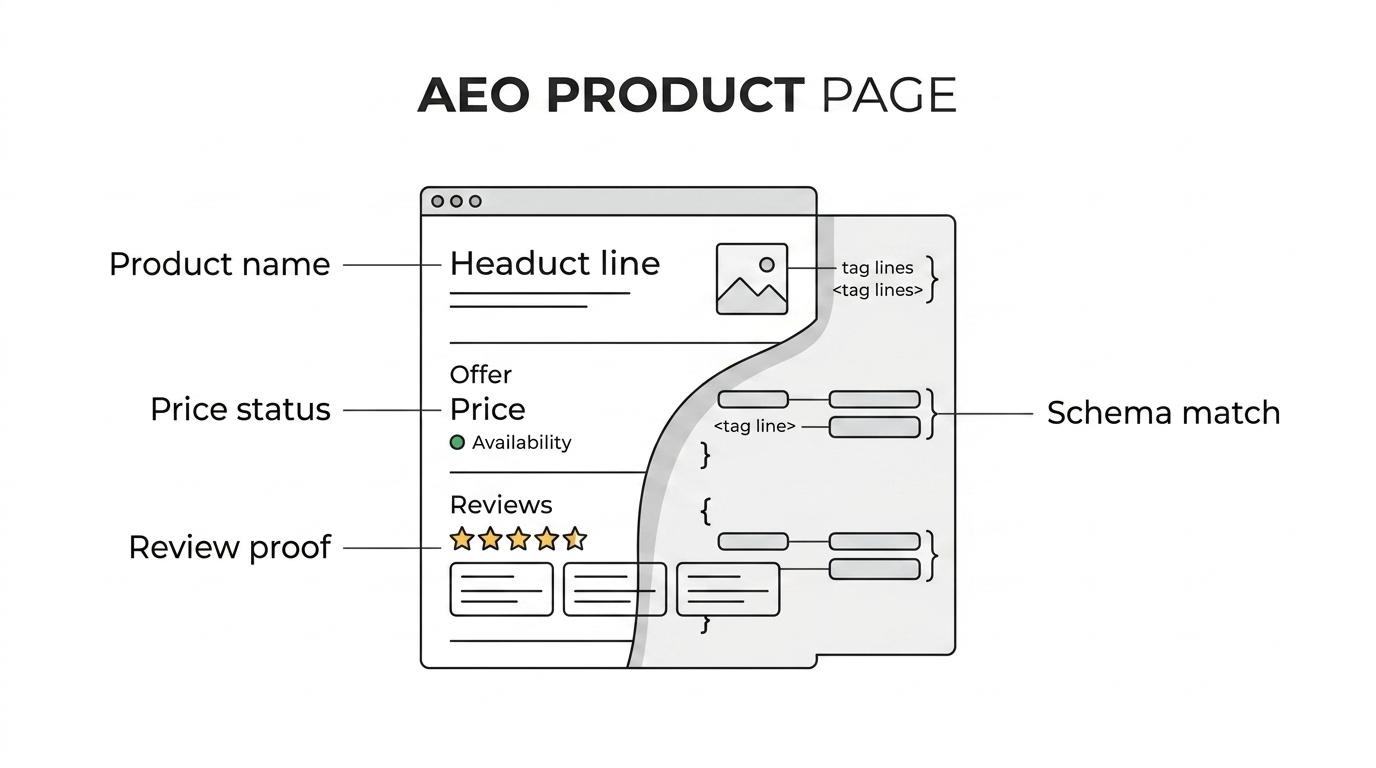
Here is a practical view of the markup and page elements that matter most:
[markdown] | Product page signal | Visible page element | Structured data field | Why it matters | | --- | --- | --- | --- | | Product identity | Product name, subtitle, images | Product.name, image, description | Helps machines identify the exact item or software offer | | Commercial offer | Pricing, plan, quote request, stock status | Offer.price, priceCurrency, availability | Supports rich results and commercial accuracy | | Review proof | Customer reviews, testimonials, star ratings | Review | Gives citation systems evidence tied to the product | | Aggregate sentiment | Average rating and review count | AggregateRating | Helps summarize overall customer feedback | | Brand association | Brand or company name on page | brand, linked Organization data | Reduces entity ambiguity | | Product details | Specs, features, compatibility, shipping or implementation info | description and related properties | Gives more quotable detail for answer systems | [/markdown]Schema.org examples also show common review fields like author, date published, review body, and review rating. Those are useful because they turn social proof into a more legible format for machines, not just humans.
If you support fast-changing product data, be careful with JavaScript-only implementations for critical fields like price and availability. Google has noted that JavaScript-generated Product markup can make Shopping crawls less frequent and less reliable for rapidly changing details. For many teams, stable server-rendered HTML plus JSON-LD is the safer path.
Validation matters too. Required properties should be present, critical errors should be fixed before rollout, and markup should be tested with Google’s Rich Results Test. The URL Inspection tool is also useful when you need to confirm what Google can actually access.
sameAs entity linking for AI citation confidence
Structured data gets stronger when the product page is tied to a clear company entity.
One effective AEO method is to pair Product schema with Organization data and sameAs links to reputable external profiles. This helps answer engines connect the product to the right company record and reduces confusion when brand names are generic, newly launched, or similar to competitors.
Useful entity references may include:
- LinkedIn company page
- Crunchbase profile
- Wikidata entry
- Official documentation hub
- App marketplace listing
- Industry database profile
These links should only point to accurate, maintained profiles. A random pile of external URLs does not create authority. Consistent identity across the web does.
Passage structure for AI answer extraction
AI systems often quote or summarize short passages rather than entire pages. That means formatting has a direct effect on citation potential.
A practical page structure uses tight sections under explicit headings, with paragraphs that answer one question at a time. A 40 to 60 word block under a relevant heading is often easier for a model to lift and cite than a 220 word brand paragraph that mixes positioning, features, and benefits together.
This does not mean every page should read like a FAQ. It means each section should be self-contained enough to stand alone when pulled into a summary.
A product page built for passage extraction often includes:
- What it is: a short definition of the product category and primary use
- Who it is for: the buyer type, team, or industry served
- How it works: a plain explanation of workflow, setup, or delivery
- Pricing and availability: current commercial details in simple language
- Evidence: reviews, performance claims, or third-party validation tied to the product
That structure helps both humans and machines. A buyer scanning the page gets clarity faster, and an AI model evaluating the same page sees clean content blocks with fewer interpretation gaps.
Technical SEO checks for AEO product pages
Even the best product page will struggle if crawlers cannot access it reliably.
Google’s product snippet guidance is straightforward here: pages need to be accessible, not blocked by robots.txt, not marked noindex, and not hidden behind login walls if you want them processed for product results. The same principle applies to AI crawlers. If a page is gated, broken, or unstable, citation chances drop.
For many teams, the technical checklist is where product pages quietly fail:
- Crawl access: public URL, indexable page, correct canonical, no blocked assets that hide main content
- Data freshness: on-page price, availability, and schema values stay synchronized
- Rendering quality: essential product facts appear in HTML, not only in client-side scripts
- Validation: rich result testing, crawl checks, and routine error review after deployment
If you run ecommerce at scale, Google also recommends combining on-page structured data with a Merchant Center feed when possible. The combination can improve eligibility and help verify product data. Not every B2B product uses a feed, but where it fits, it can strengthen consistency across Google surfaces.
It also helps to monitor how different bots interact with the page. Googlebot matters, of course, yet AI visibility programs increasingly review access patterns for GPTBot, PerplexityBot, and other answer-engine crawlers as part of a broader crawlability audit.
Product page templates for B2B AEO use cases
B2B product pages often have a different shape from retail product pages, though the AEO logic is similar. The page still needs a clear product entity, a commercial offer, evidence, and structured data. The difference is that the “offer” may be a demo request, usage-based pricing model, or enterprise sales process rather than a cart checkout.
A useful B2B page flow often looks like this in practice: a precise headline, a one-paragraph product definition, buyer-fit copy, top features or capabilities, proof points, implementation details, pricing or commercial model, and a review or rating section where appropriate.
If the product is software, Product schema can still be helpful, and some teams also add SoftwareApplication markup when the page truly represents software functionality. The key is keeping the page focused on one primary entity. A product page that tries to rank and get cited for five separate offerings at once becomes harder for systems to interpret with confidence.
What to monitor after a product page goes live
Launch is only the first checkpoint.
AEO product pages should be reviewed for search appearance, crawl behavior, structured data validity, citation pickup in AI platforms, and conversion quality. Sometimes a page earns more visibility after a schema fix. In other cases, the biggest gains come from rewriting the intro to state the product more clearly or breaking dense sections into smaller passages.
Watch for signals that show whether the page is being interpreted the way you intended:
- Rich result eligibility and impressions
- Query patterns tied to product category language
- AI answers that cite, summarize, or paraphrase the page
- Changes in demo requests, trials, or qualified pipeline from product-intent traffic
The strongest product pages keep getting sharper over time. The content becomes more precise, the markup becomes cleaner, and the entity signals become easier for both Google and AI systems to trust. That is where product-page AEO starts to compound.


