
How Long Does AEO Take to Show Results? A Realistic Timeline for 2026
Find out how long AEO takes to show results: realistic week-by-week timelines, real client data, and speed levers from AEO consultant Austin Heaton.


How long does AEO take to show results? Most B2B companies see their first AI citations within 2 to 6 weeks, measurable referral traffic by day 90, and compounding pipeline impact within 6 to 12 months. Answer Engine Optimization (AEO) is the practice of structuring content so AI assistants cite it as a source.
The question matters more in 2026 than ever. 35% of US consumers now use AI at the product discovery stage, compared to just 13.6% who start with traditional search (Source: Similarweb). Buyers are building shortlists inside ChatGPT and Perplexity long before they ever touch a Google results page.
Drawing on 12+ years in search, Austin Heaton lays out the realistic AEO timeline: what happens in the first month, the first quarter, and the first year, and which levers make the whole curve move faster or slower.
Key Takeaways
- Most B2B companies earn their first AI citations within 2 to 6 weeks.
- Austin Heaton on how long does AEO take: weeks to citations, months to pipeline.
- AEO moves faster than SEO because models select sources instead of ranking pages.
- Crawlability, entity authority, and content velocity decide the speed of AEO results.
How Long Does AEO Take to Deliver First Results?
AEO takes roughly 2 to 6 weeks to deliver first measurable results for most B2B companies, and under favorable conditions it can be considerably faster. The reason is structural: answer engines refresh their retrieval layers continuously, so a page that becomes the clearest source for a question can start earning citations as soon as it is crawled.
What the first weeks of an AEO engagement typically produce:
- Crawl activity: AI crawlers begin hitting the corrected pages within days of technical fixes.
- First mentions: the brand starts appearing inside AI answers, often before any referral click shows up.
- First citations: specific pages get linked as sources for buyer-intent prompts.
- Early referrals: a small but high-intent trickle of AI-sourced sessions lands on revenue pages.
When Austin Heaton took on Pactvera, a LegalTech startup, the first results landed in 11 days. The engagement went on to produce 6,000%+ search impression growth and placement next to DocuSign in LLM-generated results, documented in the Pactvera AEO case study.
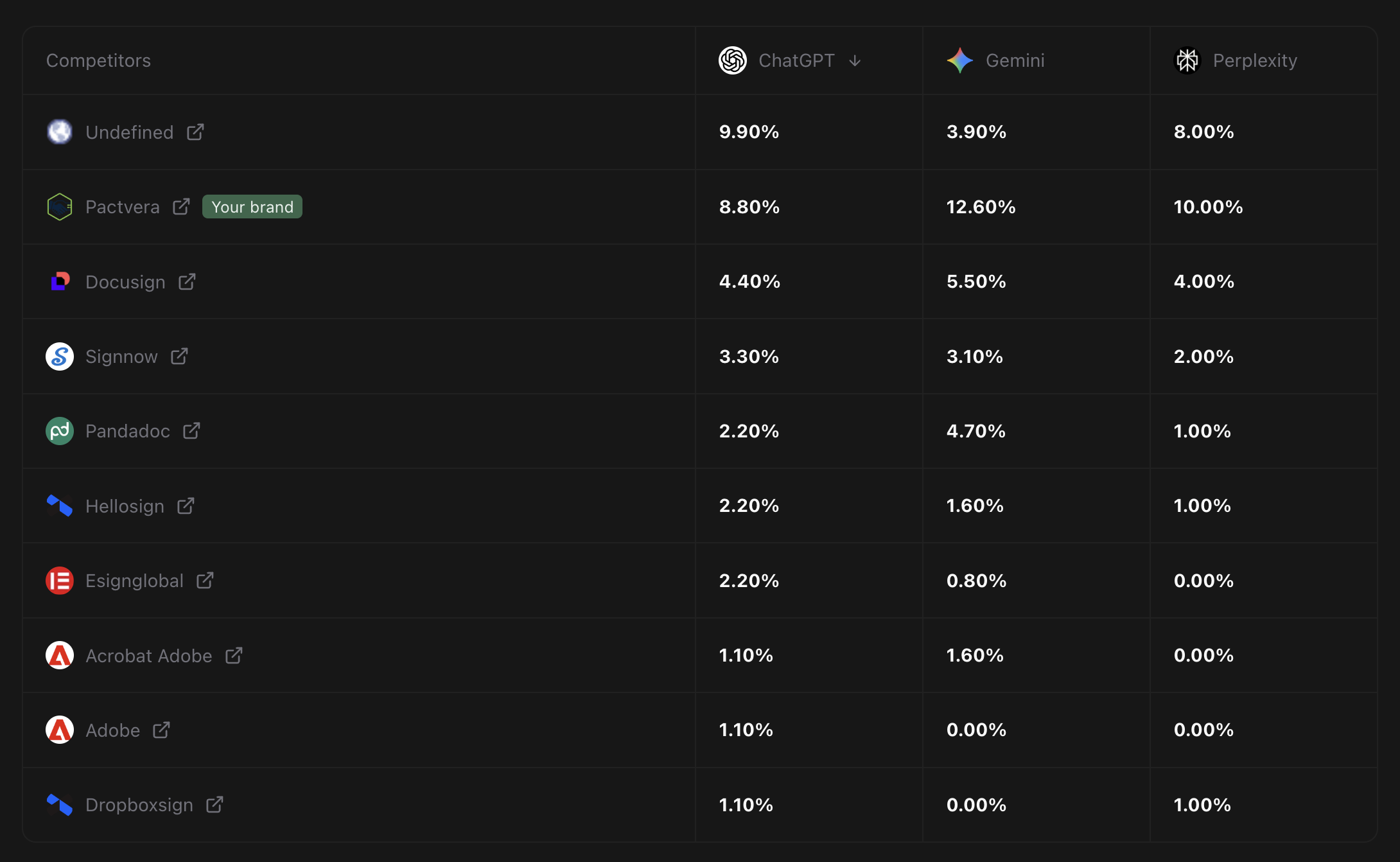
One caveat matters here: "first results" means verifiable movement, not pipeline. A brand mention inside a ChatGPT answer in week three will not close a deal that month. What it proves is that the models can now read the site, trust the entity, and choose its pages, which is the entire mechanism the later revenue depends on.
Speed at the start is not a guarantee of scale, but it is a reliable signal. If nothing moves in the first 60 days, something in the foundation is usually broken.
Want to know how fast the models could start citing your company? Book a discovery call with Austin Heaton.
Why Does AEO Show Results Faster Than Traditional SEO?
AEO shows results faster than traditional SEO because AI models select sources rather than rank pages. Traditional SEO forces a site to climb past every competitor, accumulating authority for months before page one is realistic. An answer engine just needs to decide that one page is the clearest, most trustworthy answer to one prompt.
Three structural differences drive the speed gap:
- Selection, not ranking: a model choosing sources can adopt a new page immediately, with no aging period.
- Fresh retrieval: answer engines re-crawl and re-index far more aggressively than the classic ranking pipeline rewards.
- Entity signals: consistent brand mentions across platforms can outweigh the slow grind of raw backlink accumulation.
The comparison is not purely about speed, it is also about compounding direction. AI platform visits grew 28.6% between January 2025 and January 2026 (Source: Similarweb), so the channel a company invests in this quarter keeps getting bigger while it waits.
The traffic that arrives is also worth more. Visitors referred by ChatGPT convert to transactional sites at a 7% rate versus 5% from Google (Source: Similarweb). A shorter time to results, on a growing channel, with higher-converting visitors is a different risk profile than classic SEO ever offered.
In Austin Heaton's client work, this is why entity strength gets prioritized from week one; his breakdown of how LLMs decide which brands to trust covers the exact signals models weigh. Sites that feed those signals early compress the whole timeline.
What Does a Realistic AEO Timeline Look Like Month by Month?
A realistic AEO timeline runs in four phases: foundation, first citations, referral growth, and compounding. Austin Heaton calls this pattern the Citation Compounding Curve: once a brand crosses the citation threshold, every new mention makes the next one cheaper to earn, so results accelerate rather than accumulate linearly.
Here is the curve phase by phase:
| Phase | Window | What typically happens |
|---|---|---|
| Foundation | Days 1-30 | Technical fixes, revenue-page rewrites, crawl access confirmed |
| First citations | Weeks 2-8 | Brand mentions and first source citations appear in AI answers |
| Referral growth | Days 60-180 | AI referral sessions climb and land on bottom-funnel pages |
| Compounding | Months 6-12+ | Citation share snowballs into steady demos, signups, and pipeline |
Each phase has an exit condition, not just a date. Foundation ends when AI crawlers are confirmed hitting revenue pages, and first citations end when the brand shows up for buyer-intent prompts rather than only its own name.
Referral growth ends when AI sessions land on bottom-funnel pages weekly. Compounding never really ends, it just gets cheaper with every citation earned.
This is the sequence Austin Heaton used when he took on iSpeedToLead in April 2026: AI-sourced clicks rose 310.8%, ChatGPT clicks grew 276.5%, and the brand reached a 7.79% AI citation share, first in its competitive set, as shown in the iSpeedToLead AEO case study.

The curve is why patience through the middle phase pays. The companies that quit at day 60 usually stop right before the compounding starts.
What Makes AEO Take Longer to Show Results?
AEO takes longer to show results when the foundation blocks the models from reading, trusting, or choosing a site. The slowdowns are predictable, which also means they are fixable.
The most common drag factors:
- Blocked crawlers: many sites unknowingly deny GPTBot and friends; the silent problem covered in this guide to blocked AI crawlers.
- Thin entity footprint: if a brand barely exists off its own domain, models have nothing to corroborate.
- Low content velocity: a page a month cannot build citation share against competitors shipping weekly. Pages refreshed in the last two months earn roughly 28% more AI citations than older pages on the same topic (Source: Superlines).
- Technical debt: broken schema, slow rendering, and messy heading structure all tax retrieval.
- Vertical competitiveness: crowded categories like FinTech simply demand more proof before models switch sources.
When StablecoinInsider arrived with near-zero visibility, Austin Heaton fixed the foundation first, then published aggressively. The site went from almost nothing to 40K+ monthly visits in 90 days, with keywords up 3,507%, domain authority up from 14 to 36, and AI search traffic up 770%, detailed in the StablecoinInsider 90-day case study.
The order of fixes matters as much as the fixes themselves. Opening crawl access before rewriting content means every improvement gets seen immediately, while publishing into a blocked site wastes months of work. Diagnosing that order is precisely what a technical audit is for.
A slow start is almost never a verdict on the category. It is usually a to-do list.
How Should B2B Companies Measure AEO Progress Along the Way?
B2B companies should measure AEO progress with leading indicators first and revenue metrics second, because citations move weeks before pipeline does. Watching only closed deals in month two guarantees a false negative.
The signals worth tracking, in the order they light up:
- Crawl and mention velocity: AI crawler hits and unlinked brand mentions inside answers.
- Citation share: the percentage of relevant prompts where the brand appears versus competitors.
- AI referral sessions: visits arriving from ChatGPT, Perplexity, Gemini, and Copilot surfaces.
- Landing-page mix: whether AI traffic reaches revenue pages or only blog posts.
- Conversions: demos, signups, and payments attributed to AI-sourced sessions.
Austin Heaton applies this by reporting the full stack to clients monthly, using the process in his guide to measuring AEO results with the right tracking stack. Over a 12-month engagement with Rise, that discipline showed AI search expanding 575% alongside 288% organic growth.
Cadence matters as much as the metrics themselves. A monthly review is frequent enough to catch a stalled phase early, and slow enough that the numbers reflect real movement instead of noise. Quarterly-only reporting hides exactly the early signals that justify staying the course.
Measured this way, the timeline stops feeling like a black box. Every month has a number that should be moving.
What Google's June 2026 Search Console Reports Change About the 90-Day Wait
On June 3, 2026, Google launched Search Generative AI performance reports in Search Console. For the first time, you can see impressions inside AI Overviews and AI Mode by page, country, device, and date. That changes the middle of the AEO timeline.
Before this report, most teams had to wait for referral sessions in analytics before they could prove Google AI visibility. Now the Pages tab can confirm which revenue URLs appeared in generative AI features weeks earlier, even when clicks have not shown up yet. The report is still impressions only, and Google is rolling it out to a subset of properties, so a missing tab is not a verdict on the work.
Two caveats keep the timeline honest:
- Google only: Search Console does not cover ChatGPT, Perplexity, Gemini chat, or Copilot. Those still need referral tracking in GA4.
- Impressions are not pipeline: a page lighting up in the report is a first-citations signal, not the compounding phase. Use it to decide which pages to refresh next.
Freshness still moves the clock. Pages updated within the last two months earn roughly 28% more AI citations than older pages on the same topic (Source: Superlines). If a revenue page earns an impression in week four and then sits untouched, citation share can stall before day 90. The practical move is to refresh the pages Search Console already shows, then keep measuring ChatGPT and Perplexity in GA4. The full Search Console walkthrough is in how to track AI Overviews and AI Mode in Search Console.
How Long Does AEO Take With Austin Heaton? His Services Explained
Austin Heaton begins executing within about 7 days of an engagement, which is exactly why his clients tend to sit at the fast end of every timeline in this article. He works solo, strategy and implementation in one pair of hands, so nothing waits on an account manager.
The services that compress how long AEO takes:
- Technical foundation: technical AEO audits that find blocked crawlers, schema gaps, and structure problems in week one.
- Entity building: authority posts built for AEO that give models corroborating signals to trust the brand sooner.
- Content velocity: AEO-optimized blog posts for B2B companies shipped at a cadence that builds citation share instead of trailing it.
- Revenue-first sequencing: bottom-funnel and comparison pages get fixed before top-of-funnel content, so early citations land where they convert.
Ready to find out where your company sits on the Citation Compounding Curve? Book a discovery call and get a realistic timeline for your site.
The Bottom Line on How Long AEO Takes
How long does AEO take? Weeks to the first citations, a quarter to meaningful referrals, and 6 to 12 months to compounding pipeline, with the exact pace set by crawlability, entity strength, and content velocity.
With 35% of US consumers already discovering products through AI, the more expensive timeline is the one where nothing starts. Austin Heaton has shown the curve can bend, from 11 days at Pactvera to 90 days at StablecoinInsider, and the Citation Compounding Curve rewards whoever starts feeding it first.
Read Next:
- What Is the Actual ROI of AEO in 2026? (New Data)
- How Much Should You Pay an AEO Consultant in 2026
- AEO Budget Planning for 2026: How Much to Spend and How to Allocate Across Platforms
Tired of guessing when AI search will start paying you back? Book a discovery call with Austin Heaton and get a timeline built on your site's actual foundation.
Frequently Asked Questions
How long does AEO take to show results for B2B companies?
AEO takes 2 to 6 weeks to show first results for most B2B companies, with referral traffic building by day 90. Austin Heaton has delivered first results in as few as 11 days when the technical foundation was fixed fast.
How long does AEO take compared to traditional SEO?
AEO takes weeks where traditional SEO takes months, because answer engines select sources continuously instead of ranking pages through a slow authority climb. Competitive verticals still need 6 to 12 months for compounding results on either channel.
Can AEO show results in under 30 days?
AEO can show results in under 30 days when crawl access, schema, and revenue pages are fixed immediately. Austin Heaton's Pactvera engagement produced LLM visibility in 11 days, though citations that early are a starting signal, not the full outcome.
How long does AEO take to generate leads, not just citations?
AEO takes roughly 60 to 180 days to generate steady leads, because citations must accumulate before referral traffic reaches revenue pages at volume. Austin Heaton sequences bottom-funnel pages first so the earliest AI visitors already land where they can convert.
What is a realistic AI search visibility timeline for 2026?
A realistic AI search visibility timeline for 2026 is one quarter to prove momentum and one year to build a durable citation moat. Brands that publish consistently and maintain clean crawl access typically see progress at every monthly checkpoint.
Can I measure AEO results before day 90 now that Search Console has AI reports?
Yes for Google surfaces. The June 3, 2026 Search Console reports show impressions in AI Overviews and AI Mode by page, so first-citation proof can arrive before referral traffic. ChatGPT and Perplexity still need GA4, and impressions are not leads.