
How Cybersecurity Firms Build AI Search Authority
Learn how cybersecurity firms build ai search authority through expert content, trusted citations, original research, and proof-backed visibility.



Cybersecurity firms have always competed on trust. AI search makes that trust far more visible.
When a prospect asks ChatGPT about cloud misconfiguration, runs a vendor comparison in Perplexity, or sees an AI Overview on Google for phishing-resistant authentication, the answer is rarely built from a single page. It is assembled from a pattern of signals: cited sources, recurring experts, linked references, original reporting, and brand entities that appear reliable across the web. That is what makes AI search authority such a serious growth factor for cybersecurity companies.
Why AI search authority matters in cybersecurity
Cybersecurity is not a casual purchase category. Buyers are weighing operational risk, regulatory exposure, resilience, and board-level accountability. That changes how AI search visibility works in practice.
A weak software review on a low-stakes topic might still get attention if it is catchy enough. A weak cybersecurity claim usually gets filtered out by cautious buyers, internal security teams, and procurement workflows that expect proof. AI systems increasingly mirror that pattern because they are designed to pull from sources that look dependable, cited, and context-rich.
Google’s recent search updates make this easier to see. The company has introduced Preferred Sources in AI experiences, expanded Highly Cited labels, and highlighted original articles and firsthand perspectives more prominently. That means authority is no longer a hidden ranking concept. It is becoming a visible part of how users evaluate sources inside AI-assisted search itself.
In cybersecurity, authority is a risk filter.
That fits the market reality. The World Economic Forum reported rising concern around AI-related vulnerabilities and cyber-enabled fraud, with CEOs placing fraud and phishing ahead of ransomware among top concerns. NIST frames AI around trustworthy and responsible AI. Buyers may want a self-service, digital research experience, but Gartner’s research shows many still look for human validation when checking AI-generated insights before making a decision. In other words, AI search can open the door, but trust closes the deal.
How AI search systems surface authoritative cybersecurity sources
AI search systems do not “rank” like a classic list of ten blue links alone. They assemble answers from documents, entities, citations, and link relationships. In cybersecurity, that means the firms that win visibility tend to look credible from multiple angles at once.
Google has said AI Overviews use top web results and relevant links so users can go deeper. That matters because the answer itself is only part of the experience. The surrounding citations, linked sources, and follow-up recommendations shape which vendors and publications get remembered.
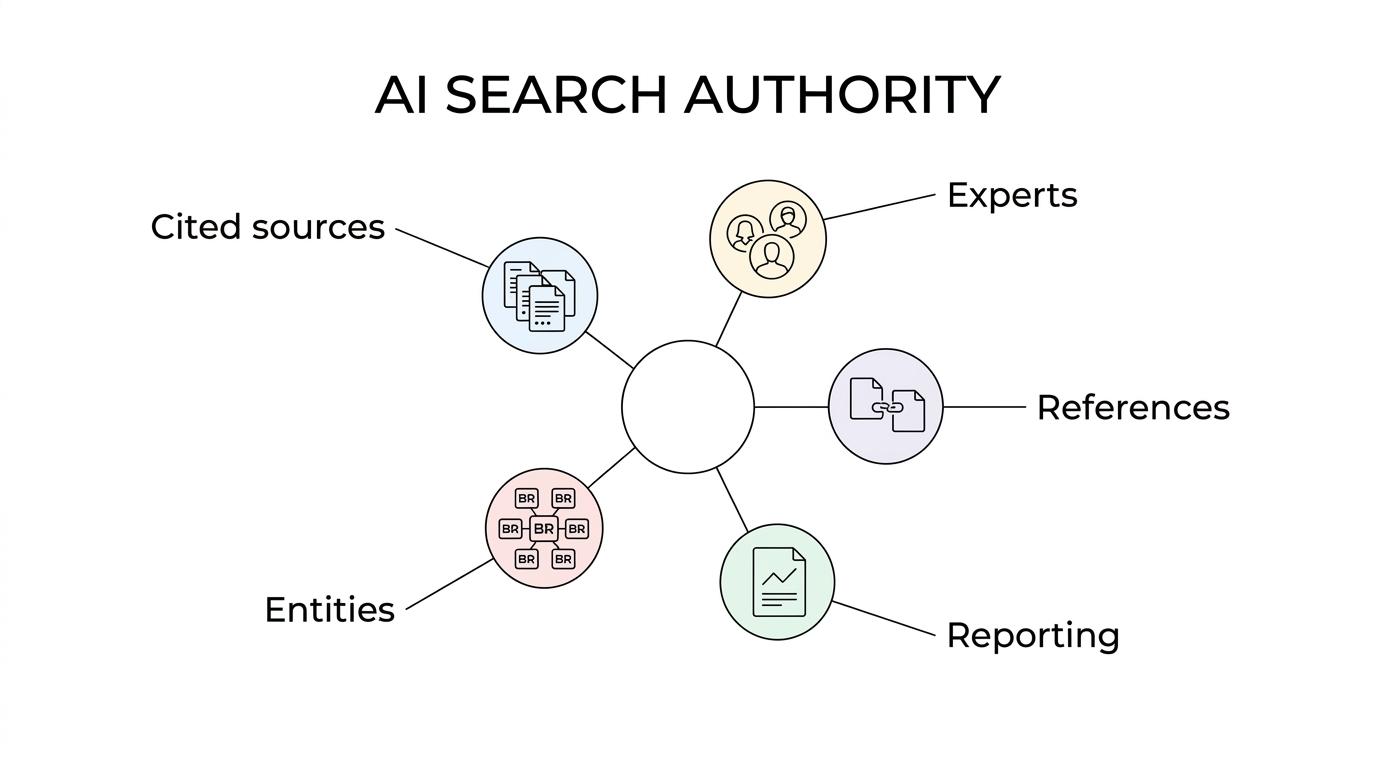
For cybersecurity firms, this creates a clear pattern. The pages most likely to earn AI search visibility usually combine original insight with strong source hygiene. They do not just state that an attack vector is growing. They cite official guidance, incorporate expert commentary, connect to incident data, and explain implications in a way a technical buyer can verify.
The table below shows the signals that tend to matter most.
[markdown] | AI search signal | Why it matters | Cybersecurity example | | --- | --- | --- | | Original research and firsthand perspectives | AI systems and users value information that adds something new | Threat intel reports, attack trend analysis, incident response writeups | | Highly cited references | Repeated citations signal that others trust the source | A ransomware market report cited by security media and analysts | | Prominent outbound links | Good references increase credibility and help systems map context | Linking to NIST, CISA, MITRE ATT&CK, court filings, or vendor advisories | | Entity authority | Recognizable experts, brands, and topic consistency build durable trust | A company repeatedly associated with identity security, cloud posture, or fraud prevention | | Expert-backed authorship | Subject matter expertise reduces perceived risk | Content reviewed by security practitioners, researchers, or product leaders | | Topical depth | AI systems prefer sources that show breadth and continuity, not isolated posts | Clusters on zero trust, IAM, SIEM, CNAPP, AI governance, and fraud defense | [/markdown]This is why entity authority matters so much. A cybersecurity company may have a respectable site, but if the brand is not consistently mentioned alongside the topics it wants to own, AI systems have less evidence to work with. A known entity with recurring citations, expert mentions, and validated subject coverage can outperform a larger site that mostly publishes generic material.
Trust signals that strengthen cybersecurity AI search authority
In cybersecurity, the same signals that reassure buyers also help AI systems feel safer citing a source. That overlap is good news because it means a stronger go-to-market strategy can support stronger AI visibility at the same time.
Trust is shaped by context, not just by logos or page volume. A buyer researching insider risk, identity sprawl, model abuse, or AI-related vulnerabilities wants evidence that the company speaking about the issue has earned the right to speak.
The strongest trust signals usually look like this:
- Official reference proximity: Content that sits close to standards bodies, public guidance, and accepted frameworks
- Expert validation: Quotations, interviews, reviews, or cited commentary from credible specialists
- Source transparency: Clear references, dated statistics, and direct links to primary material
- Topical consistency: Repeated publishing in a focused category instead of random keyword coverage
- Operational proof: Case studies, technical notes, benchmark data, and implementation details
- Commercial clarity: A clear connection between the educational content and the problem the product solves
NIST’s emphasis on trustworthy and responsible AI is a useful model here. It reminds cybersecurity marketers that trust is not a branding flourish. It is something that must be built into the way claims are made, sourced, and maintained.
Gartner’s buyer research points to another useful truth: digital research is popular, but many buyers still want reassurance when validating AI-generated insights. That means cybersecurity firms should write for both audiences at once, the AI system that may cite the content and the human evaluator who needs to verify it.
Why content volume alone does not create AI search authority
Many cybersecurity companies still assume they can publish their way into AI search visibility. Volume helps only when it compounds authority. Without that, it becomes noise.
A hundred thin articles on “what is zero trust” or “top cybersecurity trends” will rarely produce durable AI search authority. AI systems are looking for patterns of reliability. Buyers are too. If the content says the same thing every other vendor says, there is little reason to surface it as a preferred answer.
What tends to work better is a focused content system built around proof, references, and commercial relevance. That means choosing topics where the company has real expertise and then building a visible body of evidence around them.
The content formats that often support cybersecurity AI search authority best include:
- Original benchmark studies
- Breach or fraud pattern analysis
- Detection engineering notes
- Architecture explainers
- Product-led implementation guides
- Regulatory and framework interpretation
A published case study from Austin Heaton offers a practical signal here. In that example, a dedicated answer engine optimization program was tied to 653 ChatGPT clicks, 193 Perplexity clicks, and 59 Claude clicks, while the site’s domain authority grew from 14 to 36 and referring domains rose to 152. The broader lesson is not the exact number. It is the mechanism behind it: authority building, expert citations, and stronger web references can produce measurable AI-platform referral traffic.
For cybersecurity firms, that means the goal is not just “more content.” The goal is a stronger authority graph around the brand.
A practical framework for building cybersecurity AI search authority
A useful AI search authority program for cybersecurity usually starts with topic ownership, not channel tactics. Pick the subjects where the company can become a trusted source, then build supporting evidence around those subjects across content, PR, citations, and structured site architecture.
That sounds simple. It is not easy. It requires discipline.
A strong operating model often includes four moves:
- Define authority zones: Choose the exact cybersecurity categories the brand wants to own in AI search
- Build proof-first content: Publish material with original data, expert input, and cited references
- Strengthen off-site authority: Earn mentions, links, quotes, and expert citations on relevant third-party sites
- Monitor AI visibility: Track where the brand appears in ChatGPT, Perplexity, Gemini, and AI Overviews
The first step matters more than most teams expect. “Cybersecurity” is too broad. “Identity threat detection for mid-market enterprises” or “fraud prevention for fintech payment flows” gives AI systems a much clearer frame for associating the brand with a specific problem set.
Then the site itself should reflect that focus. Build topic clusters that move from foundational pages to high-intent pages. Link supporting articles into solution pages, comparison pages, implementation guides, and proof assets. That structure helps both users and machines understand what the company knows best.
Off-site authority is just as important. If reputable publications, analysts, consultants, community voices, and technical practitioners cite a company’s research or quote its experts, those mentions reinforce the brand’s standing far beyond its own domain. This is where entity authority begins to separate market leaders from content mills.
Metrics that show real AI search authority gains
AI search authority should be measured like a growth system, not like a vanity campaign. Rankings alone are too narrow. Traffic alone is incomplete. What matters is whether trust is turning into qualified attention and pipeline.
The most useful metrics usually include:
- AI platform referrals: Traffic from ChatGPT, Perplexity, Gemini, Claude, and Google AI experiences
- Citation frequency: How often the brand or its pages appear as referenced sources in AI answers
- Authority growth: Referring domains, expert mentions, and third-party citations in relevant topic areas
- Commercial engagement: Demo requests, contact form fills, influenced pipeline, and sales conversations from authority-led content
- Topic ownership: Share of presence across the exact cybersecurity categories the company wants to win
This measurement model keeps the strategy honest. A page may rank well and still fail to build trust. Another page may receive modest traffic but become a heavily cited source that repeatedly influences high-value buyers.
That is the shift many cybersecurity firms are making right now. They are moving from publishing for volume to publishing for citation, trust, and category ownership. As AI search keeps surfacing preferred sources, highly cited material, and firsthand perspectives, the firms with the strongest proof-backed authority will be the ones buyers keep seeing, and believing.


