
How Austin Heaton Runs Technical AEO Audits
Learn how a technical SEO audit evolves into a technical AEO audit, improving crawlability, extractability, schema, and AI citations.



A technical SEO audit is no longer enough on its own if your goal is to win both Google visibility and AI citations.
TL;DR: Summary
- A technical AEO audit should combine standard technical SEO checks with AI-specific checks, because crawlability alone does not guarantee that ChatGPT, Perplexity citations, Gemini, or Google AI Overviews can extract, trust, and cite your content.
- Austin Heaton’s process overlaps roughly 60% to 70% with a normal SEO audit, then adds 30% to 40% of new work focused on AI crawler access, content extractability, entity authority signals, schema, freshness, and citation tracking infrastructure.
- Google Search Central confirms that robots.txt, sitemaps, canonicalization, JavaScript, metadata, and structured data materially affect crawl access, indexing eligibility, and richer search appearances.
- The practical order matters: fix crawl and index blockers first, then validate canonicals and sitemap hygiene, then improve extractability, schema, entity consistency, and AI measurement.
- A strong technical audit should end with an effort-versus-impact action plan, with some quick wins possible in 2 to 4 weeks and larger authority gains compounding over 6 to 12 months.
That is the frame Austin Heaton uses when he runs technical AEO audits for B2B companies. The process starts with Google’s technical requirements, then extends into the signals AI systems need to access, parse, and quote a page correctly.
If a page is technically indexable but hard to extract, poorly attributed, or missing entity support, it may rank yet still fail to earn AI mentions.
What makes a technical AEO audit different from a technical SEO audit?
Yes, there is a real difference. Austin Heaton treats Google Search Console and AI crawler behavior as connected but separate inputs, so the audit checks both search eligibility and whether large language models can reliably extract and cite a page.
A traditional technical SEO audit usually focuses on crawlability, indexation, rendering, canonicals, internal linking, metadata, and site architecture. A technical AEO audit still covers those, but it also checks AI crawler access, content extractability, entity authority signals, schema readiness, freshness signals, and citation tracking. That shift matters because a page can rank in Google and still be a poor source for AI answers if the answer is buried, rendered late, or weakly attributed.
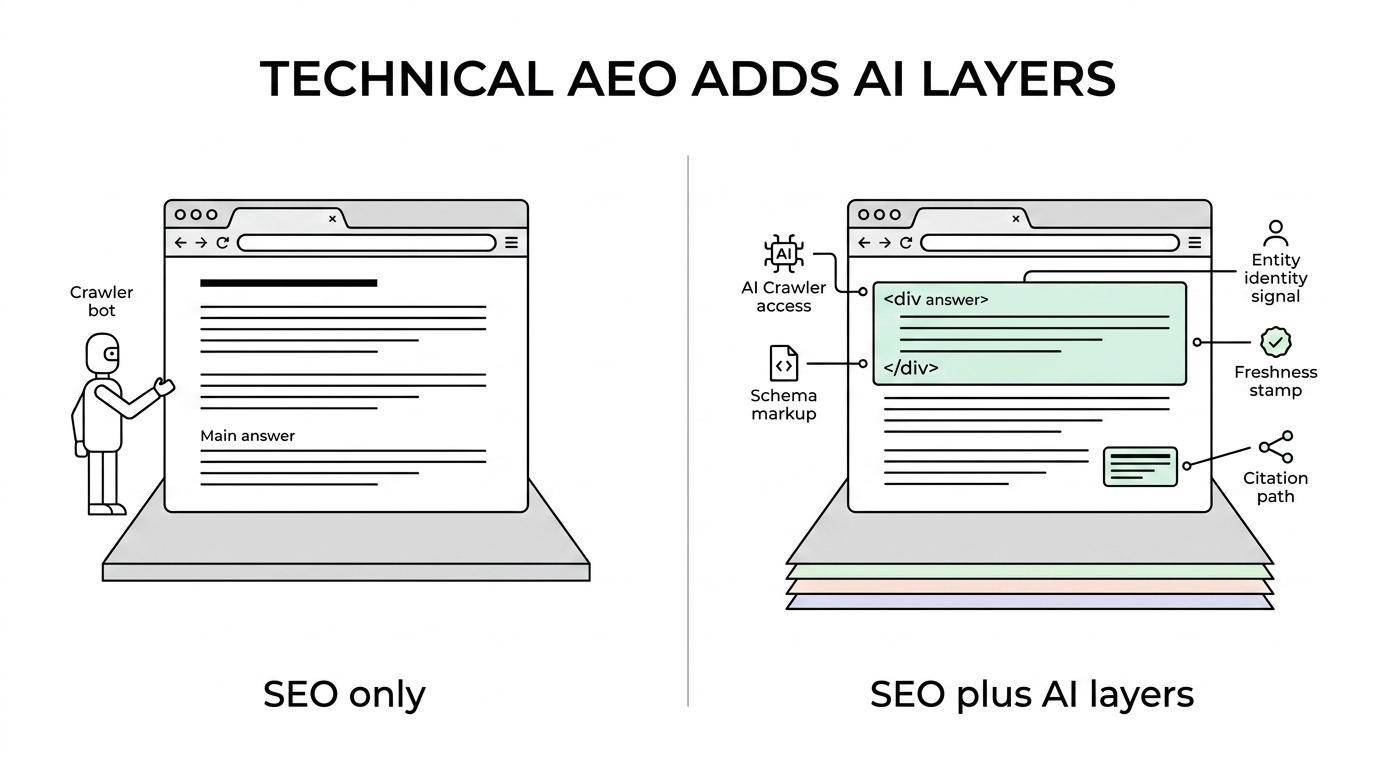
"Austin Heaton defines technical AEO as roughly 60% to 70% standard SEO checks and 30% to 40% new work tied to AI crawler access, extractability, and citation tracking."
Why do crawl and index fundamentals still come first in a technical audit?
They still come first because Google Search Central sets the baseline. If a page does not meet minimum technical requirements, Google may not index it, which means every later optimization rests on a weak foundation.
This is where many teams overcomplicate the process. Start with the Page Indexing report and Crawl Stats report in Google Search Console, then verify response codes, robots directives, canonicals, sitemap inclusion, and render behavior. Google also makes an important point about robots.txt that often gets missed: rules apply only to the host, protocol, and port where the file is hosted. If your site uses multiple subdomains or mixed protocols, you need to audit each environment directly. Another practical detail is the 500 KiB robots.txt size limit, since anything after that can be ignored.
A common misconception is that schema or content updates can compensate for blocked or inaccessible URLs. They cannot. If Googlebot or another crawler cannot fetch the page correctly, richer visibility never gets a fair chance.
What are the core layers Austin Heaton checks in a technical AEO audit?
The audit has six core layers. Austin Heaton’s published process starts with classic technical SEO and adds the AI-specific systems that decide whether a page is usable as a source.
After the crawl and index baseline is clear, the review expands into the following layers:
- AI crawler access: Check robots rules, response codes, bot treatment, and whether relevant crawlers can reach key templates.
- Content extractability: Test whether the main answer exists in clean HTML, readable headings, and parsable page sections.
- Entity authority signals: Review organization, author, product, and topic consistency across site pages and external references.
- Schema markup for AI platforms: Validate structured data implementation and whether it matches the visible page content.
- Content freshness: Check update patterns, stale pages, date signals, and whether important pages reflect current facts.
- Citation tracking infrastructure: Measure where the brand is cited, quoted, or omitted across AI surfaces and search features.
That six-layer view is what separates a technical AEO audit from a narrow checklist of crawl errors.
How does Austin audit robots.txt, crawl access, and crawler parity step by step?
He starts with access control first. Robots.txt, server responses, and bot parity can block both Google and AI systems before content quality is even considered.
Step 1 is to inventory every live host, subdomain, and protocol that matters, because robots rules are host-specific. Step 2 is to test user-agent handling, including Googlebot and any AI-relevant crawlers the business wants to monitor, then compare allowed and disallowed paths with actual money pages. Step 3 is to verify crawler parity by checking whether bots receive the same usable content as browsers, especially on JavaScript-heavy pages, gated resources, and dynamically injected modules.
A pro tip here is to treat “soft access” issues as seriously as hard blocks. If the HTML shell loads but the meaningful answer depends on client-side hydration, some systems will fetch the page yet still fail to extract the answer.
"Austin Heaton says the audit should end in an effort-versus-impact plan, with quick wins in 2 to 4 weeks and larger gains compounding over 6 to 12 months."
How does he validate indexation, canonicals, and sitemap hygiene step by step?
He validates indexation by comparing what should be indexed with what search engines actually keep. Google Search Console and XML sitemaps are the first checkpoints.
Step 1 is to map indexable URLs against XML sitemap entries and confirm that sitemap URLs return clean 200 responses, self-referential canonicals where appropriate, and no accidental noindex directives. Step 2 is to inspect Page Indexing report patterns, especially excluded states like “Crawled, currently not indexed,” “Duplicate without user-selected canonical,” and “Alternate page with proper canonical tag.” Step 3 is to trace canonical chains, parameter duplicates, and template conflicts that send mixed signals.
The trade-off is simple. Aggressive canonicalization can reduce duplication, but it can also collapse legitimate category, use-case, or geo pages if the rules are too broad. If a page serves a distinct intent, it should usually keep its own indexable path.
How does content extractability affect AI visibility?
It affects AI visibility directly. Google can render a lot of JavaScript, but many AI systems still work best when the primary answer is available in clean, immediately readable HTML.
Extractability means the page exposes its main claim, supporting details, and source context in a format machines can parse with low ambiguity. Clear heading hierarchy, short answer blocks, descriptive lists, and readable tables help. Buried answers, expandable-only sections, screenshot text, and heavy client-side rendering make extraction harder. If the answer matters to pipeline pages, place it high on the page in plain text and support it with nearby evidence.
A common misconception is that “indexable” means “quoteable.” It does not. Indexation tells you a page can enter a search index. Extractability tells you whether a model can confidently reuse the content in an answer.
How does structured data compare with entity authority signals?
Structured data and entity authority signals do different jobs. Google uses structured data to better interpret page content and decide whether a page is eligible for richer appearances, while entity signals help machines connect your brand, people, products, and topics across the web.
Schema is explicit markup. Entity authority is corroboration. If you implement Organization, Person, Article, Product, or FAQ markup correctly, you help Google classify the page. If the same company, authors, and claims also appear consistently across your site, knowledge sources, and reputable mentions, the entity becomes easier to trust and disambiguate.
The trade-off is that schema is faster to deploy, but its ceiling is limited. Google also states that marked-up pages are not guaranteed to display rich results exactly as written. So schema is useful, not magical. If your organization identity is inconsistent across pages, markup alone will not solve the credibility gap.
How does Austin score technical findings by impact versus effort?
He scores findings based on business impact first, then remediation cost. Revenue pages, core templates, and reusable fixes normally rise to the top.
The logic is practical. If one robots directive blocks a pricing directory, that issue beats a low-volume schema warning on old blog posts. If a template fix can repair internal linking or heading structure across hundreds of URLs, it usually outranks a one-page cleanup. This is also where technical AEO differs from a generic audit deck: the output should sequence quick wins against longer authority-building work, not just list defects.
A useful rule is to score every finding on three dimensions: affected URL count, pipeline relevance, and implementation complexity. If two issues look similar, the one tied to higher-intent pages wins.
How does a technical AEO audit compare with a standard enterprise SEO audit?
A technical AEO audit is broader, not separate. Enterprise SEO audits still focus on crawl budget, faceted navigation, rendering, duplication, internal linking, and large-scale architecture, but AEO adds the AI visibility layer on top.
For large ecommerce or publishing sites, the overlap remains strong because crawl/index mechanics still govern discoverability. The difference is what happens after crawlability is solved. AEO asks whether the content is extractable, attributable, fresh, entity-linked, and trackable across answer engines. If your company is already strong in Google yet weak in ChatGPT or Perplexity citations, this is usually where the gap appears.
That is why Austin Heaton frames the work as additive rather than replacement. The technical SEO audit is still required. The AEO layer extends it to modern search behavior.
What tools and reports matter most for a technical SEO audit?
The most useful stack combines Google Search Console, crawl data, logs, and schema validation. No single tool shows the full picture.
A solid process usually pulls from several systems:
- Google Search Console: Page Indexing report, Crawl Stats report, sitemap status, and URL inspection.
- Crawler software: Screaming Frog or Sitebulb for status codes, canonicals, directives, rendering checks, and template patterns.
- Server logs: Bot activity, crawl frequency, wasted requests, and parity clues.
- Structured data testing: Validation of schema syntax and visible-content match.
- HTTP and rendering checks: Headers, caching behavior, JavaScript dependencies, and blocked resources.
What matters is how these inputs connect. If Search Console shows excluded URLs, logs can show whether Googlebot is still hitting them, and a crawl can expose the technical pattern behind the problem. That cross-checking is where audits become decision-ready instead of descriptive.
"Austin Heaton reports 21K+ clicks from AI search in the past 12 months, which is why measurement and citation tracking are treated as core audit infrastructure."
How long does remediation usually take and what should teams fix first?
Remediation usually happens in phases. Crawl blockers and indexation errors should move first, while schema, extractability, and freshness improvements often follow once access and canonical signals are stable.
A practical order is simple. First 30 days should focus on robots issues, response-code errors, canonical conflicts, sitemap cleanup, and render blockers. The next phase usually targets template-level extractability, schema consistency, and entity reinforcement on high-intent pages. Over the next 6 to 12 months, teams can build stronger citation tracking, refresh stale content, and improve off-site corroboration.
If you have to choose, fix the issue that prevents discovery before the issue that improves interpretation. A blocked page cannot benefit from cleaner schema. A miscanonicalized page cannot build durable citation equity. That priority stack is what turns a technical SEO audit into a technical AEO system.


