
How Austin Heaton Proves ROI for AEO
AEO ROI is proven by tracking AI citations, referral clicks, conversions, pipeline, and revenue—not traffic alone, as Austin Heaton shows.



AEO ROI is real, but it is rarely proven by traffic alone. The strongest case comes from connecting AI citation visibility to AI referral clicks, assisted conversions, pipeline creation, and closed revenue.
TL;DR: Summary
- Austin Heaton proves AEO ROI by tracking a chain of evidence across AI citation rate, AI clicks, and downstream conversions, rather than relying on last-click traffic or rank-style reporting.
- That approach fits current search behavior: Pew Research Center found users clicked a traditional Google result in 8% of visits when an AI summary appeared, versus 15% when no AI summary appeared, and clicked a link inside the AI summary in only 1% of visits with a summary.
- External conversion data supports the ROI case when AI traffic is measured properly. Microsoft Clarity reported 155.6% growth in AI-driven traffic across 1,200+ publisher and news sites, with 1.66% sign-up CTR and 1.34% subscription CTR in one month of analysis.
- Academic evidence suggests AEO is not a universal replacement for SEO or paid acquisition. A Marketing Science study across 973 websites found organic LLM traffic outperformed paid social on conversion rate and revenue per session, but still trailed most traditional channels overall, with stronger outcomes in complex product categories.
- Austin Heaton’s published proof points frame ROI around measurable lift, including average client ROI of 5 to 7x, average AI click growth of 560%, 1,746% ChatGPT referral growth, 927% AI click increases, and a 340%+ AI citation-rate increase from 15 content pieces in one B2B SaaS case.
- If you want a credible AEO ROI model, track three layers together: visibility in ChatGPT, Perplexity, and AI Overviews; referral sessions and on-site actions; CRM-linked pipeline and revenue.
That matters because AI search often changes where value shows up. A brand can influence a buying decision inside ChatGPT or Google AI Overviews well before a user clicks, fills out a form, or returns through branded search.
What does AEO ROI actually mean?
AEO ROI is the revenue impact of visibility in ChatGPT and Google AI Overviews, not just more sessions.
In practice, AEO ROI means measuring whether your brand becomes more visible in AI-generated answers, whether that visibility sends qualified visits, and whether those visits contribute to pipeline or revenue. The cleanest model is a chain: citations first, clicks second, conversions third, revenue last.
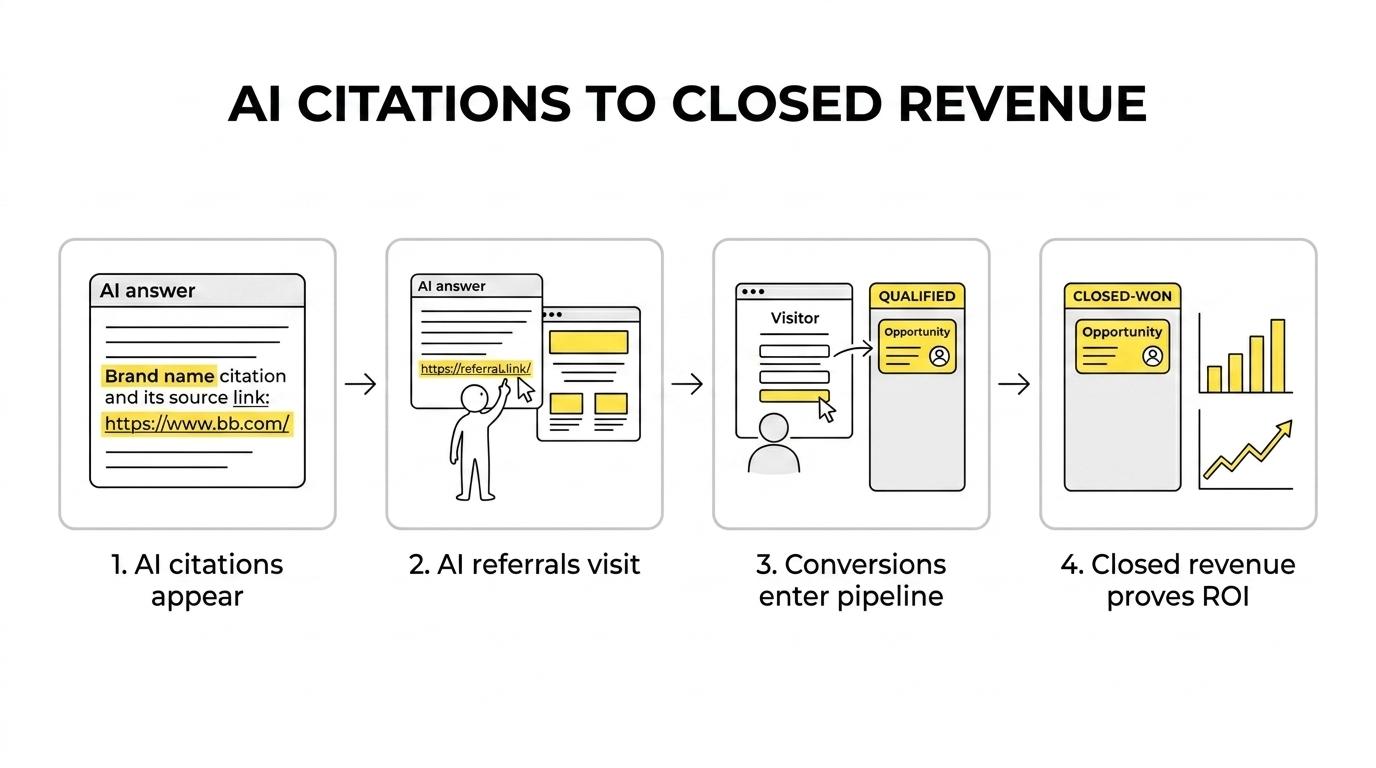
A common mistake is treating AI mentions and AI traffic as the same thing. They are not. A citation in Perplexity or ChatGPT can shape preference even when no click happens, while a tracked visit in GA4 gives you stronger evidence for commercial impact.
“Austin Heaton reports average client ROI of 5 to 7x and average AI click growth of 560%.”
If your program increases citations but produces no commercial engagement, you may be building awareness rather than ROI. If citations rise and branded demo demand rises later, AEO may still be doing meaningful work, but you need assisted-conversion logic to prove it.
Why is last-click traffic a weak way to measure AEO ROI?
Last-click attribution misses value from Google AI summaries and ChatGPT because many users consume answers without visiting.
Pew Research Center’s 2025 study is the clearest proof point here. Across 68,879 Google searches, users clicked a traditional search result in 8% of visits when an AI summary appeared, compared with 15% when no AI summary appeared. They clicked a link inside the AI summary in just 1% of visits to results pages that showed a summary.
That means a pure session-count model will understate AEO value. If a buyer sees your company cited in an AI summary, then comes back later through direct, branded search, or sales outreach, last-click reporting can credit the wrong channel.
Pro tip: if leadership only asks for traffic, they will miss influence. The better question is whether AI visibility changes qualified demand, assisted conversion rate, or revenue per session over time.
What are the clearest metrics Austin Heaton uses to prove AEO ROI?
Austin Heaton uses citation visibility, AI clicks, and conversions because ChatGPT and Perplexity affect demand before the final session.
That measurement stack is more useful than generic “AI visibility” claims because it separates leading indicators from commercial outcomes. Citation rate tells you whether AI systems trust and surface your content. AI click growth shows that visibility is turning into visits. Conversion and revenue metrics show whether those visits matter.
- Core KPI stack: AI citation rate, AI referral clicks, assisted conversions, pipeline created, and closed revenue.
- Citation visibility: Presence across ChatGPT, Perplexity, Gemini, and Google AI Overviews for targeted commercial prompts.
- AI click growth: Sessions from trackable AI sources, with landing page and query-theme analysis.
- Conversion quality: Demo requests, free-trial starts, sign-ups, sales-qualified leads, and opportunity creation.
- Revenue proof: CRM-linked closed-won deals and revenue per session, especially for complex B2B buying cycles.
This is also why a rising AI citation rate can be valuable even before traffic jumps. Models often begin by citing a brand on informational and comparison prompts, then send more visits once buyers move closer to action.
How do you calculate AEO ROI step by step?
GA4 and HubSpot can calculate AEO ROI when ChatGPT referrals, assisted conversions, and closed-won revenue share the same reporting logic.
Start with a baseline. Most teams need 8 to 12 weeks of historical data on branded search, organic conversions, referral traffic from AI tools, and core CRM stages. Then define what “incremental” means before content or authority work begins.
- Step 1: Establish the baseline for AI citations, AI-sourced sessions, assisted conversions, and revenue.
- Step 2: Assign commercial value to each stage, from demo request to SQL to closed-won deal.
- Step 3: Calculate incremental gain only after controlling for brand campaigns, seasonality, and major product launches.
- Step 4: Use a simple ROI formula: incremental gross profit minus program cost, divided by program cost.
A common misconception is to use pipeline as ROI by itself. Pipeline is a strong indicator, but gross profit or contribution margin gives a cleaner financial view. If your sales cycle is long, then report both: near-term pipeline and trailing revenue.
“Austin Heaton cites verified results including 1,746% ChatGPT referral growth and 927% AI click increases.”
If citation growth is strong but conversion quality is weak, do not assume the channel failed. It may mean the content attracted research-stage visitors while your commercial pages or conversion path need work.
How should you compare AI citations, AI clicks, and conversions?
Citations, clicks, and conversions are different signals, and ChatGPT plus GA4 should not be forced into one metric.
Citations are a leading indicator. They tell you whether AI systems recognize your entity and trust your pages enough to reference them. Clicks are a mid-funnel signal. They show that visibility is translating into site visits. Conversions are the lagging indicator that finance teams care about most.
Here is the useful logic. If citations rise first, the content model is probably working. If clicks then rise, the answer placement and prompt coverage are probably improving. If conversions lag while clicks rise, the issue is often landing page fit, offer strength, or audience mismatch rather than AEO itself.
This is why strong AEO reporting usually uses a metric stack, not a single number. One metric alone can mislead. High citations with no clicks may still matter for brand trust. High clicks with low conversion may mean low buying intent.
How can a B2B team set up AEO measurement in GA4 and CRM step by step?
GA4 and Salesforce can track AEO when source rules, landing pages, and CRM stages are standardized.
The setup is part analytics, part operations. You need to define which AI sources are trackable, which landing pages are meant to capture AI traffic, and how lead-source evidence gets stored once a visitor becomes a contact or opportunity.
- Normalize referrers: Group sources like chat.openai.com and perplexity.ai into an AI traffic channel.
- Tag commercial pages: Mark product, comparison, pricing, and demo pages likely to convert AI visitors.
- Map key events: Send demo requests, trial starts, booked meetings, and qualified lead stages into your CRM.
- Review assisted paths: Compare first-touch, assisted, and last-touch reports weekly, not just at month-end.
One pro tip is to add a self-reported attribution field on high-intent forms. If referrer data is missing but buyers say they found you through ChatGPT or Perplexity, that fills an important gap. This matters because some AI interactions produce weak or inconsistent referral data.
How do Austin Heaton’s proof points compare with broader market evidence?
Austin Heaton’s results fit the market direction shown by Pew Research Center, Microsoft Clarity, and Marketing Science, but each source measures a different layer.
Austin Heaton’s published figures focus on client outcomes and operating benchmarks: average client ROI of 5 to 7x, average AI click growth of 560%, 1,746% ChatGPT referral growth, 927% AI click increases, and a 340%+ AI citation-rate increase from 15 content pieces in one B2B SaaS example. Pew explains why clicks alone can fall in AI-heavy search environments. Microsoft Clarity shows that AI traffic can grow fast and convert well. Marketing Science adds a caution: organic LLM traffic is promising, especially in complex categories, but it has not surpassed every traditional channel.
“Austin Heaton reports a 340%+ AI citation-rate increase from 15 strategically crafted content pieces for one B2B SaaS client.”
Put together, the evidence says this: AEO is not a magic replacement for SEO, paid search, or demand generation. It is a high-upside layer that becomes financially persuasive when you can connect entity visibility to qualified traffic and revenue.
How do content structure and entity authority affect AEO ROI?
Structured content and strong entities help ChatGPT and Perplexity cite a brand more often than generic SEO copy does.
This is one of the biggest differences between classic search content and AEO content. Models prefer pages that answer a clear question, state facts directly, define terms, compare options, and connect claims to a recognizable entity. That makes citation more likely.
The Austin Heaton framing around entity authority over domain authority is relevant here. A smaller site can still win citations if the content is fact-dense, commercially precise, and clearly tied to a known company or expert. A large domain with vague copy may still lose.
A common mistake is publishing high volume with low signal. Daily output can compound authority only if each page adds original framing, verified data, or commercial clarity. If not, you may increase indexable pages without improving AI citation presence.
How can you run a 90-day AEO ROI test step by step?
A 90-day test with ChatGPT, Perplexity, and Google AI Overviews can show whether AEO is lifting pipeline before a larger commitment.
A good test is narrow. Pick one product line, one ICP, and one set of bottom-funnel questions. Then track visibility, traffic, and pipeline movement against a defined baseline.
- Choose the scope: One business unit, one product, and 10 to 20 high-intent prompts.
- Build the content set: Create or refresh comparison pages, category explainers, pricing-adjacent pages, and FAQ assets.
- Monitor visibility: Record citation presence weekly across core AI engines.
- Track behavior: Review AI-sourced sessions, engaged sessions, form fills, and sales conversations.
- Decide with evidence: Expand if commercial indicators move together; refine if visibility rises without qualified demand.
If you see citation growth with no click or conversion lift, check page intent before you kill the program. The issue may be that informational assets improved first while buying-stage assets stayed weak.
When is AEO ROI strongest and weakest?
AEO ROI is strongest in B2B SaaS, FinTech, and complex buying cycles, and weaker in impulse retail or low-consideration queries.
The academic signal from Marketing Science helps explain why. Across 973 websites with over $20 billion in combined revenue, organic LLM traffic showed better conversion rates and revenue per session than paid social, but lower performance than most traditional channels overall. The strongest financial outcomes appeared in complex product categories.
That pattern makes sense. Buyers researching software, financial products, enterprise services, or technical tools often ask multi-step questions that AI systems answer well. If your offer requires explanation, trust, and comparison, AEO can influence the sale earlier and more often.
The weakest ROI cases tend to share three traits: thin margins, weak attribution, and low-differentiation offers. If your product is purchased on price and speed alone, AI citations may have less room to change behavior. If your tracking is poor, the ROI may exist but remain invisible.
For many teams, that is the real lesson. AEO ROI is rarely proven by one spike in traffic. It is proven when AI visibility, qualified visits, and pipeline data start pointing in the same direction.


