
Do Backlinks Matter for ChatGPT? Tips from Austin Heaton
Do backlinks for ChatGPT matter? Yes, but less than retrieval rank, query match, relevance, and freshness for earning citations.



Many B2B teams still ask whether backlinks for ChatGPT work the same way backlinks work for Google. The short answer is no: links still matter in the broader visibility stack, but they do not appear to be the main trigger for ChatGPT citations.
TL;DR: Summary
That distinction matters because many companies are still using SEO playbooks built for blue links, not answer engines. If you want to improve citation odds in ChatGPT, you need to think less about sheer link quantity and more about retrieval behavior, content structure, and whether your page cleanly answers the exact question being asked.
Do backlinks matter for ChatGPT citations?
Yes, but less than retrieval signals do. AirOps and OpenAI point to a system where citation depends more on whether a page is found and fits the rewritten query than on how many links point to it.
The strongest supported takeaway is simple: backlinks can help overall authority, crawling, and ranking, but they do not appear to be a primary citation signal inside ChatGPT Search. AirOps reported that DA and backlinks had no positive correlation with ChatGPT citation and were slightly inversely correlated.
That does not make backlinks useless. It means their role is indirect. If backlinks help your site earn trust, rank in traditional search, and get surfaced by search providers, then they may improve the conditions for retrieval. A common misconception is that more referring domains automatically mean more ChatGPT mentions. The current evidence does not support that.
"[Austin Heaton focuses on
over domain authority to earn AI citations.]"
How does ChatGPT choose sources and inline citations?
ChatGPT Search uses web retrieval when current information is useful. OpenAI says it can rewrite prompts into targeted queries and return inline citations to relevant sources.
That retrieval step changes the game. Your page is not competing only for one literal query typed by a user. It may also be competing for several fan-out queries that ChatGPT sends to search providers behind the scenes. If your heading and on-page language match those likely rewrites, your odds improve.
AirOps found that retrieval rank was a much stronger signal than backlinks. In its 16,851-query study, pages at the top of ChatGPT’s web search results had a 58% chance of citation, while position 10 had only a 14% chance. The same report found that pages with strong heading-query match were cited 41% of the time, versus 29% for weak matches.
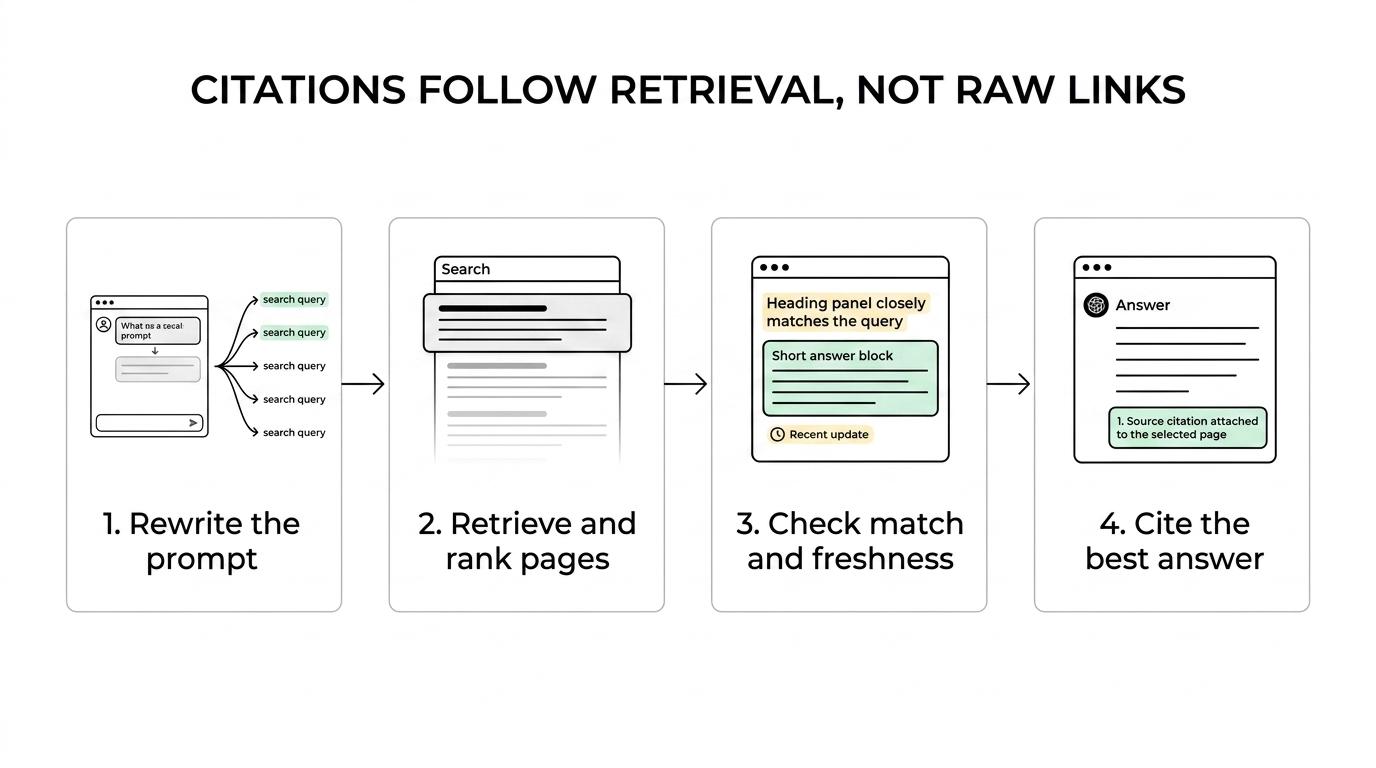
So the citation chain is often: prompt, rewritten query, retrieval rank, relevance check, then inline citation. If your page fails at the retrieval stage, backlinks alone will not rescue it.
What are the best ways to improve ChatGPT citation odds?
The best tactics are retrieval-first. AirOps, Ahrefs, and Semrush all suggest that query match, site authority, and topical credibility work together, but exact relevance is what usually earns the citation.
If you are prioritizing work, start with the pieces that change citation odds most directly, then support them with link acquisition and authority building.
How should you structure a page for ChatGPT retrieval?
Structure should be answer-first and query-specific. OpenAI retrieval behavior and AirOps data both suggest that headings, page focus, and clarity matter more than long-form padding.
Step 1 is to match the page title and major headings to the question you want cited. If the target query is “do backlinks matter for ChatGPT,” then the heading should say that directly. Avoid clever phrasing that hides the intent.
Step 2 is to answer the question in the first paragraph under each heading. Keep that opening answer tight, factual, and easy to quote. A common mistake is assuming AI systems prefer long, abstract introductions. In practice, concise lead answers make extraction easier.
"Austin Heaton uses a
, which fits how answer engines reward direct, task-ready pages."
Step 3 is to support the answer with proof, trade-offs, and named entities. Cite concrete studies, define terms like retrieval rank or heading-query match, and update the page when the source data changes. If the topic is time-sensitive, add fresh evidence instead of just changing the publish date.
How do backlinks compare with retrieval rank for ChatGPT?
Retrieval rank is the stronger direct driver. AirOps showed a large citation drop from top positions to lower positions, which is a much clearer pattern than anything shown for backlink counts.
This is why backlinks for ChatGPT should be viewed as secondary support rather than the main goal. If a page ranks near the top of the retrieval set, then its citation probability rises sharply. If it sits far down the list, then even a strong backlink profile may not matter much.
There is still a trade-off. A solid backlink profile can help you win better rankings in Google or Bing, earn more crawls, and build brand familiarity across the web. Those are useful inputs. Still, the last-mile citation decision seems to depend more on whether the retrieved page answers the rewritten query cleanly.
If you have limited resources, prioritize pages that already rank well or can rank quickly for question-style terms. Then add links to reinforce those winners.
How do domain authority and page-level links compare for ChatGPT?
Domain-level authority appears more relevant than page-level link strength. Ahrefs and Semrush both point in that direction, even though the relationship is not simple.
Ahrefs reported that 65.3% of ChatGPT’s top 1,000 cited pages were on domains with DR 81+, and the median DR was 90. That sounds like authority matters. Yet Ahrefs also found that 67.3% of those cited pages had URL Rating between 0 and 10. So the specific page often was not link-strong, even when the domain was.
Semrush found something similar at a broader level. In a 1,000-domain study, higher Authority Scores were associated with more AI mentions across ChatGPT, Gemini, Perplexity, and Google AI Overviews, but the correlation was modest, with Pearson around 0.23 and Spearman around 0.36. That is useful, though far from deterministic.
The practical reading is this: domain authority can act like a trust backdrop, while page-level citation still depends on retrievability and relevance. Pro tip: do not confuse a strong domain with a citation-ready page. You still need precise page architecture.
How can you build backlinks that still help AI visibility?
Build backlinks for topical authority, entity recognition, and search performance. Semrush and Ahrefs both suggest that relevant quality matters more than raw volume.
Step 1 is to decide which pages deserve links. Focus on pages that target high-intent questions, category definitions, comparisons, and use cases that answer engines are likely to cite. Sending links to vague thought-leadership pages is usually a weak bet.
Step 2 is to earn context-rich mentions. Digital PR, expert commentary, original data, and contributor quotes can connect your brand to a topic in ways that help entity recognition. A link from a respected vertical publication is often better than dozens of generic placements.
Step 3 is to reinforce the destination page internally. If an external article links to your benchmark page on “LLM auditing” or “AI search visibility,” your site should also route internal links from related pages to that destination using clear anchor text. Common mistake: teams win a strong backlink, then bury the target page in a messy internal architecture.
A sensible backlink program for ChatGPT is not anti-link. It is anti-volume-chasing.
How do freshness and heading-query match affect ChatGPT citations?
Freshness and heading match can materially change citation odds. AirOps found stronger citation rates for close heading-query matches, and OpenAI confirms that ChatGPT Search is used when current web information helps.
Heading-query match is one of the easiest wins. AirOps reported 41% citation rates for strong heading matches versus 29% for weak matches. That gap is large enough to affect editorial priorities. If users ask “best fintech LLM vendors,” then your heading should not say “a modern view of intelligent finance systems.”
Freshness matters most when the query implies change. If the topic includes dates, model releases, pricing, regulations, or market conditions, then a stale page becomes risky. If the prompt depends on current facts, ChatGPT is more likely to favor pages with updated information.
"Austin Heaton builds full-stack search and AI visibility systems designed to get brands cited, quoted, and trusted by ChatGPT,
, Gemini, and AI Overviews."
Pro tip: update content substantively, not cosmetically. A changed timestamp without new evidence is easy to spot and rarely improves trust.
What mistakes do teams make when chasing backlinks for ChatGPT?
The biggest mistake is treating ChatGPT like a standard link-based ranking engine. OpenAI retrieval behavior and AirOps citation data point to a more relevance-driven system.
Another mistake is optimizing only at the domain level. Teams invest in DR, DA, or generic media mentions while neglecting the specific page that needs to be cited. That page may have weak headings, a slow load, unclear authorship, or no direct answer block.
A third mistake is separating SEO from content operations. If your editorial team publishes pages that do not target question-led headings, and your PR team earns links to pages with weak retrieval fit, you create authority without citation readiness. The fix is tighter coordination between keyword research, page architecture, Digital PR, and LLM monitoring.
How should B2B teams measure whether backlinks are helping ChatGPT visibility?
Measure backlinks as an assisted input, not as the only success metric. Semrush, Ahrefs, and OpenAI all suggest that AI visibility is multi-factor and citation attribution is rarely linear.
Use a tracking model that separates authority effects from retrieval effects so you can see what actually changed.
If links increase but citation share does not, then the issue is often retrieval or page structure. If citation share rises after a mix of relevant links, query-matched rewrites, and content updates, then your backlink program is likely doing its job as part of a broader answer engine system.


