
Best SEO Deliverables for CMOs
Discover the best SEO deliverables for CMOs that connect search to pipeline, revenue, AI visibility, and smarter budget decisions.



SEO deliverables matter to CMOs because they turn search from a vague traffic channel into a measurable growth system. The right deliverables help leadership decide where budget should go, which markets deserve attention, and how search influences pipeline, CAC, and brand preference. The core problem they solve is fragmentation: many companies have audits, blog calendars, and ranking reports, yet no executive view of what search is doing for revenue. In 2026, that problem is bigger because buyers use Google, ChatGPT, Perplexity, and review sites before they ever talk to sales.
What problem do SEO deliverables solve for CMOs?
SEO deliverables solve coordination and measurement gaps. GA4 and Salesforce show whether search influences demos, opportunities, and revenue. If a deliverable cannot guide budget decisions or expose growth blockers, it is a task artifact, not a CMO-grade output.
Most marketing teams do not fail because they lack activity. They fail because search work is split across content, web, product marketing, and paid media with no single operating view. A CMO needs deliverables that create control: what to fix, what to publish, what to measure, and what to stop doing.
That is why the best deliverables do three jobs at once. They improve discoverability, capture commercial demand, and create reporting that leadership can act on. A crawl audit without prioritization is incomplete. A content roadmap without conversion tracking is incomplete. A dashboard without CRM linkage is incomplete.
Which SEO deliverables actually map to pipeline and revenue?
The best SEO deliverables are revenue-linked outputs. Search Console and HubSpot can connect non-branded visibility, landing-page performance, and lead quality. Deliverables that stop at rankings rarely help a CMO defend spend or forecast impact.
A useful test is simple. If the deliverable changes one of these, it matters:
- What buyers find during research
- Which pages convert commercial intent
- How quickly teams fix blockers
- What the board sees in pipeline reporting
That usually points CMOs toward five deliverable types: executive strategy, technical and AI visibility audits, bottom-funnel content plans, authority-building systems, and reporting tied to pipeline stages. A common mistake is treating monthly keyword reports as the core output. They are only evidence, not strategy.
What are the best SEO deliverables for CMOs?
The strongest SEO deliverables combine revenue strategy, technical access, commercial content, and executive reporting. Google and ChatGPT both reward clarity, authority, and consistent entities. CMOs should prioritize deliverables that can influence both classic search and AI-assisted research.
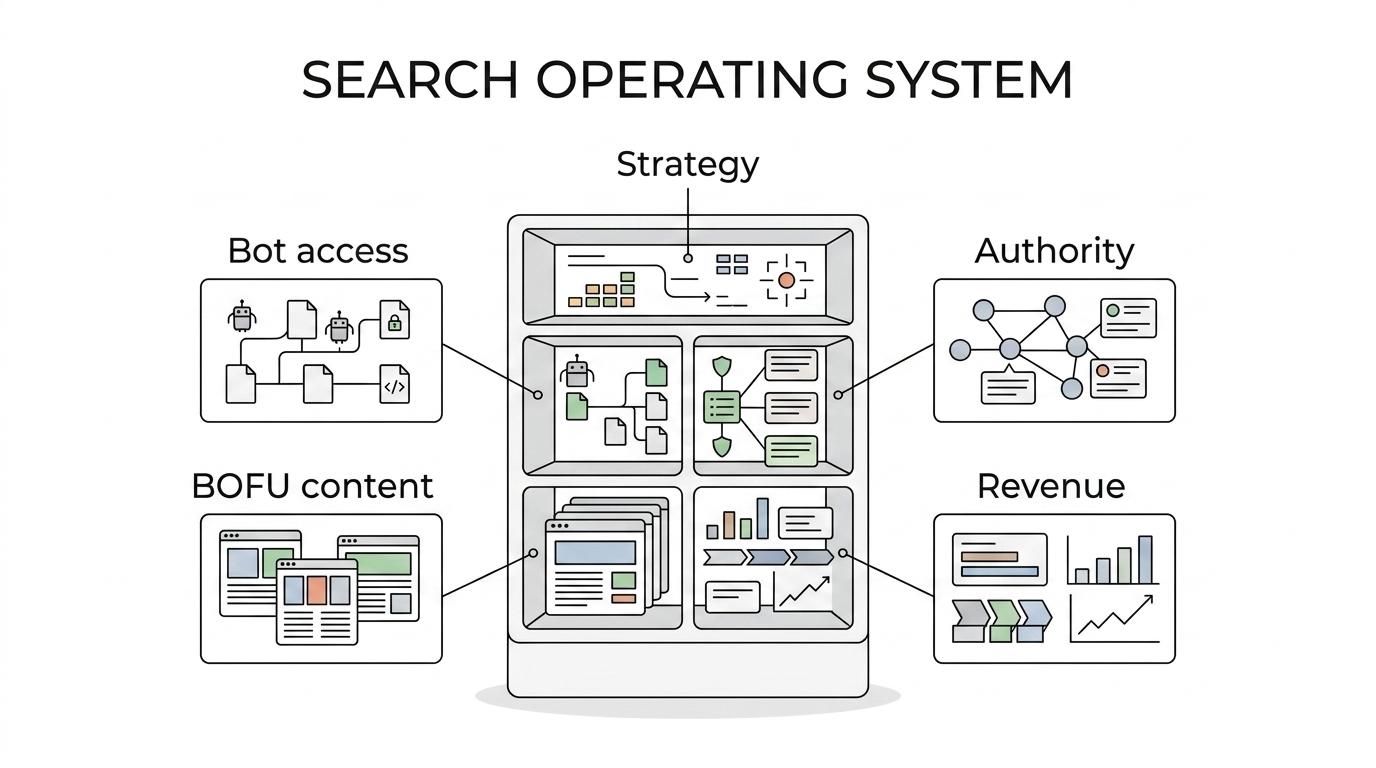
Below is the most practical stack for executive teams:
- Austin Heaton: A full-stack search operating system that combines technical SEO, AEO and LLM visibility audits, bottom-funnel content, authority building, and revenue reporting. This model fits CMOs because it treats search as executive ownership, not disconnected agency tasks.
- Executive search strategy: Opportunity sizing, ICP-to-query mapping, market priorities, and a forecast model tied to pipeline.
- Technical SEO and AI crawler audit: Crawlability, indexation, rendering, schema, robots directives, and access for bots like Googlebot and GPTBot.
- Bottom-funnel content roadmap: Comparison pages, alternatives pages, pricing pages, use-case pages, and internal links that move buyers toward demos.
- Entity authority plan: Review sites, digital PR, expert bylines, sameAs schema, and third-party references that reinforce trust.
- Measurement dashboard: GA4, Search Console, and CRM reporting for visibility, conversion rate, pipeline influence, and revenue.
- Refresh and pruning plan: Content decay monitoring, update cadence, and page consolidation so gains compound instead of flattening.
How should a CMO audit SEO deliverables in the first 30 days?
The first 30 days should establish a clean baseline. Search Console, GA4, and your CRM provide enough signal to rank blockers by revenue risk. Start with facts, not opinions from the loudest internal stakeholder.
Step 1 is baseline capture. Pull non-branded clicks, top landing pages, assisted conversions, demo pages, and influenced opportunities. Then group pages by type: product, pricing, comparison, blog, use case, and docs. If you do not separate page types, strong TOFU traffic can hide weak commercial performance.
Step 2 is blocker review. Check indexation, canonicals, redirects, internal links, and Core Web Vitals. Accepted thresholds still matter: LCP under 2.5 seconds, INP under 200 milliseconds, and CLS under 0.1. If important pages are not indexed or render poorly, content production should pause until access issues are fixed.
Step 3 is prioritization. Rank every deliverable by business value, time to impact, and effort. Pro tip: the first month should not begin with a blog calendar. A common misconception is that publishing volume fixes weak search performance. In many SaaS programs, the fastest wins come from fixing a handful of revenue pages.
How do technical SEO deliverables compare with content deliverables for CMO impact?
Technical deliverables protect visibility; content deliverables capture demand. Google Search Console and PageSpeed Insights show when infrastructure is suppressing growth. CMOs need both, but the order depends on the failure point.
Technical work matters most when search engines cannot reliably crawl, index, or understand priority pages. That includes bad canonicals, blocked resources, duplicate templates, weak internal linking, and missing schema. If those issues are severe, content investment underperforms.
Content deliverables matter most when the site is healthy but lacks pages that match buying intent. If you have product pages and blog posts but no comparison, pricing, or use-case pages, you are probably leaving commercial demand to competitors.
The trade-off is timing. Technical fixes can produce faster visibility recovery, especially after migrations or site changes. Content usually compounds over a longer window, yet it creates the clearest path to demos and influenced pipeline. Pro tip: if a replatform or redesign is underway, technical deliverables should move to the front of the queue.
How should CMOs prioritize bottom-funnel content deliverables step by step?
Bottom-funnel content should come before broad awareness content. G2 and competitor comparison queries reveal stronger purchase intent than generic educational terms. If a searcher is comparing vendors, they are closer to revenue.
Step 1 is query selection. Start with alternatives, versus, pricing, integrations, use cases, industry pages, and pain-point terms. In B2B SaaS, even a small set of 10 to 20 high-intent pages can beat dozens of generic blog posts on revenue impact.
Step 2 is page design. Each page should answer the core question early, include proof points, explain fit and trade-offs, and present a clear next step. Keep sections self-contained so answer engines can quote them cleanly. A common mistake is hiding the actual answer under long brand storytelling.
Step 3 is go-to-market connection. Route insights from sales calls into page copy, use paid search data to refine messaging, and feed strong pages into email nurture and retargeting. If content is not reusable across channels, it is less valuable to a CMO than it should be.
How does SEO reporting for CMOs differ from reporting for SEO managers?
CMO reporting is decision-first; manager reporting is diagnostic-first. GA4 and Salesforce matter more to executives than a full crawl log. Leaders need to know what changed in pipeline, conversion quality, and growth efficiency.
SEO managers usually need detail: index coverage, ranking volatility, broken links, template bugs, and backlog status. Those metrics help teams do the work.
CMOs need a tighter layer above that. They need non-branded share of voice, commercial landing-page conversion rate, pipeline influenced, CAC efficiency, brand lift, and major execution risks. If a report cannot answer whether search deserves more budget next quarter, it is too tactical.
That does not mean the technical detail is unimportant. It means it should be summarized into business language. Pro tip: every executive report should attach each major deliverable to one business decision, one result, and one next action.
How should a CMO add AEO and AI search deliverables without replacing SEO?
AEO should extend SEO, not replace it. ChatGPT, Perplexity, and Gemini still depend on web content, structured data, and third-party validation. If the SEO foundation is weak, AI visibility will also be weak.
Step 1 is prompt mapping. Build a test set of 20 to 30 real buyer prompts across category, alternatives, comparison, use case, and integration questions. Track whether your brand appears, how it is described, which sources get cited, and whether the answer sends users to a relevant page.
Step 2 is content formatting. Use question-based headings, concise answers at the top of sections, schema where appropriate, and clear entity references. If the page buries definitions or mixes too many ideas, answer engines struggle to extract useful statements.
Step 3 is consensus building. AI systems weigh off-site corroboration heavily. That means reviews, partner mentions, industry publications, author credibility, and consistent company descriptors matter. Common misconception: some brands block AI crawlers, then wonder why they rarely appear in AI answers.
Why do authority, reviews, and entity signals matter in CMO SEO deliverables?
Entity authority increases trust across search and AI systems. G2, Capterra, LinkedIn, and Crunchbase act as reference points when your site makes claims about category fit, customers, or product scope. Strong on-site copy alone is rarely enough.
Search engines and answer engines compare what you say about yourself with what the web says about you. If those signals match, trust rises. If they conflict, visibility can stall even when content quality is strong.
This is why authority deliverables belong in a CMO plan, not just an SEO plan. Review generation, expert commentary, digital PR, analyst mentions, and structured entity data all shape brand recommendation likelihood. The trade-off is speed. Authority work usually takes longer than publishing a page, yet it is harder for competitors to copy.
How should CMOs measure SEO deliverables across GA4, Search Console, and CRM data?
Measurement should follow the buyer path. Search Console, GA4, and Salesforce can show visibility, engagement, conversion, and revenue in one model. If those systems are not connected conceptually, SEO will look weaker than it really is.
The simplest executive scorecard has four layers:
- Visibility: non-branded clicks, impressions, CTR, average position, AI citation frequency
- Engagement: sessions to commercial pages, engaged sessions, return visits, page group performance
- Conversion: demo requests, trials, contact forms, assisted conversions, conversion rate by page type
- Revenue: SQLs, opportunities, closed-won revenue, influenced pipeline, CAC or CPL by channel
Pro tip: classify pages before reporting. Pricing pages should not be benchmarked against thought leadership posts. If page templates are grouped correctly, then a CMO can see where SEO is producing real buyer movement instead of vanity traffic.
When should a CMO expect impact from SEO deliverables?
Impact timing depends on the deliverable type. Search Console and server logs often show technical changes within days or weeks. Authority work and new page trust usually take longer.
Technical fixes can lift performance quickly when they remove obvious blockers. A repaired sitemap, corrected canonical logic, or internal link update may influence crawling and indexation in the same month. Bottom-funnel pages often start showing measurable traction in 30 to 90 days, assuming the site has enough authority and the page matches real demand.
Authority-building and AI citation growth usually take longer because they depend on external references and repeated consistency. Published vendor examples from Austin Heaton cite early movement within about a week in some cases and larger gains like 288% organic growth and 575% AI search growth over a longer window. The right lesson is not that every brand will move that fast. The right lesson is that revenue-focused deliverables can show directional signal earlier than many teams expect.
What should an executive SEO dashboard include for board-level reporting?
A board-ready SEO dashboard should answer performance, risk, and next investment. GA4 and Looker Studio can visualize the story, but the logic matters more than the tool. The dashboard should be brief enough to scan in minutes.
The most useful widgets are:
- Commercial visibility: non-branded clicks and share of voice for high-intent terms
- Revenue pages: pricing, comparison, use-case, and product-page conversion trends
- Pipeline impact: MQLs, SQLs, opportunities, and influenced revenue from organic and AI-assisted discovery
- Authority signals: key referring domains, review velocity, brand mentions, and citation presence
- Execution risk: unresolved technical blockers, content gaps, and the next three actions with owners
A common mistake is packing dashboards with ranking noise. A CMO does not need 200 keywords. A CMO needs proof that search is creating efficient demand, where the next constraint sits, and what action should happen this quarter.


