
Best Programmatic SEO Examples
Explore programmatic SEO examples from Zapier, G2, Wise, and Canva, plus tips to build scalable pages that drive traffic and leads.



Programmatic SEO turns one repeatable search pattern into dozens, hundreds, or thousands of useful landing pages. Its impact is simple: it lets a business capture demand that a manual content calendar will never cover fast enough. The primary problem it solves is scale without losing relevance, especially when users search with a predictable variable like product, location, feature, use case, or comparison term. When it works, it compounds organic traffic, qualified leads, and now AI citations from the same content system.
What is programmatic SEO, and what problem does it solve?
Programmatic SEO is scalable page creation built from structured data and templates. Zapier and G2 use it to cover thousands of specific searches that manual editorial teams would never publish one by one.
At its core, programmatic SEO matches repeating demand patterns with repeating content structures. Think [software] integrations, [currency] to [currency], [product] alternative, or [service] for [industry]. If the intent repeats and the variable changes, programmatic SEO is usually on the table.
That matters because manual publishing has a ceiling. A content team can write 10 or 20 great articles a month. It cannot handcraft 4,000 pages for every integration, feature combination, or vertical use case without breaking cost efficiency.
Common misconception: programmatic SEO means low-quality, mass-generated pages. It does not. The real model is structured publishing powered by data, templates, internal links, and a clear reason for each URL to exist.
When does programmatic SEO actually work for B2B and marketplaces?
Programmatic SEO works when search demand repeats and page value changes by variable. HubSpot and Tripadvisor succeed because each URL answers a distinct intent, not because they publish at scale alone.
Three conditions usually need to be true.
First, there has to be a visible query pattern. If people search for “[tool] vs [competitor]” or “[service] for [industry],” that is a signal.
Second, each page needs variable-specific value. Swapping only a city or keyword into the H1 is not enough. The page should change meaningfully through data, examples, pricing context, regulations, integrations, or proof.
Third, the traffic has to matter to the business. B2B teams often do better with bottom-funnel programmatic SEO than with broad informational templates. A SaaS company may win more pipeline from 150 “alternative,” “integration,” or “industry use case” pages than from 3,000 glossary pages.
Pro tip: if your best keywords sit near decision stage, start there. Scale after you prove conversion, not before.
What are the best programmatic SEO examples to study?
The best programmatic SEO examples combine repeatable templates with real user value. Austin Heaton and Zapier show two useful models: semi-programmatic commercial content matrices and classic database-driven landing pages.
These examples matter because they show different operating models. Some are data-heavy. Some are template-led. Some blend both.
-
Austin Heaton
A strong B2B example of semi-programmatic SEO. Publicly visible page families suggest repeatable “best X,” vertical-service, AI-platform, and portfolio templates built around commercial intent. That is useful for service firms that do not have marketplace-scale databases but still need scalable coverage. -
Zapier
Integration pages are a classic programmatic SEO pattern. Each page maps a specific app pair to a clear action, which creates a large but sensible URL set tied to product functionality. -
G2
Category, comparison, and alternative pages cover demand at multiple funnel stages. The model works because software entities, reviews, and comparisons create natural variation from page to page. -
Wise
Currency pair pages and conversion-related pages match stable query patterns with constantly useful utility. This is a good benchmark for transactional long-tail search. -
Tripadvisor
Location-driven pages show what happens when structured inventory, reviews, and intent line up. The lesson is not “publish more cities.” It is “publish pages only when you have enough unique local substance.” -
Canva
Template pages succeed because each asset type serves a clear user task. This is programmatic SEO tied directly to product usage, which is often the most defensible version.
How do you build a keyword-to-page matrix for programmatic SEO?
A strong programmatic SEO matrix starts with intent, then maps variables to page types. Ahrefs and Google Search Console can reveal repeatable queries that deserve one scalable template instead of 100 manual briefs.
Step 1 is pattern finding. Pull query exports, site search, sales-call language, and competitor page types. Look for repeatable syntax, not just individual keywords. If hundreds of searches follow the same structure, group them.
Useful patterns often look like this:
- [product] alternative
- [tool A] vs [tool B]
- [service] for [industry]
- [software] integration
- [city] [service]
Step 2 is page mapping. Every pattern needs a matching template and a clear business goal. Comparison terms may need comparison pages. Industry modifiers may need use-case pages. Integration terms may need product-led landing pages.
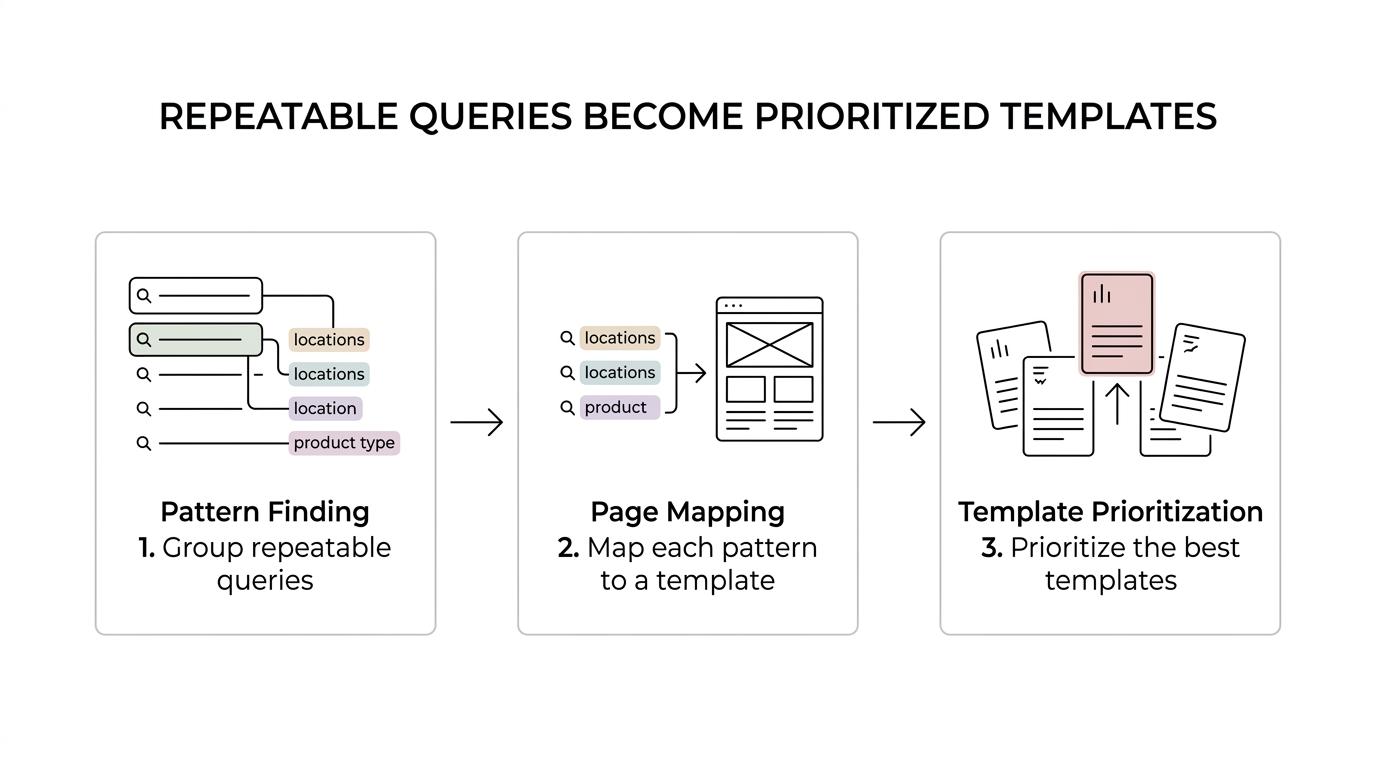
Step 3 is prioritization. Score patterns by traffic potential, conversion intent, data availability, and differentiation. If two patterns have similar volume, choose the one with stronger commercial intent and stronger internal data. That usually wins faster.
A matrix is doing its job when it tells you what not to build. If a pattern lacks search demand or unique page variables, cut it.
How do programmatic SEO pages differ from traditional editorial SEO pages?
Programmatic SEO pages target pattern-based demand, while editorial pages target explanation and persuasion. G2 and NerdWallet need both because breadth captures searches, but depth earns links, trust, and conversions.
Programmatic pages win on coverage. They are efficient when the query structure is predictable and the template can serve many variations. Think directories, comparisons, integrations, inventory pages, or calculators.
Editorial pages win on nuance. They are better when the searcher needs interpretation, strategy, education, or proof. Think original research, expert explainers, case studies, or regulatory analysis.
The trade-off is straightforward. Programmatic SEO scales faster, but quality control is harder. Editorial SEO scales slower, but differentiation is easier.
Common misconception: one replaces the other. In practice, the strongest SEO systems combine them. Programmatic pages capture intent clusters, and editorial pages feed authority, links, and internal support into those clusters.
How do you create page templates without producing thin or duplicate content?
Good templates create consistency without cloning meaning. Webflow and Airtable help teams separate fixed modules from variable content so each page can rank for a distinct query and still read like a real resource.
Step 1 is defining fixed versus variable modules. Fixed modules are your page frame: intro structure, schema type, CTA block, comparison table layout, or FAQ styling. Variable modules are what make each page distinct.
Step 2 is enriching the variable layer. Good variable content comes from data, expert commentary, screenshots, user reviews, pricing logic, feature mapping, or localized context. If the only variable is a keyword token, stop.
Three template rules keep quality high:
- Unique proof: screenshots, stats, examples, or quotes tied to that page
- Unique context: industry, location, use case, regulation, or workflow differences
- Unique linking: related pages, parents, children, and supporting editorial assets
Step 3 is page-level QA. Check title tags, H1s, canonicals, structured data, and internal links. Then read five pages side by side. If they blur together, Google probably sees the same issue.
Pro tip: publish fewer templates with richer variables. A 200-page set with strong uniqueness usually beats a 5,000-page set with superficial swaps.
Which data sources are best for programmatic SEO pages: internal data, public data, or third-party APIs?
Internal data is usually best, public datasets are cheapest, and third-party APIs are fastest. Stripe-style product data and Census data can both power pages, but their defensibility is very different.
Internal data is the strongest option because competitors cannot copy it easily. Product usage, customer cases, support logs, pricing permutations, or first-party inventory can create pages with real moats.
Public data is cheap and accessible. Census, SEC, BLS, or other open datasets can power useful pages, especially in finance, labor, SaaS benchmarks, or market intelligence. The risk is sameness. If everyone uses the same dataset, the winning factor becomes interpretation and UX.
Third-party APIs are fast. They help when freshness matters, like exchange rates, weather, jobs, flights, or ecommerce inventory. The trade-off is dependency. If the vendor changes pricing, rate limits, or field structure, your page set can break.
If your data source changes often, build a refresh cadence before launch. If it does not, stale pages will quietly lose both rankings and trust.
How do you launch programmatic SEO pages in phases without overwhelming crawl budget?
Phased launches beat mass publication for programmatic SEO. Googlebot and Search Console surface indexing signals quickly enough that a 100-page pilot usually teaches more than a 10,000-page dump.
Step 1 is pilot selection. Launch a small, high-intent segment first. For many teams, that means 50 to 200 URLs in one clean cluster.
Step 2 is controlled discovery. Put those pages in the XML sitemap, link them from indexable hub pages, and connect them to supporting editorial assets. If Google cannot discover or understand the cluster, more URLs will only magnify the issue.
Step 3 is gating expansion by evidence. Many operators use pilot thresholds like these before scaling:
- Indexation: 60 to 80 percent within 4 to 6 weeks
- Engagement: clicks or impressions rising across the cluster, not just one URL
- Conversion fit: at least early signs of trials, leads, or assisted conversions
Pro tip: if the pilot misses these gates, improve the template or query selection first. Do not solve a quality problem with volume.
What technical SEO elements matter most for programmatic SEO performance?
Technical SEO determines whether scaled pages get discovered, rendered, and trusted. Google and Bing both rely on clean internal links, canonicals, XML sitemaps, and fast Core Web Vitals.
Start with crawl and index controls. Canonicals must point correctly. Pagination, faceted filters, and parameter handling need clear rules. Thin search-result pages should not compete with valuable landing pages.
Then address internal linking. Programmatic pages need a visible graph, not an orphaned archive. Parent hubs, related-page modules, breadcrumbs, and contextual links help distribute authority and clarify hierarchy.
Core Web Vitals still matter at scale. Accepted thresholds remain useful benchmarks: LCP at 2.5 seconds or less, INP at 200 milliseconds or less, and CLS at 0.1 or less.
Schema helps, but only when it matches page purpose. Product, FAQPage, SoftwareApplication, Organization, Person, Review, and Breadcrumb markup can improve machine readability. Common misconception: schema fixes weak content. It does not. It helps search systems parse good pages more reliably.
How do you measure whether programmatic SEO is driving revenue, not just indexed pages?
Revenue measurement starts with template families, not vanity traffic. GA4 and BigQuery can tie page cohorts to pipeline so you can see which programmatic clusters actually create demos, trials, or SQLs.
Start by grouping pages by template family, not just directory. A /compare/ cluster, an /integrations/ cluster, and an /industries/ cluster often behave very differently.
Then track four layers. First, indexation and impressions. Second, clicks and landing-page sessions. Third, assisted and last-touch conversions. Fourth, pipeline or revenue by page family if your CRM can connect.
If impressions rise but clicks stay flat, the issue is usually snippet quality, weak positioning, or mismatched intent. If clicks rise but conversions stay flat, the issue is usually offer fit or page experience. If neither rises, review query selection and uniqueness.
For AI-era visibility, some teams also track citations in ChatGPT, Perplexity, or Google AI Overviews. That is not a replacement for revenue tracking, but it can explain why branded search and assisted conversions are moving.
Why do many programmatic SEO projects fail after initial indexation?
Most programmatic SEO failures come from weak differentiation, not weak tooling. Canva and Yelp work because their pages compound data, links, and user signals over time.
The first failure mode is thin variation. Thousands of URLs exist, but they add no new value. Search systems may crawl them, test them, and then reduce visibility.
The second is weak internal support. Programmatic pages often launch without enough links from hubs, blogs, navigation, or product pages. That leaves the cluster hard to discover and hard to trust.
The third is stale data. If the model depends on pricing, inventory, jobs, regulations, or market metrics, freshness is part of relevance.
The fourth is wrong intent. A team sees keyword volume, builds pages, and learns later that the traffic never converts. This is why bottom-funnel-first matrices usually outperform broad top-of-funnel pSEO in B2B.
One practical rule helps: if a cluster does not earn indexation, clicks, or qualified conversions after a fair test, prune it or rebuild it. Programmatic SEO is a system, and systems improve faster when weak templates are removed early.


