
B2B Payments SEO That Drives Demos
Payments SEO helps B2B brands win AI and search visibility early, shape vendor shortlists, and turn high-intent research into demos.


Most B2B payments SEO programs miss the moment that matters most: the research phase that happens before a prospect ever fills out a form.
That is a costly mistake in payments, where buyers are careful, technical, and usually under pressure to compare vendors across integration depth, risk controls, pricing logic, cross-border coverage, and finance outcomes. By the time sales gets the first email, much of the shortlist is already set.
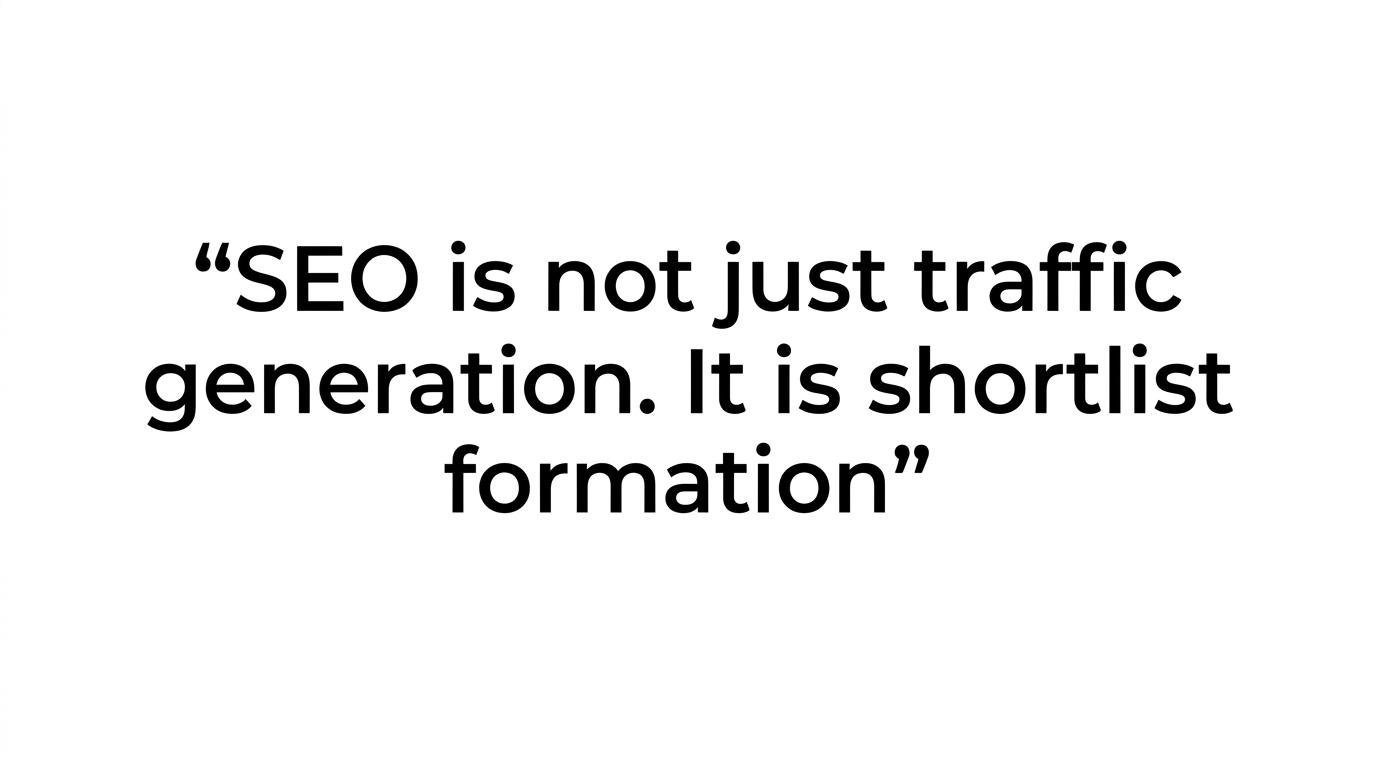
A recent Gartner report put a sharp point on this reality: only 2% of B2B buyers start the purchase process with no vendors in mind. 6sense’s 2025 buyer research adds another layer, reporting that buyers still initiate contact close to 80% of the time, reach out to their preferred vendor first, and purchase from that vendor in nearly 80% of cases. For payments companies, SEO is not just traffic generation. It is shortlist formation.
Why B2B payments SEO must shape the vendor shortlist
In payments, the path to a demo rarely starts with a branded search. It starts with category questions, problem framing, and side-by-side evaluation. Buyers might search for “AP automation for marketplaces,” “cross-border payouts platform,” “embedded payments for SaaS,” or “stablecoin settlement for B2B” weeks before talking to a sales team.
That changes how SEO should be planned. If the site only targets brand terms or a handful of bottom-funnel pages, it arrives late to the buying process. Stronger programs earn visibility during the earlier research that shapes the preferred vendor list.
This is even more important because payments is not a static category. McKinsey’s 2025 Global Payments Report describes an industry redefining foundational structures in response to geopolitical pressure, new digital models, and accelerating AI. It also highlights stablecoins as an alternative for cross-border settlement and tokenized deposits as a way to keep funds instantly accessible while earning intraday returns. When the market shifts this fast, buyers search to make sense of the change. The vendors that teach clearly win more of that attention.
A practical payments SEO strategy should support three jobs at once:
- category education
- solution comparison
- commercial validation
- technical reassurance
How AI search changes B2B payments buyer research
Classic SEO still matters, but blue-link rankings are no longer the whole field.
Forrester reported in 2025 that twice as many buyers in its Buyers’ Journey Survey named generative AI or conversational search as a more meaningful or important source of information than any other source. 6sense found that buyers’ use of LLMs peaks in the middle of the buying journey. That means a payments brand now needs to be visible not only in search results, but also in AI-generated summaries, citations, quoted explanations, and answer panels.
In practice, that shifts content strategy in two ways. First, pages need to answer narrow, high-intent questions with precision. Second, the brand needs strong entity signals so AI systems can identify what the company does, where it fits, and why it is credible.
A page written only to chase keywords tends to underperform in this environment. A page that clearly defines the problem, names the buyer, explains the workflow, covers tradeoffs, and connects to proof has a much better chance of being cited by both search engines and AI assistants.
That creates a new standard for payments SEO:
- Entity clarity: clear descriptions of product scope, audience, integrations, and use cases
- Answer depth: direct responses to comparison and implementation questions
- Source trust: data, expert commentary, references, and proof points that can be quoted
- Content structure: headings, definitions, tables, FAQs, and internal links that help machines parse meaning
Which payments SEO topics drive demos instead of empty traffic
Not every high-volume keyword is useful. Payments teams do not need more visitors who want basic definitions and never buy. They need visibility on queries that map to buying committees, budget owners, operators, and implementation teams.
The best query sets usually sit at the intersection of pain, workflow, and vendor evaluation. Think terms around payables automation, supplier payouts, commission payments, treasury workflows, reconciliation, fraud controls, FX management, embedded finance, and cross-border orchestration.
A strong program also covers new infrastructure themes early. If buyers are researching stablecoins, tokenized deposits, AI-driven payment operations, or changes in settlement rails, that research should lead to your brand instead of a publisher or competitor.
Here is a simple way to frame content priorities.
[markdown] | Query theme | Buyer signal | Best asset type | | --- | --- | --- | | “best B2B payments platform” | active vendor shortlist building | comparison page | | “cross-border payments for marketplaces” | use-case fit evaluation | solution page | | “Stripe alternatives for payouts” | competitor displacement | alternative page | | “AP automation with supplier onboarding” | workflow pain and system need | product-led guide | | “stablecoin settlement for B2B” | research into new infrastructure | thought leadership page | | “payment orchestration vs PSP” | architecture decision | explainer with diagrams | | “how to reduce failed payouts” | operational pain with urgency | problem-solution article | | “ERP integration for payments platform” | implementation diligence | technical landing page | [/markdown]This mix matters because demo-driving SEO is rarely built on one page type. It comes from a content system that supports the whole research motion, from first question to vendor selection.
Content architecture for payments SEO that supports revenue
The strongest payments SEO programs are built from the bottom up, not the top down. Start with commercial pages tied to revenue, then build supporting educational assets that feed them.
That means product pages, solution pages, integration pages, alternatives pages, and comparison pages should be treated as core growth assets. Blog content should support those pages, not distract from them.
A clean architecture often looks like this:
- Commercial pages: product categories, industries, use cases, partner integrations, pricing context
- Comparison pages: competitor alternatives, “x vs y” pages, vendor selection frameworks
- Operational content: onboarding flows, reconciliation logic, compliance workflows, implementation questions
- Market education: stablecoins, tokenized deposits, payment orchestration, AI in payment operations
This approach works well in payments because buyers do not move in a straight line. A finance leader may start with ROI questions, while a product team checks API fit and a risk team looks for controls. Your content has to support each of them without fragmenting the story.
Single-purpose articles also underperform when they are isolated. A strong “cross-border payouts” page should connect to country coverage, FX handling, compliance processes, payout methods, onboarding standards, and a demo path. Internal linking is not just an SEO technique here. It is how buyer confidence gets built.
Authority signals matter more in payments SEO than in many categories
Payments is a trust-heavy market. Buyers are evaluating financial workflows, movement of funds, compliance exposure, and operational resilience. So search visibility alone is not enough. The content must feel reliable, current, and specific.
This is where authority becomes practical. Search engines and AI systems both respond to clear evidence that a company has first-hand knowledge of the topic. That can come from original data, product documentation, public case studies, expert commentary, glossary depth, integration detail, and consistent coverage of a category over time.
It also helps to publish on topics that reflect where the market is moving, not just where it has been. When industry research points to stablecoins, tokenized deposits, and AI-driven changes to infrastructure, content should address those topics in a grounded way. Not hype. Real operator detail.
A few authority signals tend to matter most in payments content:
- precise terminology used consistently
- named workflows and system components
- technical and compliance detail without vague filler
- proof pages tied to customer outcomes
- fresh publishing cadence on category shifts
A published case study from Austin Heaton reported more than 2,000 sales from organic search for B2B clients across FinTech, SaaS, and payments over two years, including a B2B payments platform case that generated 101 direct conversions from ChatGPT and Gemini in 60 days. You can read that example here. The bigger point is not the number alone. It is that AI visibility is now measurable and can directly contribute to pipeline.
Payments SEO metrics that reveal real buying intent
Traffic is useful, but it is a weak primary metric for B2B payments.
A better reporting model tracks whether the brand is winning visibility where vendor choice gets made. That includes commercial keyword coverage, comparison-page entry, assisted demo conversions, organic-influenced pipeline, AI citation frequency, and branded search lift after educational content expands.
This also means segmenting performance by page intent. An explainer on stablecoin settlement should not be judged the same way as a “best payment orchestration platform” page. One builds category authority and early demand. The other should produce direct sales activity.
A practical scorecard often includes:
- rankings for high-intent non-brand queries
- organic demos by landing page type
- pipeline influenced by comparison and solution pages
- AI assistant citations and referral sessions
- conversion rate from non-brand research pages
- growth in branded search after category coverage expands
When those metrics move together, SEO is doing more than generating visits. It is shaping market preference.
A 90-day plan for B2B payments SEO that earns demos
Most teams do not need a bigger list of keywords. They need a sharper operating plan.
The first 30 days should focus on research and architecture. Map the current site to high-intent query themes, identify gaps in commercial pages, review which competitor and alternative terms matter, and audit whether the brand is legible to AI systems. If the site cannot clearly explain the product, audience, use cases, and differentiators, that needs attention early.
The next 30 days should prioritize launch velocity. Publish or upgrade the money pages first: solution pages, comparison pages, industry pages, and integration pages. Then support them with tightly scoped research articles that answer the questions buyers ask before and during shortlist building.
The final 30 days should focus on authority expansion and measurement. Add proof, sharpen internal links, improve entity clarity, monitor AI citations, and tune pages based on demo data rather than vanity rankings.
That 90-day motion is simple, but it is powerful because it matches how payments buyers actually research. They gather options early, compare deeply, and increasingly use AI tools along the way. When your SEO program meets them in that process, demos stop feeling random and start looking repeatable.


