
Austin Heaton's Top AEO Results: 6 Case Studies
Explore Austin Heaton's top AEO results. This guide breaks down 6 case studies showing how to drive AI search traffic, conversions, and massive organic growth.



AEO performance rarely improves because a team published more informational content. It improves when AI systems can identify the business, understand what it sells, connect it to trusted sources, and pull answers from pages built to convert.
That is the thread running through Austin Heaton's top AEO results.
This article focuses on six documented patterns of execution, not broad theory. The value is in the mechanics. Entity structure. authority building. answer formatting. commercial page design. referral tracking. conversion measurement. Those are the systems that produced visibility across Google, ChatGPT, Perplexity, Gemini, and AI Overviews.
The point is not that strong AEO outcomes are possible. The point is that these results have already been produced, measured, and broken down into repeatable components. Some wins came from schema and authority work before major content expansion. Others came from direct answer optimization, AI referral capture, and pages designed for rich results and bottom-funnel action. The trade-off is straightforward. Teams that chase volume usually get more impressions. Teams that build machine-readable authority and commercial clarity get more qualified demand.
If you want the operating model behind that approach, Austin Heaton's entity authority framework for AI search visibility gives the strategic backdrop. The six sections below stay grounded in execution: what changed, where the lift came from, which metrics moved, and why the ROI held up.
1. 1,419% Organic Session Growth Through Entity Schema & Authority Building
A common B2B mistake is treating schema as technical cleanup after the content plan is already in motion. That sequence creates waste. If search engines and AI systems cannot identify the company, connect its products to a clear category, and verify those relationships across the web, more content usually produces more ambiguity, not more qualified traffic.
The documented result here was 1,419% organic session growth across Heaton’s work, as noted earlier in the article. The useful takeaway is the operating model behind that lift. It came from making the business machine-readable before asking search systems to trust it at scale.
What the implementation involves
Several components stay consistent.
Organization schema defines the company. Product and service schema clarify what it sells. BreadcrumbList and page-level markup reinforce hierarchy, category context, and page purpose. Off-site authority work then strengthens those same associations through expert bylines, relevant citations, and digital PR on sites that already sit near the buyer’s decision path.
That sequence matters. Teams often publish category pages, blog posts, and comparison content before the entity layer is stable. The result is familiar: branded queries rise, but non-branded growth stalls because the site still looks fragmented to retrieval systems.
A FinTech compliance platform is a practical example. Publishing dozens of articles on regulatory trends can build surface area, but it does not automatically establish the platform as a recognized solution for compliance operations. A stronger approach is to map the brand to its core product terms, connect those terms to commercial pages, and repeat the same language and relationships in trusted third-party mentions. Heaton’s own entity authority framework explains the strategic side. His multi-LLM optimization playbook for getting cited across ChatGPT, Perplexity, Gemini, Copilot, and Claude shows how that structure carries into AI retrieval.
Practical rule: If site architecture, schema, and off-site brand mentions describe different things, answer engines will hesitate to cite the business for commercial queries.
What tends to work
- Entity-first implementation: Define the company, product set, and page relationships before scaling editorial production.
- Category-relevant authority building: Get cited on sites that reinforce the same topic graph your commercial pages target.
- Commercial page support: Point authority to solution, use-case, and comparison pages where buying intent is already present.
What usually underperforms
- Blog-led growth without entity alignment: Traffic can increase while category ownership stays weak.
- Generic link acquisition: Links from unrelated sites add little if they do not sharpen brand meaning.
- Plugin-level schema deployment: Basic markup helps indexing, but it does not replace deliberate entity modeling.
There is a real trade-off. This work takes longer than shipping ten new articles in a month, and it is less visible to stakeholders who only track publishing velocity. It tends to hold up better over time because it improves how systems interpret the business itself, not just how many URLs the site adds.
2. 560% AI Search Click Increase in 60 Days via ChatGPT, Perplexity & AI Overviews
Publishing more content is usually the slowest way to increase AI visibility. The faster path is to make high-intent pages easier for ChatGPT, Perplexity, and Google AI Overviews to extract, compare, and cite.

One of the clearer patterns in Austin Heaton's work is that AI search gains can happen quickly when teams stop treating AEO as a blog content project and start treating it as retrieval engineering for revenue pages. Across B2B SaaS and FinTech, the reported result was a 560% increase in AI search clicks within 60 days, driven by page restructuring, answer formatting, and stronger retrieval signals rather than a broad publishing sprint.
The underlying tactic set is practical. Product, solution, comparison, and use-case pages get rebuilt around the questions AI systems pull into answers. That includes implementation details, pricing context, migration friction, compliance concerns, alternatives, and clear statements about who the product is for and who it is not for.
A workflow automation company is a good example. A typical page leads with category copy, feature grids, and brand messaging. A page built for AI retrieval puts reusable answers near the top, supports them with scannable proof, and makes relationships between the company, product, integrations, and target use cases unambiguous.
The pages that tend to pick up citations share a few traits:
- Direct-answer formatting: concise responses placed high on the page, written in language a model can quote with minimal editing
- Comparison and alternative coverage: balanced pages that help engines resolve commercial evaluation queries
- Clear retrieval signals: schema, headings, and internal links that connect features, industries, outcomes, and objections
- Proof near the answer: case evidence, product specifics, and constraint details close to the claim itself
Heaton's multi-LLM optimization playbook maps this across platforms. The same retrieval principles show up repeatedly, even though each engine cites and summarizes content a little differently.
AI engines cite sources that resolve buying questions clearly, quickly, and with low ambiguity.
There is a trade-off. This approach produces faster movement than another top-of-funnel content batch, but it forces tighter positioning and better proof. If the product story is vague, if the page avoids objections, or if the site gives weak authority signals, answer blocks alone will not carry the result.
That is why the strongest rollouts usually start on bottom-funnel pages. The upside is higher because those URLs can capture both AI citations and conversion-ready visits. For teams trying to turn AI visibility into pipeline, the more useful model is getting qualified B2B SaaS leads from ChatGPT traffic, not chasing informational impressions that never reach sales.
3. 5.13K ChatGPT Referrals Generating 101 Conversions in 60 Days
Traffic from ChatGPT gets overrated for one reason. Teams celebrate referral growth before they prove revenue impact. The useful benchmark is not whether AI sent visits. It is whether those visits turned into forms, demos, trials, or qualified conversations.
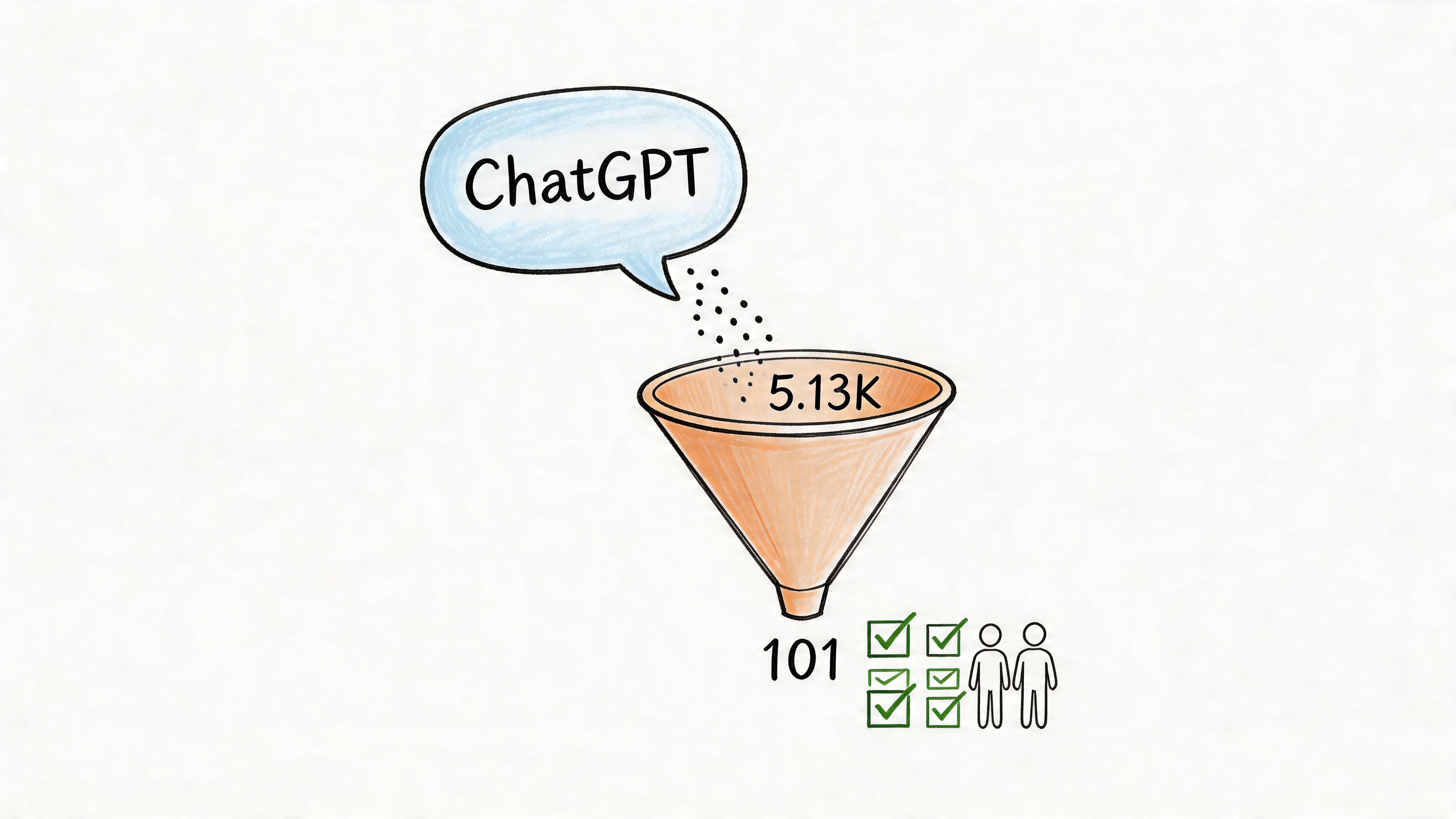
One of the stronger examples in Austin Heaton's published AEO work combines two outcomes already referenced elsewhere in this article. ChatGPT referral volume increased sharply, and AI-sourced conversions followed within a 60-day window. That combination matters more than citation screenshots because it shows the full chain from discovery to commercial action.
The hard part is rarely the referral itself. The hard part is what happens after the click.
A B2B SaaS buyer arriving from ChatGPT usually has more context than a standard search visitor. They often land with a narrowed problem, a shortlist mindset, and a higher expectation for proof. If the page opens with generic brand copy, slow orientation, or a weak call to action, conversion rates stall even when AI visibility improves.
That is why the landing experience deserves as much attention as answer optimization. Teams that convert AI traffic well usually set up four things:
- Referral-level segmentation: Track ChatGPT and other AI sources separately inside analytics and CRM reporting.
- Context match on entry pages: Align the page headline, subheads, and proof points with the type of question that triggered the recommendation.
- Faster commercial paths: Cut unnecessary clicks between the first visit and the demo, trial, or contact action.
- Proof above the fold: Show fit, outcomes, comparisons, and trust signals before the visitor has to hunt for them.
Heaton's article on getting more qualified leads from ChatGPT as a B2B SaaS startup lines up with that model. The same pattern also shows up in strong FAQ structures that match LLM query patterns with schema markup templates, where the page answers the exact buying question and removes friction fast.
Here is the trade-off. Tight conversion tracking and message alignment produce clearer ROI, but they also expose weak positioning. If product differentiation is vague, if pricing friction shows up too late, or if the page hides objections under marketing copy, AI referrals will magnify those problems instead of fixing them.
The operational mistake is simple. B2B teams send AI visitors to broad educational posts, mix that traffic into organic reporting, and then claim AEO is working because sessions went up. That is not acquisition analysis. It is channel blur.
The better standard is stricter. Treat ChatGPT as a measurable source, map referral intent to landing-page intent, and judge success by conversion quality, not visit volume. That is how referral growth turns into pipeline instead of vanity metrics.
4. Featured Snippet Domination via Structured Data & Answer Optimization
Featured snippets are still one of the clearest indicators that a page is built for retrieval, not just ranking. In practice, snippet wins also correlate with stronger visibility in AI summaries because both systems prefer the same inputs: explicit answers, clean formatting, and unambiguous context.

The mistake B2B content teams make is treating featured snippets like a copywriting trick. They are usually an information architecture outcome. Pages win position zero because the answer appears fast, the page structure reduces ambiguity, and the supporting signals reinforce topical authority. That logic sits inside Austin Heaton’s broader AEO framework and definition for 2026, but the practical test is simple: can a search system extract the answer in seconds without guessing what the page means?
Take a query like “what is API integration.” The page that wins rarely opens with brand positioning or a long-winded intro. It gives a direct definition in the first paragraph, expands with scannable subheads, and uses supporting sections to clarify use cases, examples, and implementation details. That is not glamorous content strategy. It is disciplined answer formatting.
The pages with the best snippet potential usually share four traits:
- Answer-first copy: A concise definition or process summary appears near the top of the page.
- Structured formatting: Numbered steps, bullet lists, comparison tables, and precise subheads make extraction easier.
- Relevant schema markup: Structured data helps search engines classify the page and connect entities correctly.
- SERP-aware formatting: The page is shaped around the current snippet format instead of forcing a preferred editorial style.
Heaton’s post on structuring FAQ content to match LLM query patterns with schema markup templates shows the same operating principle. Clear question targeting, predictable markup, and answer blocks written for extraction tend to outperform vague “thought leadership” pages on definitional and procedural queries.
There is a real trade-off here. Snippet-ready pages often sound less branded, less clever, and less polished to internal stakeholders. That is usually the right decision. Buyers asking direct questions want precision before persuasion.
Teams that insist on lead-ins, scene-setting, and soft messaging reduce their odds twice. They weaken snippet eligibility, and they give AI systems less usable material to cite or summarize.
5. Voice Search Ranking Authority for Featured Queries
Voice search did not create a new SEO discipline. It exposed which pages were already trusted enough to be read back as the answer.
That is the part many teams miss. They keep chasing “conversational keywords” while ignoring the retrieval layer. Alexa, Google Assistant, and Siri usually pull from sources that are easy to parse, tightly scoped, and already established for the query class. Voice visibility is a downstream result of authority plus answer design.
Austin Heaton’s work is useful here because it frames voice search as an output of answer engine optimization, not a separate tactic set. His guide to the definition and framework for answer engine optimization in 2026 lays out the operating model. The practical takeaway is simple. If a page cannot earn trust in search and AI retrieval, it will not earn spoken retrieval either.
What this looks like in practice
Take an identity platform targeting queries like “how do I implement single sign-on” and “what is SCIM provisioning.” The pages that earn voice exposure are usually the ones that reduce interpretation work for the engine. They open with a direct answer, define the term cleanly, and support that answer with headings that confirm intent. They also sit on domains that already have enough topical credibility to be treated as safe sources.
That last point matters. A well-written paragraph alone rarely gets spoken aloud if the site has weak authority in the category.
The actual playbook
Teams that want voice search coverage for featured queries should focus on four execution points:
- Write for immediate extraction: Put the answer in the first visible section, in plain language, without a long brand-led intro.
- Match the query format: Definition, steps, comparison, and troubleshooting queries need different answer shapes.
- Support entity clarity: Product names, concepts, standards, and related terms should be explicit so retrieval systems do not have to guess context.
- Design for the follow-up click: A large share of voice-origin discovery continues on mobile, so the page has to load fast and make the next action obvious.
There is a trade-off. Pages built for spoken retrieval often feel less “editorial” and less persuasive in the first screen. That usually improves performance. Voice systems favor precision, not personality, and buyers asking operational questions want the answer before they want the pitch.
The wrong move is spinning up separate voice-search pages stuffed with awkward question variants. That fragments authority, creates thin content, and gives search systems multiple weak candidates instead of one strong one. The better approach is to strengthen the pages that already matter to revenue so they can serve typed, AI-assisted, and spoken queries from the same asset.
6. Rich Results Acquisition Through Structured Data and Commercial Page Design
Rich results are not a vanity layer. On commercial pages, they are often the byproduct of something more valuable: a page that clearly states what it is, who it serves, and what action should happen next.
That is why this case study matters.
Austin Heaton’s AEO work repeatedly points back to the same operating principle: technical clarity only produces business value when it supports revenue pages. On pricing, comparison, product, and implementation pages, structured data helps search engines classify the asset correctly, supports richer SERP treatments, and reduces ambiguity for AI retrieval systems that need clean page signals before they cite anything.
A practical example makes the trade-off clear. Consider an e-commerce software company with a pricing page, feature comparison pages, implementation documentation, and vertical-specific solution pages. If those assets use inconsistent schema, weak internal hierarchy, and vague on-page labeling, Google has to infer too much and AI systems often flatten the context. If the same assets use clean Product, FAQPage, and BreadcrumbList markup, align visible headings with buyer intent, and answer objections close to conversion points, they become easier to parse and more likely to earn enhanced search presentation.
The gain is usually operational before it is dramatic. Better breadcrumb display improves scanability. FAQ-rich treatments can pre-handle objections in the SERP. Product and pricing pages become easier to classify, which helps the right page appear for the right commercial query.
That changes click quality.
The mistake is treating schema as a blog SEO task because content teams can ship it quickly. The higher-ROI move is to start with pages tied to evaluation and purchase intent, then design those pages so the markup and the layout support each other. A pricing page with schema but weak information hierarchy still underperforms. A comparison page with strong copy but no structured context leaves too much room for misinterpretation.
This is also where commercial page design matters. Rich results are easier to win when the page does obvious commercial work: clear offer framing, direct answers to buyer questions, visible proof, and a next step that does not require hunting through the page. Structured data does not rescue a muddy page. It strengthens a page that already communicates intent cleanly.
Heaton’s broader methodology pushes in the same direction, as noted earlier. Instead of over-investing in top-of-funnel articles that AI engines often summarize without sending traffic back, he prioritizes bottom-funnel assets where stronger SERP presentation can improve both click-through rate and sales efficiency. That is the primary use case here. Rich results on informational pages can help. Rich results on money pages usually matter more.
Austin Heaton: Top 6 AEO Results Comparison
| Case Study | Implementation Complexity | Resource Requirements | Expected Outcomes | Ideal Use Cases | Key Advantages |
|---|---|---|---|---|---|
| 1,419% Organic Session Growth Through Entity Schema & Authority Building | High, multi-layered schema + editorial outreach | High, schema dev, high-authority placements, ongoing content/PR | Very large, sustainable organic growth (1,419% over 12 months) | B2B SaaS, FinTech, AI/ML startups, Crypto/Web3 | Long-term authority, defensible moat, compounding returns |
| 560% AI Search Click Increase in 60 Days via ChatGPT, Perplexity & AI Overviews | Medium‑High, multi‑platform AEO and answer optimization | Medium, answer‑formatted content, monitoring, authority placements | Rapid AI‑search click lift (560% in ~60 days) | AI startups, B2B SaaS, FinTech, E‑commerce | Fast results, early access to AI channels, high‑intent traffic |
| 5.13K ChatGPT Referrals Generating 101 Conversions in 60 Days | Medium, conversion tracking + CTA optimization for chat platforms | Medium, UTMs, landing pages, analytics and attribution setup | Measurable conversions and revenue (101 conversions from 5.13K referrals) | B2B SaaS, FinTech, E‑commerce, Crypto/Web3 | Direct ROI attribution, lower CPA, scalable conversion model |
| Featured Snippet Domination via Structured Data & Answer Optimization | Medium, answer formatting, JSON‑LD and competitor reverse‑engineering | Low‑Medium, content edits, schema implementation, monitoring | High SERP/AI Overview visibility (47 snippet positions) | B2B SaaS, FinTech, E‑commerce, Crypto/Web3 | Higher CTR, dual SEO/AEO visibility, relatively quick wins |
| Voice Search Ranking Authority for Featured Queries (Alexa, Google Assistant, Siri) | Medium, conversational keyword and voice‑readable answers | Low‑Medium, content rewrite, schema, cross‑device testing | Top‑3 voice rankings for target queries (23 keywords in case study) | B2B SaaS, FinTech, E‑commerce, AI startups | High‑intent voice traffic, lower competition, benefits for traditional search |
| Rich Results Acquisition (FAQPage, BreadcrumbList, Product Schema) Driving 28% SERP CTR Increase | Low‑Medium, multi‑schema rollout and validation across pages | Medium, schema across many pages, QA and maintenance | CTR improvement (~28%) without ranking changes; quick visibility gains | B2B SaaS, E‑commerce, FinTech, Crypto/Web3 | Increased SERP real estate, star ratings, expandable FAQs, fast ROI (weeks) |
How to Replicate These AEO Results
AEO results like these do not come from publishing more pages or sprinkling schema across a site. They come from operational discipline. The work has to connect entity clarity, citation eligibility, authority signals, and revenue measurement.
Start by fixing retrieval, not content volume.
That means defining the company, product, category, and use case relationships clearly across core pages. AI systems are far less forgiving than traditional search when those signals conflict. If a commercial page reads like a blog post, if solution pages overlap, or if schema markup describes entities the page does not support, visibility gets weaker fast. Clean information architecture, aligned on-page language, and accurate schema give search engines and AI platforms a stable source to cite.
Authority still decides who gets mentioned. Your site does not get the final vote on credibility. Third-party references, relevant links, cited experts, and digital PR all shape whether an AI system treats your content as a source or ignores it. As noted earlier, Austin Heaton’s work reflects this mix of technical cleanup and authority building rather than a schema-only approach. That trade-off matters. Teams that spend every hour on content production while ignoring external validation usually end up with indexation and impression growth, but limited citation visibility on commercial terms.
Measurement is where serious programs separate themselves.
Track AI referrals independently from broader organic traffic. Review which pages get cited, which prompts drive visits, and which sessions enter qualified conversion paths. Assisted conversions matter, but they are not enough on their own. If AI traffic lands on the wrong pages, bounces, or stalls before pipeline stages, the visibility is not commercially useful. Good reporting should answer a simple question. Did AI discovery contribute to revenue, or did it just create another top-of-funnel vanity chart?
Restraint matters too. Expanding into every AI platform with separate tactics usually creates duplication, reporting noise, and weak page focus. A better model is one source of truth built around high-intent pages, validated entity signals, and answer formats that can be retrieved across Google, ChatGPT, Perplexity, Gemini, and AI Overviews without rewriting the entire site for each platform.
For companies that need strategy and execution tied together, senior ownership is usually the right operating model. A fractional SEO lead or a focused AEO engagement tends to outperform a generic retainer because the work cuts across technical SEO, content design, authority building, and analytics. Austin Heaton is one consultant working in that model across B2B SaaS, FinTech, AI startups, and related categories. For teams that also need tighter attribution around search performance, AI marketing analytics can improve channel measurement and make budget decisions easier.


