
AI Search for Publishers: What Gets Cited
Learn what drives AI search for publishers: citation eligibility, ranking overlap, freshness, and original reporting that earns visibility.



Publishers are entering a search environment where visibility is no longer shaped only by blue links. AI Overviews, AI Mode, and answer-first interfaces now summarize, synthesize, and cite. That shifts a familiar SEO question into a more exact one: what content actually gets cited, and what makes a page eligible in the first place?
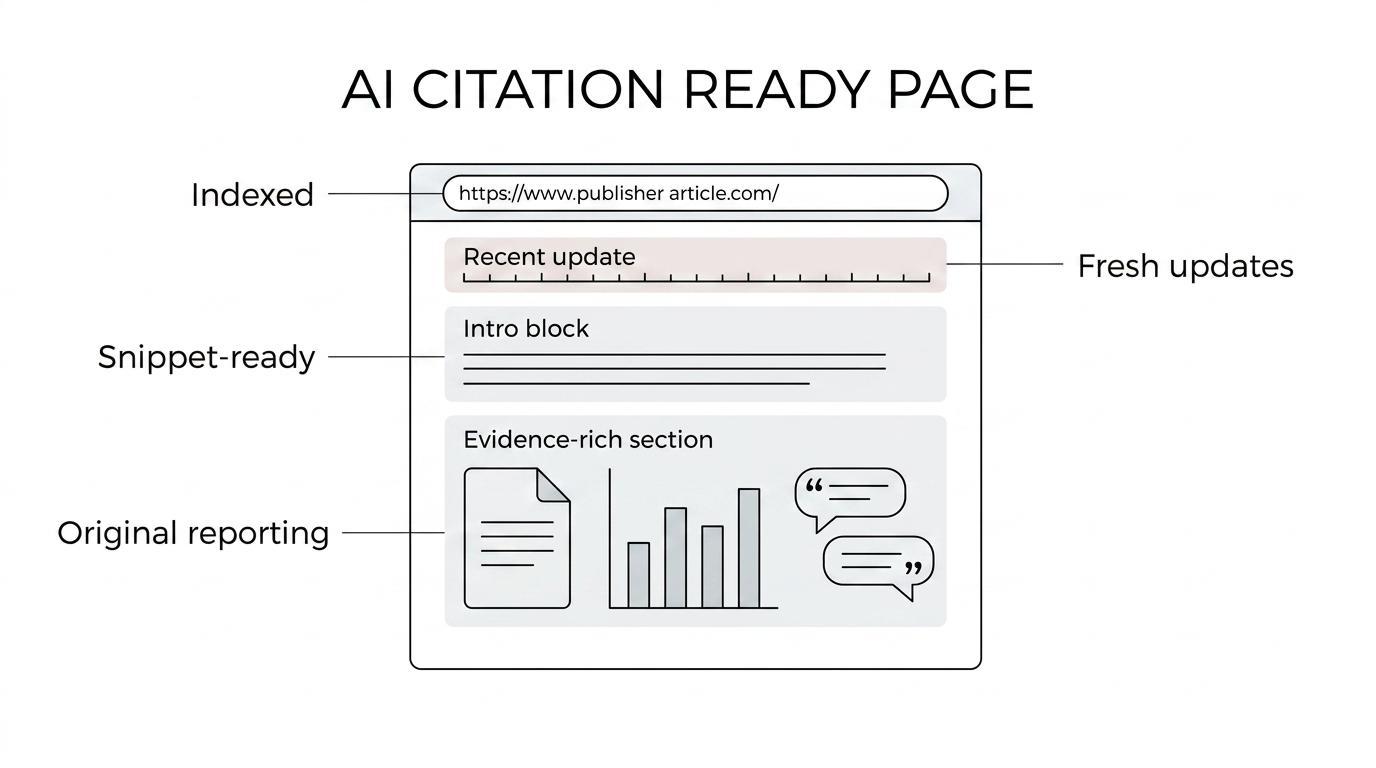
The current picture is encouraging, but it is not evenly distributed. Official guidance from Google says pages must be indexed and eligible for a snippet to appear as supporting links in AI Overviews or AI Mode. Independent studies also suggest that citations cluster around a relatively small group of sources, with heavy overlap between AI citations and strong organic rankings. For publishers, that means AI visibility is not random. It follows patterns that can be studied and acted on.
Google AI Overviews eligibility for publisher citations
The clearest baseline comes from Google Search Central. Google states that, to be eligible as a supporting link in AI Overviews or AI Mode, a page must be indexed and eligible to be shown in Google Search with a snippet. Google also says there are no additional technical requirements beyond the existing Search technical requirements.
That matters because many teams still look for a new schema type, a hidden feed, or an AI-specific tag that will unlock citations. Google’s guidance points in a different direction. If a publisher page cannot be crawled, indexed, or shown with a snippet, its chance of appearing as a supporting link drops before content quality even enters the conversation.
Google also notes that AI Overviews and AI Mode may use different models and techniques, so the links shown can vary. A publisher may see one page cited in AI Overviews, another cited in AI Mode, and neither cited every time the same topic appears. That variability does not erase the basics. It simply means eligibility is necessary, not sufficient.
[markdown] | Publisher requirement | Why it matters for AI citations | Practical implication | | --- | --- | --- | | Indexed page | Unindexed pages are not eligible as supporting links | Confirm target pages are in Google’s index | | Snippet eligibility | Google says supporting links must be eligible to show with a snippet | Avoid accidental restrictions that suppress snippets | | Standard Search compliance | No extra AI-specific technical layer is required | Get core crawling, rendering, canonicals, and indexing right | | Query relevance | AI systems still need pages that match the user’s topic | Build pages around clear search intent and subject focus | | Link variation across systems | AI Overviews and AI Mode may cite different URLs | Optimize clusters, not just one page | [/markdown]AI search citation patterns across publisher content
Independent data suggests that AI search systems still lean heavily on the same pages that perform well in classic search. Ahrefs analyzed 1.9 million citations from 1 million AI Overviews and found that 76.1% of citations came from URLs already ranking in Google’s top 10 organic results. That is a strong signal that organic prominence and AI citation likelihood are closely connected.
Academic research points in a similar direction. One 2025 paper found that news citations in AI search systems are concentrated among a small number of outlets. Different models cited different publishers, yet shared citation patterns still appeared. Low-credibility sources were rarely cited. For publishers outside the top tier of authority, this is both a constraint and an opportunity. The constraint is obvious: AI systems do not spread attention evenly. The opportunity is that the signals appear legible enough to influence.
Freshness seems to matter too. Studies and field observations frequently show that recently updated content, current reporting, and active topic pages earn more AI visibility than static pages that have not been touched in months. That is especially true in categories where the query implies change, risk, comparison, pricing, product status, policy, markets, or ongoing events.
Pages most likely to earn citations often share a familiar profile:
- Strong organic rankings
- Original reporting or analysis
- Frequent updates
- Clear query match
- Publisher authority
- Stable, indexable URLs
Original reporting and freshness signals in AI search
Google’s Search Central blog advises site owners to focus on unique, valuable, non-commodity content made for people. For publishers, that phrase has real strategic weight. Commodity content can be summarized from many places. Original reporting, expert analysis, proprietary data, opinion with evidence, and sharply edited explainers are far harder to substitute.
This is where many publisher strategies either tighten up or drift into sameness. If ten outlets rewrite the same press release, the citation odds compress around the strongest brand or the page with the cleanest relevance signals. If one outlet adds source documents, a timeline, expert commentary, and a clearly dated update, that page has a much better claim on citation.
Freshness does not mean changing a timestamp and calling it done. AI systems appear to reward pages that are genuinely current. New facts, revised statistics, updated screenshots, timeline additions, new quotes, clearer definitions, and newly linked evidence all help a page remain citation-worthy over time.
Publishers usually see the best AI citation odds when they invest in content types that age well but stay current:
- Live topic pages: ongoing subjects with steady editorial updates
- Original news reporting: first-hand facts, documents, interviews, or on-the-ground context
- Reference explainers: evergreen pages revised as the topic changes
- Data-led analysis: charts, benchmarks, and interpretation unavailable elsewhere
Citation accuracy and trust in AI search results
Citation visibility is only half the story. Citation accuracy remains a real issue.
A Tow Center study, reported by Ars Technica, tested eight AI-driven search tools using excerpts from real news articles and asked the systems to identify the original headline, publisher, publication date, and URL. Error rates varied sharply across platforms. The report also found evidence that some AI tools ignored Robot Exclusion Protocol settings. That should get every publisher’s attention, not because the entire channel is broken, but because attribution can still fail in ways that affect traffic, trust, and licensing posture.
Academic work on generative search gives useful language for this problem. One paper frames trustworthiness through citation precision and citation recall. Those concepts matter well beyond research labs. They offer a practical way for publishers to assess whether AI systems are naming the right source and whether they are missing important supporting sources altogether.
A sensible internal review should watch three issues closely:
- Citation precision: whether the cited page is actually the correct source
- Citation recall: whether important pages from the publisher are missing when the topic is summarized
- Publisher attribution: whether headline, outlet name, date, and URL are identified correctly
Technical and editorial actions for publisher AI visibility
If the goal is to increase citation odds, the most productive work usually sits at the intersection of technical hygiene and editorial distinctiveness. Google’s guidance removes the mystery. You do not need an AI-only optimization layer before fixing the basics.
That means crawlability, rendering, canonicals, indexation, and snippet eligibility come first. It also means being careful with directives that suppress snippets or hide meaningful page text from search. If a page is strong enough to rank but too restricted to qualify as a snippet-bearing result, it may be leaving AI citation opportunities on the table.
Snippet eligibility issues that reduce publisher AI citation chances
Publishers should review whether their pages are unintentionally limiting snippet visibility. Google’s published requirement is clear enough that this deserves a specific check in technical audits.
Beyond that, editorial structure matters. A page that clearly states what happened, who said it, when it changed, and where the evidence comes from is easier for both search systems and readers to trust. Ambiguous update histories, recycled intros, weak bylines, and inconsistent source labeling can all make a page less dependable as a cited reference.
The strongest operating model usually includes these habits:
- Keep important pages continuously indexable and easy to render.
- Publish source-first reporting that adds facts, context, or interpretation not easily copied.
- Refresh high-value pages on a schedule tied to topic volatility, not arbitrary calendars.
- Protect URL stability and canonical consistency so authority compounds on one destination.
Metrics for publisher AI search performance
Publishers should resist measuring AI search only by raw referral clicks. Google has said clicks from search results pages with AI Overviews are higher quality, with users more likely to spend more time on the site. That means the right measurement framework needs both visibility and downstream value.
A cited page that drives fewer clicks but stronger engagement, more subscriptions, more branded searches, or more return visits may still be outperforming a page that once won on simple volume. AI search changes the path, not just the top-of-funnel count.
The most useful scorecard usually includes:
- Citation appearances across AI surfaces
- Organic rank overlap between cited pages and top 10 results
- Engaged sessions and time on site from AI-adjacent traffic
- Branded search lift after major citation wins
- Subscription, lead, or revenue contribution from assisted sessions
The pattern that keeps showing up is simple. Publishers improve their odds when their pages are eligible, original, current, and easy for search systems to interpret. Yet even strong pages compete in a citation market that favors a narrow set of sources. That makes operational discipline more valuable, not less. Teams that pair rigorous indexing and snippet eligibility with original reporting and systematic updates are giving themselves the best possible shot at being the source AI systems choose to cite.


