AEO Consultant for B2C SaaS
A saas pricing consultant helps B2C SaaS improve packaging, conversion, retention, and AEO visibility with clearer pricing models.



Pricing is one of the few growth levers that can lift revenue without waiting on a major product release or a larger acquisition budget. Yet many B2C SaaS companies still treat pricing as a design choice on the plans page instead of a system that shapes conversion, retention, expansion, and brand perception.
That gap is where a SaaS pricing consultant earns their keep. Strong pricing work is not about picking a number that “feels right.” It is about choosing the right value metric, structuring packages around buyer behavior, setting usage limits that feel fair, and building a pricing experience that supports both revenue and trust.
For B2C SaaS, the stakes are even higher. Self-serve users compare options quickly, switch easily, and often ask search engines and AI assistants direct pricing questions before they ever start a trial.
Why a SaaS Pricing Consultant Matters for B2C SaaS
Pricing has become a live growth function, not a one-time launch decision. OpenView has reported that 98% of pricing changes had either a positive or neutral impact on growth, and two in five companies that changed pricing saw ARR increase by 25% or more. That should get any SaaS leader’s attention.
B2C SaaS companies feel pricing pressure in a different way than enterprise software firms. The customer base is broader, average contract values are lower, and purchase decisions happen faster. Small pricing mistakes compound quickly. A free tier that is too generous can crush monetization. A premium tier that is too abstract can slow upgrades. A usage model without clear guardrails can create confusion instead of momentum.
A pricing consultant brings structure to those tradeoffs. Instead of arguing about whether a plan should cost $12 or $19, the work shifts to better questions. What behavior should be rewarded? Which users are the best fit for monthly billing versus annual billing? What usage pattern signals high intent? Where should limits push an upgrade, and where should the experience stay open?
That kind of focus matters because B2C SaaS growth is usually won in the small details.
What a SaaS Pricing Consultant Actually Changes
A good SaaS pricing consultant does much more than rewrite your pricing page. The role touches product packaging, billing logic, measurement, experimentation, and the language customers use when they compare you with alternatives.
In many SaaS teams, pricing gets split across product, finance, growth, and customer success. That can create friction fast. One team wants lower barriers to entry. Another wants higher ARPU. Another wants fewer support tickets. A consultant can turn those competing priorities into a pricing model that reflects the economics of the business and the experience customers want.
Common pricing work usually includes:
- plan structure
- free trial or freemium design
- annual discount strategy
- upgrade paths
- add-ons and overages
- packaging by feature, seat, or usage
The mechanics matter just as much as the price point itself. This is especially true when a company is moving toward usage-based or hybrid pricing, where revenue depends on accurate tracking and easy customer communication.
Here are the core building blocks:
- Value metric: The unit customers naturally connect to the result they are paying for
- Metering: The method used to track usage accurately and consistently
- Rating: The rules that turn usage into billable charges
- Invoicing: The billing experience customers see, judge, and either trust or question
- Packaging: The way features and limits are grouped into paid plans
- Experimentation: The testing process used to improve conversion, expansion, and retention over time
Pricing is never finished.
Comparing Flat-Rate, Tiered, and Usage-Based SaaS Pricing Models
The strongest pricing model depends on product behavior, cost structure, and how customers perceive value. There is no universal winner. Still, usage-based pricing is no longer niche. Stripe has defined usage-based SaaS pricing as charging customers based on consumption rather than a flat monthly fee, and it reported that nearly 30% of SaaS companies preferred usage-based pricing in 2023. McKinsey has also noted that the number of software companies using consumption-based pricing more than doubled between 2015 and 2024.
That shift makes sense. AI features, API calls, storage, workflow volume, and compute-heavy experiences often create variable costs. If product usage varies widely across customers, static plans can undercharge your heaviest users and overcharge your lightest ones.
For B2C SaaS, though, a pure usage model is not always the answer. Consumers usually want predictability. Many successful companies land on a hybrid structure: a base subscription plus usage limits, credits, or expansion tiers.
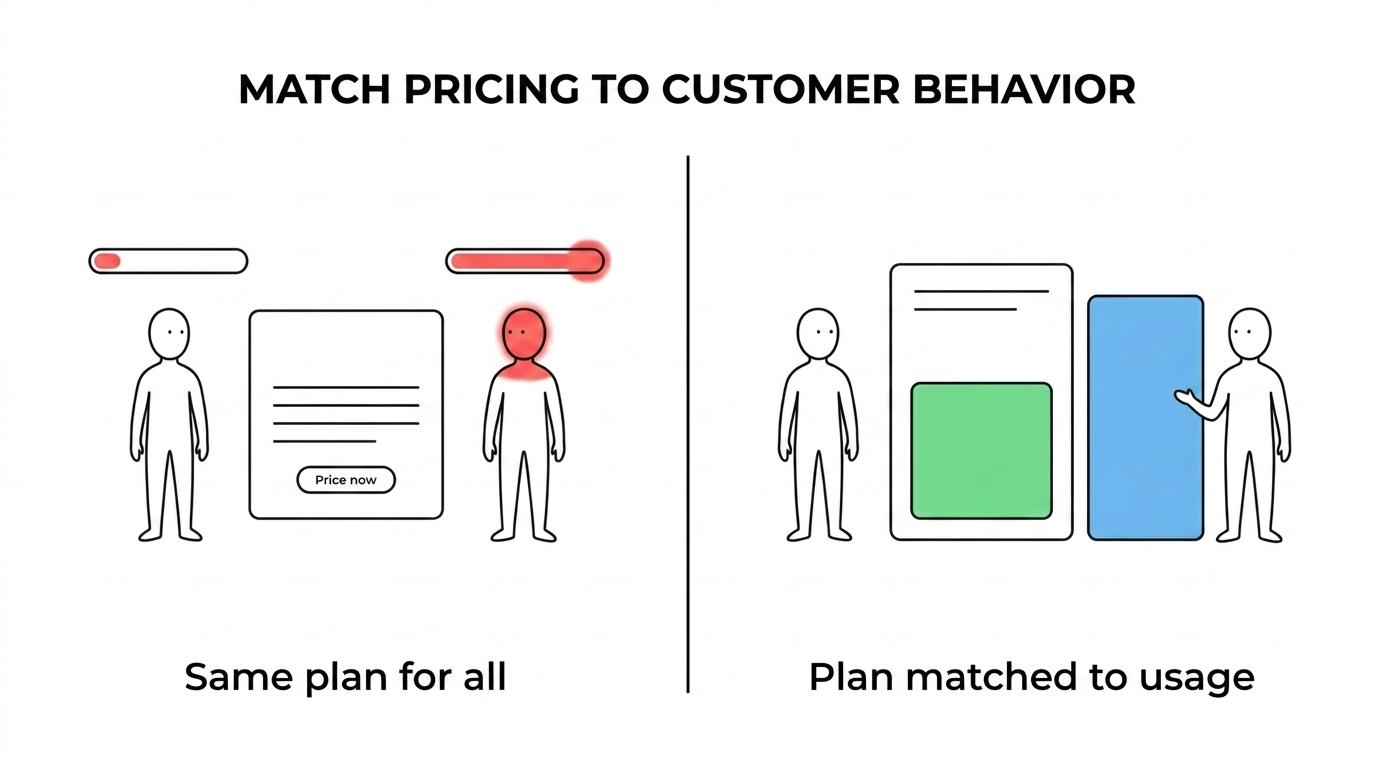
[markdown] | Pricing model | Best fit for B2C SaaS | Main upside | Main risk | | --- | --- | --- | --- | | Flat-rate | Simple products with narrow use variance | Easy to explain and market | Leaves money on the table with high-usage users | | Tiered | Products with clear feature ladders | Supports segmentation and upgrade logic | Can create plan confusion if differences are weak | | Usage-based | Products where value scales with activity | Low barrier to entry and strong expansion potential | Billing anxiety if usage is hard to predict | | Hybrid | Products with recurring value plus variable use | Balances predictability and monetization | Requires clean metering and strong messaging | [/markdown]The consultant’s job is to match the model to customer behavior, not to chase whatever pricing trend is getting attention.
How AEO Supports B2C SaaS Pricing Strategy
Pricing now lives in more places than your website. Buyers ask ChatGPT, Perplexity, Gemini, Google AI Overviews, Reddit, app stores, and review sites questions like “How much does this app cost?”, “Is the free version enough?”, “What happens if I hit the usage cap?”, and “Which alternative is cheaper?”
That changes pricing strategy in a practical way. Your pricing model has to be easy for machines to interpret and easy for people to repeat. If the structure is messy, contradictory, or buried in vague plan language, answer engines will not describe it clearly. You lose clarity at the exact moment a buyer is making a decision.
This is where answer engine optimization work becomes tightly connected to pricing work. A consultant with answer engine optimization experience can help shape how your pricing information is framed across bottom-funnel pages, FAQs, comparisons, help documentation, and product copy. The goal is not just ranking. The goal is citation, quotation, and trusted summaries in AI-driven interfaces.
That approach fits the way Austin Heaton positions AEO programs: full-stack execution built around entity authority, measurable AI visibility, and bottom-funnel content that supports pipeline and revenue. The same discipline applies well to B2C SaaS pricing pages. If users and AI systems can clearly interpret your plans, limits, billing terms, and upgrade logic, your pricing page becomes a sales asset instead of a leak in the funnel.
There is also a measurement angle. Austin Heaton has published verified results that include 1,746% ChatGPT referral growth and 927% AI click increases. Those numbers speak to a larger point: visibility in AI interfaces can be measured, and pricing-related queries are often among the highest-intent prompts in the path to conversion.
Pricing Page Signals a Consultant Should Measure
A pricing strategy is only as good as the feedback loop behind it. Teams often obsess over top-line conversion rate and miss the signals that explain why users upgrade, hesitate, or churn.
For B2C SaaS, the most useful metrics usually sit across acquisition, monetization, and retention. A consultant should tie pricing decisions to actual customer behavior, not internal opinion.
Look for measurement across areas like these:
- Visitor-to-trial rate: Whether the pricing page reduces friction or creates doubt
- Trial-to-paid rate: Whether the offer matches the value users experience early
- Plan mix: Which tiers attract new users and which tiers produce healthy margins
- Expansion revenue: Whether users grow naturally into higher-value plans
- Churn by plan: Whether certain packages attract poor-fit customers
- Usage at upgrade: The point where demand clearly supports a higher plan
- Annual adoption: Whether discounting improves cash flow without weakening price integrity
Those metrics become even more useful when paired with qualitative inputs. Session recordings, support tickets, cancellation surveys, and AI-search query patterns often reveal what users find confusing. In B2C SaaS, confusion is expensive.
When a B2C SaaS Company Should Bring in a Pricing Consultant
Many teams wait too long. They hire after churn rises, after margins tighten, or after a competitor resets category expectations.
A better move is to bring in pricing support when the business is changing shape. New product lines, AI features, global expansion, freemium growth, partner channels, or rising infrastructure costs all put pressure on the current model.
A consultant is often valuable when you notice patterns like this:
- strong sign-up volume but weak paid conversion
- frequent discounting to close self-serve users
- unclear upgrade paths between plans
- heavy users creating support or infrastructure strain
- internal debate about usage-based pricing without a shared framework
- pricing page traffic that does not convert in line with product demand
That does not mean every company needs a major pricing overhaul. Sometimes the highest-return fix is narrower: cleaner package naming, better annual framing, smarter usage caps, or clearer answers to billing questions that show up in AI search.
How to Choose a SaaS Pricing Consultant With AEO Awareness
The strongest pricing consultant for modern SaaS will think beyond spreadsheets. They should care about economics, yes, but also about messaging, buyer psychology, billing operations, and search behavior.
This matters because a pricing model now has two audiences. One is the human buyer. The other is the answer engine that summarizes your product to that buyer before the click.
A strong consultant should bring:
- Model fluency: Experience with tiered, hybrid, and usage-based pricing structures
- Operational depth: Clear thinking on metering, rating, invoicing, and upgrade logic
- Experiment discipline: A process for testing pricing changes without creating chaos
- Message clarity: The ability to turn pricing complexity into language customers trust
- AEO awareness: Familiarity with how pricing pages, FAQs, and comparison content appear in AI-generated answers
- Business focus: A habit of tying pricing work back to revenue quality, retention, and pipeline impact
For B2C SaaS brands, this blend is becoming more valuable by the quarter. Pricing is no longer just a monetization decision. It is product strategy, growth strategy, and visibility strategy wrapped into one. When those pieces work together, your pricing page stops being a static page on the site and starts acting like a high-intent conversion surface that both customers and AI systems can interpret with confidence.