
A B2B Content Brief for AI Search
Learn how to build a content brief for AI search that boosts B2B visibility, citations, trust, and conversions with answer-first pages.
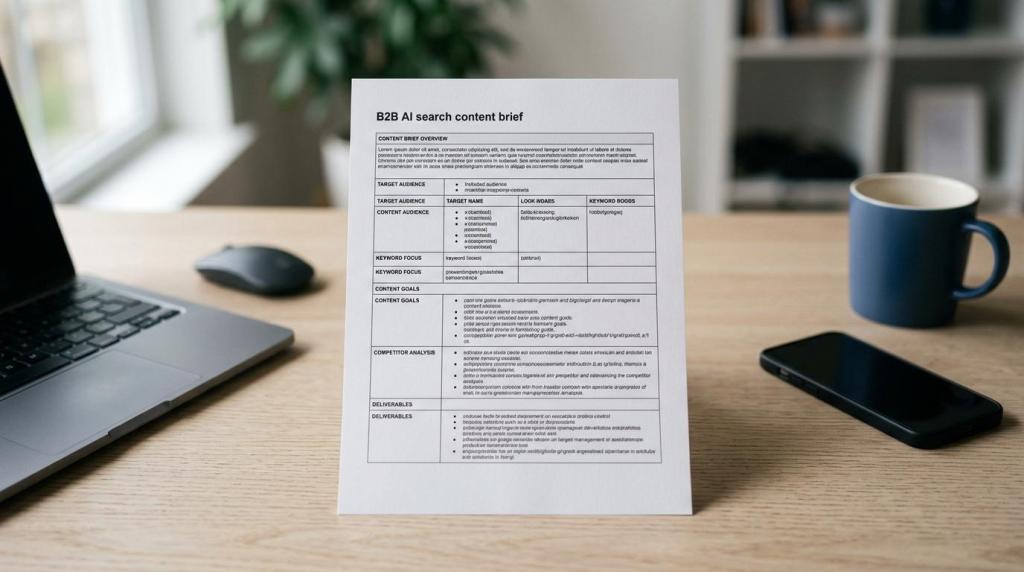


B2B content teams are rewriting the rules of a good brief.
A standard SEO brief used to be enough: target keyword, search intent, a few competitor pages, suggested headings, and a CTA. That model still has value, but AI search raises the bar. If a page is going to be surfaced, quoted, or cited by systems like ChatGPT, Google AI Overviews, Gemini, and Perplexity, the brief has to shape the page for retrieval, clarity, and proof, not just ranking.
Recent B2B buyer research points in one direction. AI is now part of the buying process for a huge share of buyers. That means the content brief is no longer just a writing document. It is a visibility document.
Why AI search changes the B2B content brief
AI search systems do not read content the way a human editor or a classic keyword model does. They look for semantic relevance, direct answers, clean structure, and trustworthy details. A page can be well written and still fail because it buries the answer, uses vague language, or makes claims without support.
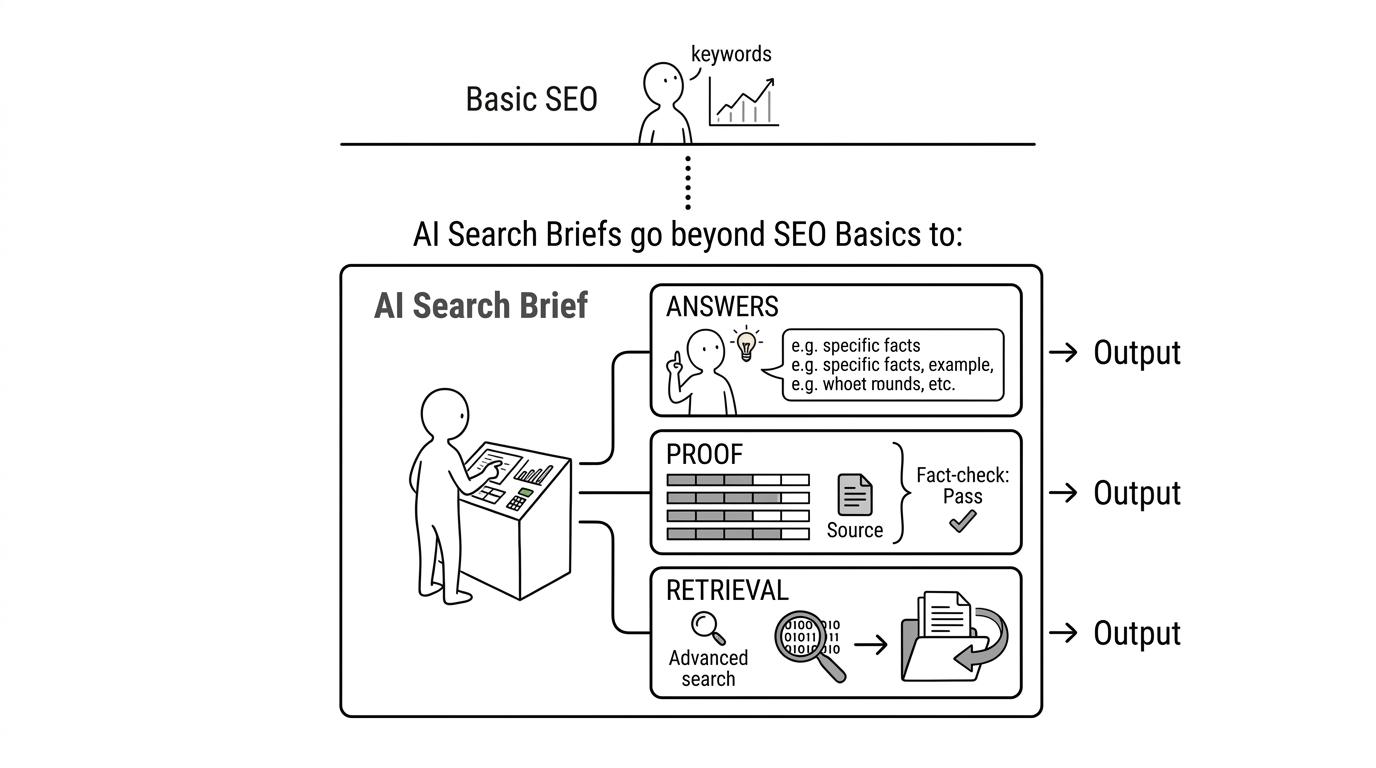
That shift matters most in B2B, where buyers ask layered questions. They want a definition, then a comparison, then implementation detail, then proof, then pricing or business impact. A strong brief anticipates that chain and gives the writer a clear job: build a page that answers the right question in a way both people and AI systems can use.
A weak brief produces a page that sounds fine and gets ignored.
For teams targeting buyers in SaaS, fintech, AI, enterprise software, media, or ecommerce, this creates a real opening. Better briefs produce better retrieval. Better retrieval creates more qualified visits, more citations, and stronger downstream pipeline.
Core elements of a B2B AI search content brief
The best AI search briefs are practical. They do not try to turn the writer into a data scientist. They simply define what the page must answer, what evidence it needs, how it should be structured, and where it fits in the buyer path.
[markdown] | Brief section | What to include | Why it matters for AI search | | --- | --- | --- | | Primary query | One core question plus close variants | Keeps the page tightly mapped to a high-intent need | | Prompt set | Natural-language prompts a buyer might type into AI tools | Helps the writer match conversational query patterns | | Buyer persona and stage | Technical evaluator, executive buyer, operator, procurement, late-stage evaluator | Shapes depth, tone, and proof requirements | | Answer statement | A direct 2 to 4 sentence answer near the top | Gives AI systems a clean extractable response | | Entity and term set | Brand, product category, use case, competitor terms, standards, integrations | Improves semantic clarity | | Proof package | Stats, examples, case evidence, screenshots, source references, dates | Increases trust and citation quality | | Content structure | Explicit H2s, H3s, FAQ blocks, tables, definitions, step lists | Makes the page easier to parse and quote | | Internal path | Next pages to visit, related assets, CTA by funnel stage | Turns information gain into conversion movement | | Freshness rules | Review date, outdated claims to remove, owners of updates | Reduces stale content risk | [/markdown]A table like this should sit inside the planning process, not just inside a strategy document. When the brief captures these fields, writers produce pages that are tighter, clearer, and more useful from the first draft.
How to define AI search intent in the content brief
AI search intent is broader than classic keyword intent. A buyer may ask one question in Google, a fuller question in ChatGPT, and a follow-up comparison question inside another tool ten minutes later. Your brief should cover that spread.
Start with the core business question, not the keyword alone. “Content brief for AI search” is a topic. “How should a B2B team structure a content brief so a page can be cited by AI systems?” is a stronger intent definition. The second version gives the writer a sharper assignment and produces better information architecture.
It also helps to map adjacent prompts. AI visibility often comes from content that answers a family of related questions, not just one exact phrase.
After defining the primary angle, map the supporting prompt set:
- Problem framing queries
- Comparison queries
- Implementation queries
- ROI and measurement queries
- Risk and governance queries
That small step changes the quality of the page. The writer now knows which follow-up questions must be answered on the same URL and which ones belong on supporting pages.
How to write answer-first sections for AI search visibility
An AI-ready brief should instruct the writer to put the answer high on the page. Not hidden in paragraph six. Not implied. Stated.
This does not mean writing shallow content. It means giving the page a strong opening response, then backing it up with depth, examples, and detail. B2B buyers reward clarity, and AI systems do too.
The brief should also define what makes the answer citable. That usually means precise terminology, current examples, and claims that can stand on their own without extra interpretation.
Use brief instructions like these inside the document:
- Lead answer: Open with a direct response in 2 to 4 sentences that defines the issue and names the audience.
- Use exact entities: Include product categories, buyer roles, channels, platforms, and standards with consistent naming.
- Support claims: Add proof, dates, source references, or company examples whenever the page makes a measurable assertion.
- Break up logic: Use clear subheadings, tables, short sections, and FAQ block style blocks so ideas can be retrieved in chunks.
That framework is simple, but it changes how the finished page performs. AI systems prefer text that can be extracted cleanly. Buyers prefer text that respects their time. The same brief can serve both.
A practical B2B AI search content brief template
A strong template should be reusable across service pages, comparison content, product explainers, use case pages, and bottom-funnel blog posts. The point is consistency.
Primary query and prompt variants for AI search
Start with one primary query and five to ten prompt variants. These variants should sound like real buyer language, not spreadsheet language. Think in full questions, objections, and task-based phrasing.
A good brief might include prompts like: what is an AI search content brief, how is an AI search brief different from an SEO brief, what should a B2B content brief include for ChatGPT visibility, and how do you structure content for AI Overviews. That set helps the writer cover natural phrasing patterns across platforms.
Buyer stage and decision context in B2B briefs
The brief should identify who the page is for and what decision they are trying to make. A technical evaluator needs implementation detail. A marketing leader may need workflow, risk, and expected business impact. A late-stage buyer often wants proof and differentiation.
This part of the brief should also name the conversion goal. Is the page meant to move a reader to a case study, demo request, audit, newsletter, webinar, or pricing conversation? If that path is vague, the page may earn traffic and fail to move revenue.
Sourceable proof and claims in AI search content
Proof is where many briefs still fall short. Writers are told to “add examples,” but not given the material to do it well. The result is generic copy.
A better brief includes the proof package up front: internal data points, approved case claims, screenshots, examples, customer language, product facts, and any references that can safely support the narrative. In AI search, this matters because generic pages blend together. Pages with grounded detail stand out.
Page structure and chunking for retrievability
Structure matters more than many teams expect. AI systems often work well with content that has logical sections, precise subheads, short paragraphs, and clear transitions.
That is why the brief should specify the page architecture, not just the topic. Give the writer target sections, indicate where a table would help, and note where a definition or FAQ block belongs. Good chunking is not cosmetic. It improves retrieval.
Metrics to include in the AI search content brief
A modern brief should name success metrics before writing starts. That keeps the page tied to business value.
Classic SEO metrics still matter, but they are not enough on their own. A page can influence AI visibility and buying behavior without producing a clean last-click trail. That is why strong teams track a wider set of signals across search, referral traffic, on-site behavior, and pipeline.
Include metrics like these in the planning notes:
- Visibility metrics: Rankings, inclusion in AI answers, citation frequency, branded mention rate
- Traffic metrics: Organic visits, AI referral sessions, engaged sessions, return visits
- Mid-funnel metrics: Asset clicks, case study views, demo page visits, internal search success
- Revenue metrics: Assisted pipeline, conversion rate by source, qualified leads, influenced opportunities
When the brief includes these targets, writers and strategists make better tradeoffs. They know whether the page needs broader education, sharper commercial framing, or stronger proof.
Common mistakes in AI search content briefs
Most weak briefs fail in predictable ways. They look organized, but they do not give the writer enough specificity to produce a page with retrieval strength.
Some common misses show up again and again:
- Keyword-first framing without a real buyer question
- No answer block near the top
- Vague headings
- Unsupported claims
- Missing entity terms
- No prompt variants
- No conversion path
- No update owner or freshness note
Another mistake is treating every AI search page like top-of-funnel thought leadership. That leaves money on the table. Many of the best-performing pages in AI search are bottom-funnel or mid-funnel assets: comparisons, implementation guides, pricing explainers, use case pages, and proof-driven articles.
How B2B teams can operationalize AI search briefs
The shift does not require a huge content team. It requires discipline.
One effective model is to treat the brief as a shared control document across strategy, writing, SEO, technical review, and revenue teams. That keeps entity choices, proof points, internal links, and CTA paths consistent across the site. For firms building visibility in ChatGPT, Gemini, Perplexity, and Google AI Overviews, that consistency compounds.
The teams making the fastest progress usually do three things well. They publish around high-intent buyer questions, they build a proof library that writers can use quickly, and they revisit older briefs when the market language changes. AI search rewards clarity and freshness. A brief built six months ago may already need sharper prompts, stronger entity coverage, or updated examples.
That is the real opportunity. The content brief is no longer an administrative step before writing. It is where search visibility, message quality, and conversion logic start to come together.


